

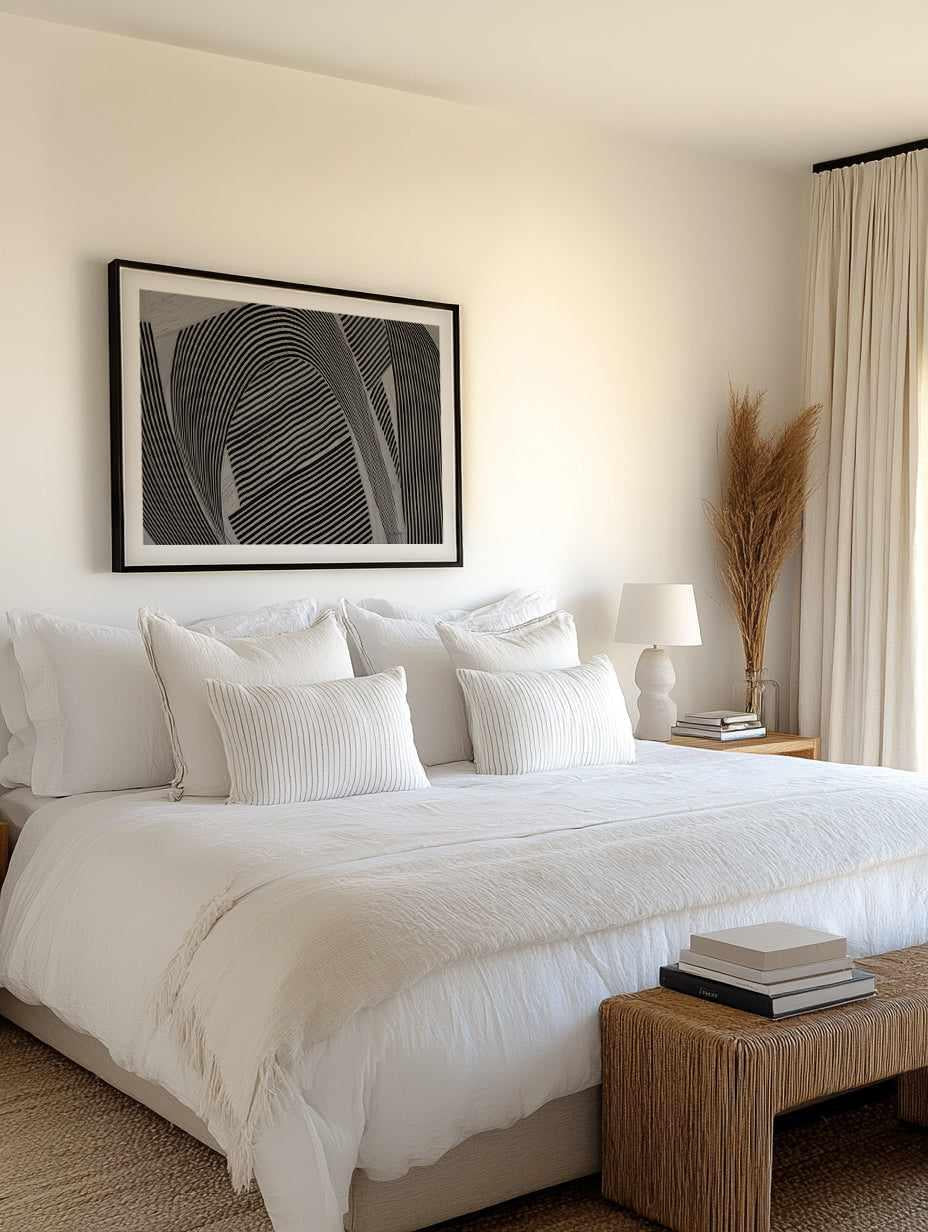
"Modern abstract art" is the most searched phrase in this category and the most quietly confused. In everyday use it means abstract art that looks current; in art history it means a specific period that ended decades ago. The confusion is harmless at a dinner party and expensive on a wall, because the two meanings point to genuinely different looks. This guide untangles them, then does the more useful thing: shows how to buy the look you actually mean.
We make and frame abstract work across both senses daily at our West Gosford facilities, and the distinction changes real decisions, palette, frame, room, so it is worth five minutes of precision before the browsing starts.


Weaving I Gray Crop · Invert by Dan Hobday Art Print · Pear on Blackboard by Marco Marella
Modern, the Period: 1860s to 1970s
In art history, modern art names the era from roughly the Impressionists to the end of minimalism, and modernist abstraction means the movements inside it: Kandinsky's improvisations, Mondrian's grids, Malevich's geometry, the New York abstract expressionists, the colour field painters. Modernist abstract style has recognisable habits: committed geometry or committed gesture, flat planes, primary and earth palettes, compositional confidence over decoration. It pairs naturally with mid-century furniture because they grew up together.
Contemporary, the Period: Now
Contemporary art simply means art being made in our own time, and contemporary abstraction is where the living genre actually is: tonal and textural fields, organic forms, digital-and-hand hybrids, quiet palettes borrowed from architecture and landscape. When people search for modern abstract art, the images they hold in mind, soft neutrals, plaster textures, gestural minimalism, are almost always contemporary abstraction in the historian's sense. The phrase means current-looking, and that is a perfectly good brief.
Ask for modern and you may be shown 1950. Ask for what the room needs and you cannot miss.
The Practical Difference on a Wall
- Modernist-styled abstraction reads as deliberate, graphic and slightly formal: strong geometry, decisive palettes, visible structure. It anchors mid-century, industrial and eclectic rooms, and it likes black finish frames.
- Contemporary abstraction reads as atmospheric and material: texture, tone, organic movement. It anchors coastal, Japandi, warm-minimal and quiet-luxury rooms, and it likes oak finish frames.
- The hybrid middle is where much of our abstract collection lives: contemporary works with modernist bones, a disciplined composition carrying today's palette. These are the safest buys of all, current without being trend-locked.


Bananas on Blackboard by Marco Marella · This Land I
Choosing by Room Style
- Mid-century room: modernist geometry or gestural work in period-adjacent palette, mustard, rust, ink, is the native pairing; our mid-century style guide builds the full scheme.
- Japandi and warm minimal: contemporary tonal and line work only; modernist boldness fights the restraint. See the Japandi wall art guide.
- Coastal and relaxed family homes: contemporary organic abstraction, the register of water and weather without the props.
- Eclectic and maximalist rooms: modernist-styled work holds its own among pattern; a strong geometric reads as intention amid the mix. The maximalism guide covers the balancing act.
- New builds and apartments: the hybrid middle, contemporary palette on modernist structure, warms builder-white boxes fastest.
Palette: the Real Tell
Style words aside, palette is how a wall reads the difference. Modernist-styled work commits: primaries, black and white, saturated earth. Contemporary work layers: bone into greige, sage into eucalyptus, chalk blue into storm. Neither is superior; they are different instruments. A useful test when torn: photograph the room and ask which the space lacks, commitment or atmosphere. Rooms heavy with texture usually want modernist commitment; rooms heavy with hard surfaces want contemporary atmosphere.
Colour-first browsing solves most of it: black and white modern abstracts for the committed end, earth-toned modern abstracts and blue modern abstracts for the layered end.


The Shore · Retro Abstract III Blue
Framing Across the Divide
Modernist-styled work takes definition: black finish frames complete graphic compositions the way a full stop completes a sentence. Contemporary tonal work takes warmth: oak finish, our most recommended pairing, connects texture to timber. White finish serves both when walls are pale and the work should float. Every frame is solid timber in oak, white or black finish, cut and joined on Italian machinery by our own artisans here in Australia, there is an art surrounding the art, and it is made to order in a couple of business days, the fastest custom art turnaround in the country.
Designer Tips
- Date the furniture, not the art: if the room's anchor pieces are mid-century, modernist-styled abstraction will always look at home; if they are linen-and-oak current, go contemporary.
- The hybrid middle future-proofs: disciplined structure in today's palette survives both the trend cycle and the furniture upgrade.
- Mixing eras on one wall works with one constant: shared palette thread, single frame finish, per our pairs guide.
- Scale rules are era-blind: 60 to 75 percent of the furniture width, centre at 145cm (57in); fixings per the hanging guide.
- We ship to more than 40 countries with all import duties paid, the price at checkout is the delivered price.
Frequently Asked Questions
What is the difference between modern and contemporary abstract art?
Strictly: modern names the historical period from the late 1800s to the 1970s, contemporary means made now. In everyday shopping, modern abstract art means current-looking abstraction, which is technically contemporary. The distinction matters on the wall because true modernist style is graphic and committed while contemporary style is tonal and atmospheric, different rooms want different ones.
Is modern abstract art still in style?
Modernist-styled abstraction has been continuously in style for seventy years, which is the strongest fashion evidence that exists. Its geometry and confidence renew with every mid-century furniture revival. Contemporary tonal abstraction is the current broader taste; both are safe buys, chosen for the right room.
What makes an abstract artwork look modern?
In the shopper's sense: a current palette (layered neutrals, sage, chalk blue, warm monochrome), material texture, and compositional restraint. In the historian's sense: flat planes, decisive geometry or gesture, and palettes of primaries and saturated earth. If a work would sit comfortably in a 1955 gallery photograph, it is modernist-styled; if it would sit in this year's design annual, it is contemporary.
Does modern abstract art suit traditional homes?
Yes, as deliberate contrast. One confident abstract in a period room signals curation, and the pairing flatters both, the room's mouldings read richer beside the work's restraint. Keep the frame classic (oak or black finish) and let palette bridge the eras.
Which colours define contemporary abstract art?
Layered low-saturation families: bone, oat, greige, clay, sage, eucalyptus, chalk and storm blues, warm greys, with saturated accents used sparingly. The palette borrows from architecture and landscape rather than the paint wheel, which is why it settles so easily into Australian homes.
Can I mix modern and contemporary abstract pieces?
Yes, and the mix reads collected when three constants hold: one shared palette thread, one frame finish, and one clear anchor work with the rest supporting. The eras argue only when two equally loud works compete for the same wall.
Is mid-century abstract art the same as modern abstract art?
Mid-century abstraction is a chapter of modernism, roughly the 1940s to 1960s, the abstract expressionist and hard-edge years, and it is the chapter most people picture when they say modern art. All mid-century abstraction is modern; not all modern abstraction is mid-century.
Browse the committed end in monochrome modern abstracts, the atmospheric end in the full abstract collection, or read the nine types of abstract art next. Made in Australia; shipped worldwide, duties paid.


