
Walk into any gallery, or scroll any wall art collection, and "abstract" turns out to be a dozen different languages wearing one name. A poured Pollock-style skein, a floating Rothko colour field, a hard-edged geometric grid and a three-stroke ink gesture share almost nothing except what they refuse to do: depict the world literally. Knowing the types is not art-school trivia. It is the fastest practical shortcut to finding the abstract work your room actually needs.
This guide maps the nine types of abstract art you will genuinely encounter when buying for your home, where each came from, how to recognise it in three seconds, and what each does to a room. It is written by people who make abstract art daily, designing, printing and framing at our two production facilities in West Gosford, NSW, for homes in Australia and more than 40 countries.


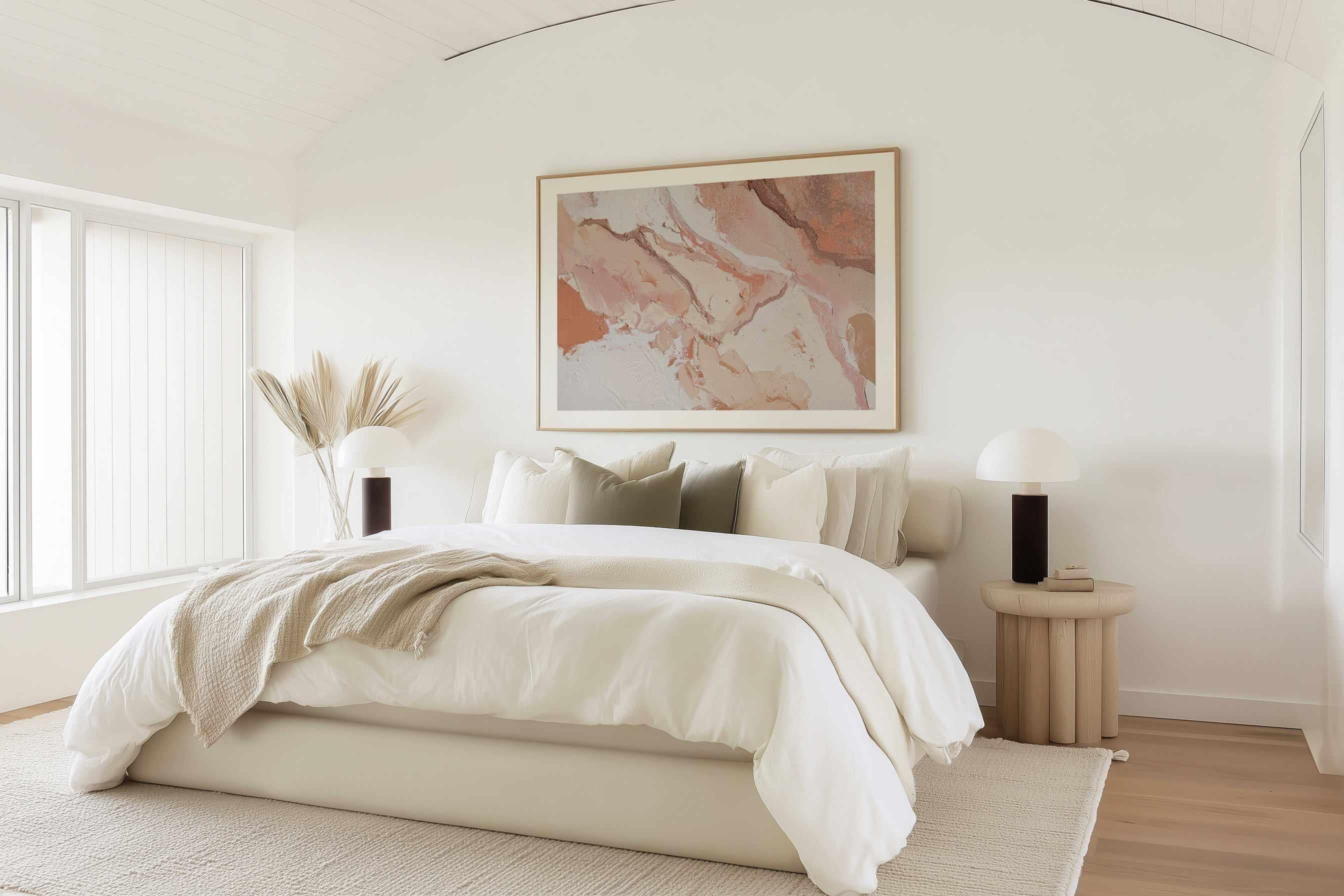
Sculpted Clay III · Slate Veil I · Slate Veil II
1. Gestural Abstraction (Action Painting)
Recognise it by: visible, energetic marks, sweeps, drips, flicks, scrapes, where the movement of the artist's arm is the composition. Born with 1940s New York abstract expressionism, Jackson Pollock's poured paintings and Willem de Kooning's slashing brushwork, it made the act of painting the subject.
In a room: gestural work is energy on demand. One confident piece animates quiet neutral schemes and gives entertaining spaces their pulse. Because the marks read as human, gestural abstraction also warms minimal interiors that risk austerity. Scale generously; cramped gestural work loses the very sweep that makes it.
2. Colour Field
Recognise it by: large, soft-edged planes of colour with little or no drawing, the painting is the colour. Mark Rothko's floating rectangles and Helen Frankenthaler's soaked canvases defined it in the 1950s; its ambition was contemplation rather than drama.
In a room: the most atmospheric type, and the designer's tool for setting a room's emotional temperature directly. Bedrooms, reading corners and any space built for exhale suit colour field work; hang it where the eye lands last at night. Layered tonal fields, like Midnight Lake No 2 Art Print, carry depth a flat paint swatch never could.
3. Geometric Abstraction
Recognise it by: hard edges, grids, circles, arcs and blocks, order made visible. Its lineage runs from Malevich and Mondrian through Bauhaus design to today's crisp digital compositions.
In a room: geometry reads as architecture, deliberate, structured, calm in a different way from colour field softness. It flatters mid-century furniture, sharpens contemporary schemes and behaves impeccably in home offices, where its order supports focus rather than distracting from it.
Learn the types and you stop shopping by luck. You start shopping by what the room is missing.
4. Lyrical and Organic Abstraction
Recognise it by: flowing, nature-adjacent rhythm without literal subjects, forms that move like water, strata, leaves or weather. Kandinsky called his most musical works improvisations, and this type keeps that sense of melody.
In a room: the easiest type to live with and the natural fit for Australian coastal, Japandi and biophilic interiors. Works such as Slate Veil III bridge indoors and out, echoing the fractal patterns of nature that we are wired to find restful. When a client cannot articulate what they want beyond calm but not boring, organic abstraction is nearly always the answer.


Forecast No 2 Art Print · Forecast No 1 Art Print
5. Minimalist Abstraction
Recognise it by: radical restraint, a few forms, a limited palette, generous empty space. Descended from 1960s minimalism (Agnes Martin's whispered grids, Ellsworth Kelly's single shapes), it asks the viewer to slow down.
In a room: minimal work needs breathing space and rewards it with sophistication. Best where architecture is strong and clutter is controlled; a single minimal piece over a console reads more expensive than a crowded gallery wall ever can. Pair with our Japandi wall art guide for the fullest version of this register.
6. Textural Abstraction
Recognise it by: surface as subject, plaster-like layers, sculptural paint, torn and mended grounds, tonal washes with grain. Rooted in postwar European art informel and Japanese wabi-sabi aesthetics, it prizes the honest mark of material.
In a room: texture is warmth without colour. In monochrome and neutral schemes textural works carry all the depth; under a picture light or raking afternoon sun they change hourly. Our wabi-sabi guide shows the interior philosophy this type belongs to.
7. Abstract Landscape
Recognise it by: a horizon you feel rather than see. Bands, washes and gradients that keep a landscape's structure, ground, distance, sky, while abandoning its detail. From Turner's late storms to contemporary Australian tonalism, it is abstraction's most approachable door.
In a room: the bridge type for anyone nervous of full abstraction. It behaves like a view: hang it where a window is missing and the room gains distance. Layered works like Bamboo Abstract II Art Print and Bamboo Abstract I Art Print show how far mood can travel on two or three bands of tone.
8. Calligraphic and Line Abstraction
Recognise it by: the discipline of the single line, ink gestures, continuous line drawing, marks descended from writing. East Asian sumi-e tradition is its deep root; Cy Twombly's scrawls its Western cousin.
In a room: line work is quiet intelligence. It suits bedrooms, studies and stairwell runs, and it mixes gracefully into gallery walls as the palate-cleanser between denser works. Keep frames slim; the line is the luxury.
9. Figurative Abstraction
Recognise it by: the body or object almost there, a shoulder-line in three strokes, a vase dissolving into colour. Matisse's cut-outs and Picasso's late line work sit here, halfway between depiction and pure form.
In a room: it carries human warmth that pure abstraction sometimes withholds, which makes it superb for living spaces and bedrooms. Works like Rose Fusion III hold a room's attention the way a good guest does, present, never demanding.


Terra Fusion I · Terra Fusion II
Mixing Types: the Collector's Move
Nothing marks a considered home like abstract types in conversation, a textural anchor, a gestural counterpoint, one line work as punctuation. The method: let one type dominate (roughly two-thirds of the wall's visual weight), keep a single palette thread running through all pieces, and unify the framing. Our guides to pairs and trios cover the spacing mathematics; the hanging guide covers the fixings.
Every type above is represented across our abstract wall art collection, with works from our artist community and in-house design team, printed with archival pigment inks, hand trimmed, and framed in solid timber (oak, white or black finish) cut and joined on Italian machinery by our own artisans in Australia. Made to order and despatched in a couple of business days, the fastest custom art turnaround in the country, shipped to more than 40 countries with all import duties paid.
Designer Tips
- Buy the type before the piece. Decide whether the room needs energy (gestural), calm (colour field, organic), order (geometric) or warmth (textural, figurative), then shortlist only within that type.
- Statement walls take one dominant type; gallery walls take three types maximum with one shared palette thread.
- Photograph your room and view shortlisted works against it on screen, the type that fills the gap is usually obvious within seconds.
- If wallpaper shares the wall or room, keep the paper textural when the art is gestural, and vice versa; order the $4.99 sample (48cm x 40cm / 19in x 16in) to test in your own light.
- Hang the finished choice with its centre 145cm (57in) from the floor and resist the urge to go higher.
Frequently Asked Questions
What are the main types of abstract art?
The nine you will meet when decorating: gestural (action) abstraction, colour field, geometric, lyrical/organic, minimalist, textural, abstract landscape, calligraphic/line, and figurative abstraction. Art history subdivides further, but these nine cover essentially everything sold as abstract wall art today.
Which type of abstract art is most calming?
Colour field and organic abstraction, especially in low-saturation palettes. Both deliver the moderate, organised complexity research links to visual rest, without high-contrast marks that ask for attention. Abstract landscapes run a close third and suit anyone who finds pure abstraction too open-ended.
What type of abstract art suits a modern minimalist home?
Minimalist abstraction and geometric work are the native fits, though a single textural piece is often the better choice, it adds the warmth minimal architecture lacks while respecting its discipline. Avoid dense gestural work unless the room needs deliberate contrast.
Is abstract landscape art still abstract art?
Yes, it sits on the representational end of the abstraction spectrum. The test is intent: an abstract landscape keeps structure (horizon, ground, atmosphere) while abandoning literal depiction. If you can name the place, it is a landscape; if you can only feel it, it is abstraction doing its job.
Can I mix different types of abstract art in one room?
Yes, and the mix is what makes a home read collected rather than bought. Hold three constants, one dominant type, one palette thread, one frame finish, and vary everything else freely.
What type of abstract art holds its value best in a home?
In decorating terms, longevity belongs to the types anchored in nature and tone: organic, textural and abstract landscape work date far slower than trend-coloured graphic styles. Monochrome versions of any type outlast their coloured cousins; palette, not type, is usually what ages.
How do I identify the type of an abstract artwork I like?
Ask two questions. Is the energy in the mark or in the colour? Marks point to gestural, calligraphic or figurative types; colour points to colour field, landscape or organic. Then: are edges hard or soft? Hard edges signal geometric or minimalist; soft edges signal the painterly types. Two answers place almost any work.
See every type in one place in the abstract wall art collection, explore abstract painting prints and abstract canvas works, or keep reading on On the Wall.


