

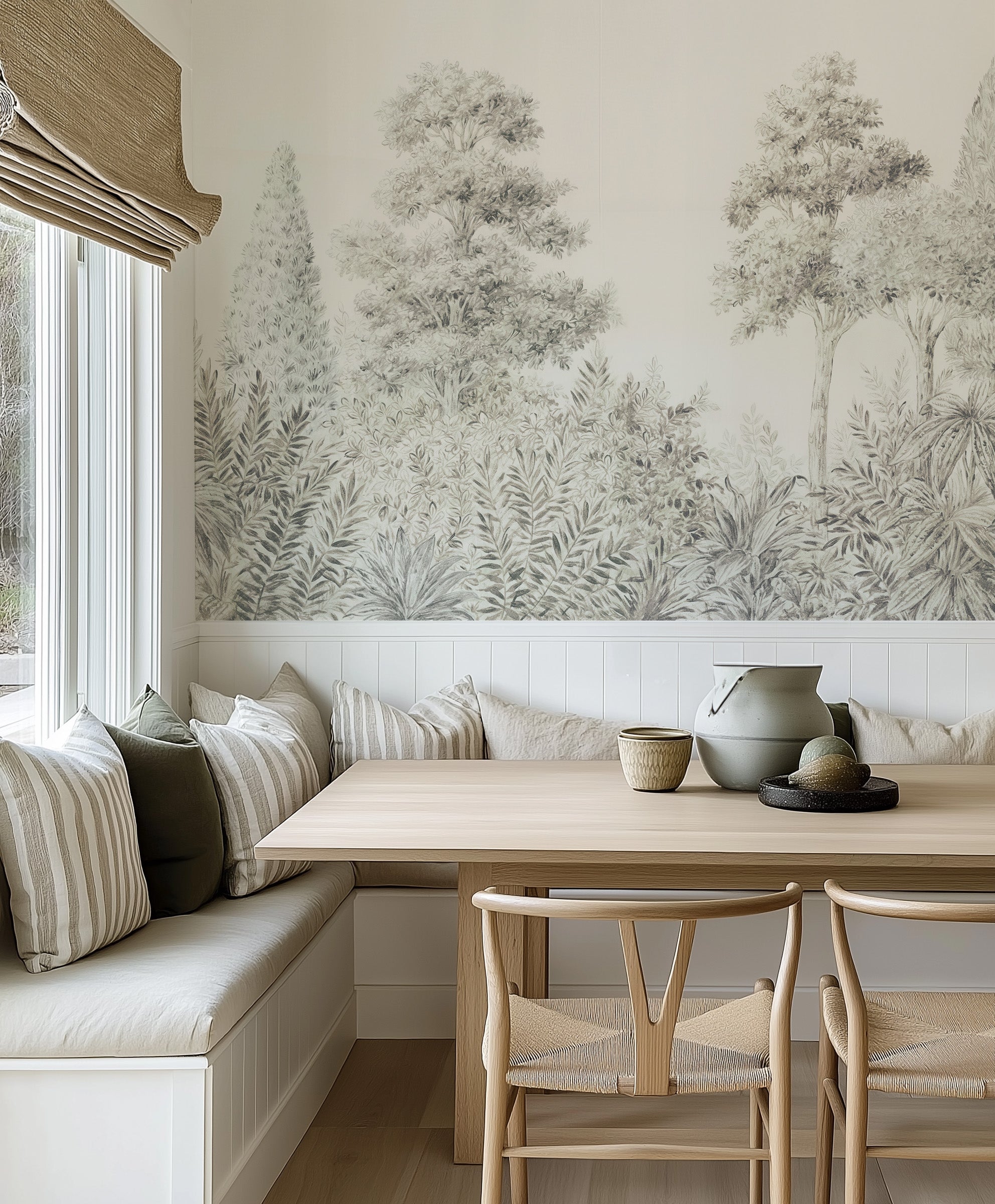
Mid-century modern is the design movement that refuses to age. Emerging from the post-war period between 1945 and 1969, it fused the disciplined geometry of the German Bauhaus, the soft material warmth of Scandinavian craft, and the optimistic experimentation of American designers working in newly accessible materials — moulded plywood, fibreglass, aluminium, plastic laminate. The result was an aesthetic that balanced function with humanity, geometry with warmth, and technological modernity with deep material comfort. Eight decades later, it remains the single most-specified design reference in Australian residential interiors, and the reason is simple: it works in almost every spatial context, for almost every budget, and it creates rooms that feel considered rather than decorated.
This is the complete guide to mid-century modern interior design from an Australian wallpaper and wall art specialist's perspective — the origin story, the five design pillars, the authentic colour palette, the pattern language, the room-by-room application, and the Australian heritage that makes this style feel native rather than imported. Whether you live in a 1960s Robin Boyd original on the Mornington Peninsula, a Harry Seidler house in Sydney's north, a coastal Beachcomber in Byron, or a new-build anywhere in the country, the principles translate. We ship wallpaper and art to more than 40 countries with all import duties paid, so if you are reading this from London, Los Angeles or Amsterdam, the same principles — and the same products — work equally well.


Reactions I Bright Abstract Art Print · Autumn Leaves Wallpaper in Neutral · Heritage Arbor Hand Painted Tree Mural Wallpaper
Origins: How Mid-Century Modern Happened
The style did not appear fully formed. It was assembled across three continents in roughly two decades. The Bauhaus school in Weimar and Dessau — founded by Walter Gropius in 1919 and dissolved by the Nazis in 1933 — sent a diaspora of designers to the United States, carrying with them the conviction that form must follow function, that industrial materials were not inferior to handcrafted ones, and that beauty emerged from clarity of purpose. Marcel Breuer, László Moholy-Nagy and Mies van der Rohe relocated to America and planted these ideas in the fertile soil of post-war optimism.
Meanwhile in Scandinavia, designers like Alvar Aalto in Finland, Arne Jacobsen and Hans Wegner in Denmark, and Bruno Mathsson in Sweden were developing a parallel tradition — softer, warmer, more rooted in timber craft, and deeply committed to human scale. When these two streams met in post-war California, something new emerged. Charles and Ray Eames, working from their Pacific Palisades studio, produced the moulded plywood chair in 1946, the fibreglass shell chair in 1950, and the Eames Lounge Chair in 1956 — three objects that, taken together, defined the look of the entire movement.
"Design is not just what it looks like and feels like. Design is how it works." — Eero Saarinen, architect of the Tulip Chair and the TWA Flight Center
The other pioneers are worth naming because their work still anchors the aesthetic: Eero Saarinen's Tulip Chair (1957) eliminated the "slum of legs" under the dining table. George Nelson's Coconut Chair and Marshmallow Sofa proved that serious design could be playful. Verner Panton's cantilevered Panton Chair (1967) pushed plastic as a sculptural material. Arne Jacobsen's Egg and Swan chairs softened modernism without betraying its principles. Behind all of them, architects including Richard Neutra, Pierre Koenig, Robin Boyd and Harry Seidler replaced load-bearing walls with floor-to-ceiling glass, dissolving the boundary between interior and garden in a way that had never been possible before.
The Five Pillars of Mid-Century Modern
If you strip the period imagery away and look at what actually makes mid-century modern coherent as a movement, five principles emerge. Any interior that observes these will read as mid-century modern, even if the pieces are contemporary. Any interior that ignores them will read as something else, even if every object is authentic 1960s.
- Organic form: Curves derived from nature — the leaf, the amoeba, the boomerang, the kidney, the human silhouette. Mid-century modern is not rectilinear; it is sculptural. Even its most geometric moments have a softened, hand-drawn quality.
- Functional honesty: Materials and construction are visible. A chair leg is a chair leg. A screw is a screw. Nothing is hidden behind false veneer or decorative skirting. This principle, inherited from the Bauhaus, is what prevents mid-century modern from ever feeling fussy.
- New materials: Moulded plywood, fibreglass, aluminium, plastic laminate, bent steel. The movement celebrated the industrial capabilities of the post-war economy rather than apologising for them. A tubular steel chair base was not a budget compromise — it was a statement about what design could now be.
- Indoor–outdoor flow: Floor-to-ceiling windows, sliding glass doors, covered terraces, courtyard gardens. The architecture of the era reimagined the wall as a permeable threshold rather than a barrier. Contemporary Australian homes — with their glazed rear additions and outdoor rooms — are direct descendants of this thinking.
- Saturated accent colour against warm wood: Mustard, teal, rust, olive and chocolate were never used as all-over schemes. They appeared as concentrated accents — a single upholstered chair, a feature wall, a ceramic vase — against a backdrop of warm honey-toned timber and cream-painted walls.


Sound Waves Black & White Wallpaper · Navy Blue Lines Wallpaper
The Authentic Mid-Century Modern Colour Palette
The colour palette of genuine mid-century modern interiors is warmer and more saturated than contemporary minimalism, but considerably more restrained than maximalism. Six accent colours dominate the period's material record: mustard yellow, burnt orange or rust, avocado or olive green, teal, warm chocolate brown, and — more occasionally — a dusty rose or coral. These are set against backgrounds of cream, bone or warm white, and grounded by timber floors and furniture in honey, walnut or teak tones.
In 2026, the most successful contemporary mid-century modern interiors interpret this palette with a slight desaturation — dusty mustard rather than schoolbus yellow, sage rather than avocado, burnt terracotta rather than fire-engine orange. This adjustment, which has been driven partly by the ascendancy of the Pantone Mocha Mousse palette, makes the period colours sit comfortably alongside contemporary furniture without reading as costume.
For related palette guides, our Warm Terracotta palette guide maps the rust and burnt-orange end of the mid-century spectrum, our Mocha Mousse palette guide covers the chocolate-brown and cream end, and our Japandi guide explores the adjacent aesthetic that borrows mid-century modern's warmth while adding Japanese restraint.
Pattern Language: The Wallpapers That Read as Mid-Century Modern
Wallpaper was central to the mid-century modern interior, and pattern innovation during the period was extraordinary. Four categories of print emerged, and each still has direct descendants in a contemporary wallpaper library. Understanding which category you are working with is the difference between a room that feels considered and a room that feels like a themed set.
Atomic-age geometrics. Starburst motifs, repeating angular shapes derived from molecular diagrams, and the famous boomerang silhouette. These were the most radical patterns of the period — graphic, high-contrast, and often black-and-white or two-colour. For a contemporary interpretation, the Industrial Shapes Black and White Wallpaper and the Sound Waves Black & White Wallpaper are the closest direct translations in our range.
Organic abstracts. The leaf, the amoeba, the kidney shape — biological forms pulled into pattern repeats. These prints feel simultaneously modernist and warm, and they read as mid-century modern more reliably than anything else in a wallpaper library. The Autumn Leaves Wallpaper in Neutral captures this category in a softened 2026 palette, while the Blush on Beige Abstract Painting Mural Wallpaper translates the painterly abstract expressionist strand into wallpaper scale.
Graphic linear prints. Simple vertical stripes, broken lines, and hand-drawn grids were widely used in period bedrooms and dining rooms. They provide rhythm without competing with furniture. The Navy Blue Lines Wallpaper is a clean contemporary reading of this type, suited to a home office or guest bedroom.
Graphic botanicals and murals. Not the heritage florals of Victorian wallpaper — the clean, high-contrast botanical prints that mid-century designers produced, with bold silhouettes, flat colour and strong outlines. Oversized painterly murals — a hallmark of 1950s residential commissions — also belong to this category. The Watercolour Mountains Mural Wallpaper and the Abstract Painted Seascape Mural Wallpaper are 2026-appropriate readings.


Blush on Beige Abstract Painting Mural Wallpaper · Watercolour Mountains Mural Wallpaper · Abstract Painted Seascape Mural Wallpaper
Browse the full wallpaper collection, or narrow to wall murals for the large-scale painterly options that suit this aesthetic. If you want a print that does not exist anywhere else, the custom wallpaper service will produce any design to your exact wall dimensions, printed in our Central Coast NSW facility in four business days.
Wall Art Language for Mid-Century Modern Rooms
Art selection in a mid-century modern interior is less forgiving than wallpaper selection because the aesthetic so clearly favours a single strong statement piece over a gallery wall. Five categories of art fit the period and its contemporary revival: abstract expressionist compositions (Rothko, Frankenthaler, Motherwell — the emotional counterweight to Bauhaus rationalism), mid-century geometric prints (hard-edge abstraction, colour-field work), op art (Vasarely, Riley — optical pattern rendered as serious painting), graphic botanical studies (single-subject plant or flower studies rendered flatly), and atomic-age graphic prints (the original movie-poster and magazine-cover aesthetic of the 1950s and 60s, now widely reissued).
In a living room, a single large abstract artwork above the sofa reads as an instant period anchor. In a dining room, a graphic print above the buffet. In a bedroom, a more restrained geometric or botanical. Our abstract art collection is the strongest source for mid-century-appropriate wall art, and our living room wall art curation includes many prints that fit the period directly. All framed pieces are mounted in a solid timber frame with oak, white or black finish — none of our frames are plastic or veneered, which matters visibly alongside genuine mid-century furniture.


Modern Cut Grey Wallpaper · January Slopes Neutral Abstract Art Print
Mid-Century Modern Room by Room
The Living Room — The Mid-Century Hero Space
The living room is where mid-century modern design earns its reputation, and the reason is simple: the era invented the open-plan social room as a distinct architectural type. A successful mid-century living room has a clear hierarchy. One feature wall carries a period-referencing pattern — an organic abstract, an atomic geometric, or a graphic mural. One seating piece anchors the room as a design object — typically a low-slung sofa in a warm neutral boucle paired with an Eames Lounge Chair replica or a Saarinen Tulip side chair. One piece of statement art hangs above the sofa, not a gallery wall. Lighting is sculptural — a Sputnik pendant, a Panton floor lamp, or an arc lamp over the reading chair. Timber is warm walnut or teak, never blonde oak. Rugs are wool, tightly woven, either plain or geometric. The result, when correctly executed, is a room that feels generous, considered and slightly cinematic — which is exactly what the mid-century originals were designed to feel like.
The Bedroom — Warmth Without Visual Noise
Mid-century modern bedrooms use restraint. The headboard wall carries a smaller-scale geometric, a softened organic abstract, or a painterly mural. Remaining walls are painted in a warm cream or bone. Bedside furniture is teak or walnut with tapered peg legs. The bed itself is a low platform rather than a tall upholstered sleigh — horizontality is the defining gesture. Linen is the textile of choice in Australian bedrooms because it suits our climate and ages with a soft hand over time; in mid-century terms, stick to warm neutrals and a single accent colour (mustard, rust, olive or teal) rather than pattern on the bed. A single small artwork above the dresser completes the room. The bedroom wallpaper collection includes many prints that work in this application.
The Dining Room — Where Bold Pattern Belongs
The dining room is the most permissive room in a mid-century modern home, and the reason is occupancy: you are in the space briefly, in the evening, usually with other people to look at. This is where a full-room wallpaper treatment in a bold geometric or organic abstract earns its place. A round tulip-base table is the period archetype. Chairs with moulded plywood or upholstered shell seats on tapered legs surround it. A single pendant light — Sputnik, George Nelson bubble, or a Louis Poulsen PH5 — hangs low over the centre of the table. A credenza or sideboard in warm timber sits against one wall, topped with a single piece of ceramic art. Wall art is minimal because the wallpaper is doing the work.
The Home Office — The Most Photogenic Room Type in Current Residential Design
The mid-century modern home office has become the most photographed room on design media, and for good reason. The ingredients are compact and clear: a warm timber desk with tapered legs, a leather or wool task chair, one wall in a geometric or organic wallpaper, a floating shelf with a carefully curated arrangement of ceramics or books, and — critically — a single piece of abstract or graphic art at seated eye height. The room photographs as well during a Zoom call as it does in a magazine, which matters more than it used to. For small-home applications, a peel-and-stick wallpaper option from our peel-and-stick collection allows you to treat one wall without committing to a permanent installation.
The Entry — Where Statement Pattern Hits First
Entries are short-occupancy spaces, which makes them ideal for a bold wallpaper treatment that would be exhausting in a living room. A single geometric or organic abstract, a warm timber console, a ceramic lamp and a mirror above are enough. In a mid-century home, the entry sets the key for the whole interior — get it right and everything that follows reads as coherent.
The Kitchen — Warm Wood Against Industrial Finishes
Mid-century kitchens balance walnut or teak veneer cabinetry against stainless steel, glass and terrazzo or hexagonal tile. Hardware is slim or integrated. A single wall — often the one opposite the cabinetry or behind an open shelf — can carry a geometric or atomic wallpaper. Pendants above the island in brass or blackened steel complete the period reference.


Dots Pattern in Pink Wallpaper · Industrial Shapes Black and White Wallpaper · Sand and Sky Abstract Expressionist Art Print
Mid-Century Modern vs Retro vs Vintage — The Distinctions Designers Actually Make
These three terms get used interchangeably, often incorrectly. The distinction matters because each implies a different procurement strategy and a different visual register.
- Mid-century modern refers specifically to the design movement of roughly 1945 to 1969. It is a defined aesthetic with identifiable principles, designers and material palette. Using the term correctly requires the room to engage with those principles — not just contain a period piece.
- Retro is a broader, more playful reference to any past era, often used loosely to describe anything from 1950s diner aesthetics to 1980s Memphis. A retro room quotes the past; a mid-century modern room applies its principles.
- Vintage refers to the provenance of individual pieces — a vintage lamp is original to its period, regardless of whether that period is 1920 or 1980. A mid-century modern room can be furnished entirely with new reproductions, or entirely with vintage originals, and remain mid-century modern either way.
The Australian Mid-Century Modern Heritage
Australia was not a passive recipient of the international style. The country produced its own distinct mid-century modern tradition, and it is worth knowing for anyone specifying this aesthetic in an Australian home. Robin Boyd — architect, critic and author of The Australian Ugliness — designed houses in Melbourne through the 1950s and 60s that remain reference points for residential architecture in this country. Harry Seidler, trained under Walter Gropius and Marcel Breuer at Harvard and under Oscar Niemeyer in Brazil, brought European and Brazilian modernism to Sydney's north shore with the Rose Seidler House (1950) and the Hamilton House (1953). Both houses are now heritage-listed and open to the public.
On the NSW Central Coast and up through the Northern Beaches and Byron Bay, the Beachcomber home — a distinctly Australian mid-century type designed by Nino Sydney for Lend Lease between 1961 and 1973 — brought the style to thousands of suburban blocks. Low-pitched roofs, exposed timber beams, floor-to-ceiling glass facing the water, and a social layout organised around indoor-outdoor flow. These houses, once seen as dated, are now among the most sought-after coastal properties in the country. If you own one, the wallpaper and art decisions described in this guide are particularly well-suited — the architecture was designed to frame exactly this kind of considered interior. Our coastal Queenslander interior design guide covers a parallel Australian regional tradition; our Art Deco revival guide covers the geometric tradition that mid-century modern built on.
Why Mid-Century Modern Is Having a 2026 Moment
Mid-century modern has never fully left, but it returns in waves, and each wave has its own flavour. The current wave, which began around 2023 and has intensified through 2025 and into 2026, differs from the last revival in three ways. First, the palette has warmed. The cool greys and whites that defined the 2015 revival have been replaced by chocolate, cream, warm terracotta and sage. Second, the silhouettes have softened. Strict tapered legs and sharp angles have given way to more curved, sculptural forms — the Scandinavian end of the spectrum has overtaken the Bauhaus end. Third, pattern is back. The 2015 revival was largely about furniture against plain walls; the 2026 revival embraces the period's pattern heritage, which is what makes wallpaper central again.
This particular configuration — warm, soft, patterned — is also what makes mid-century modern work so well in Australian homes. The warmth suits our light and our indoor-outdoor architectural tradition. The softness reads as welcoming rather than corporate. The pattern provides visual interest in the open-plan interiors that dominate contemporary Australian new-build.
Australian-Specific Considerations
Our light is harsh and blue-biased, especially in the summer months, and this affects how mid-century colours read on the wall. A mustard that photographs warm in a Copenhagen editorial can read acidic under Australian midday sun. Sample before committing — the $4.99 sample (48cm × 40cm / 19in × 16in) shipped nationally is the cheapest insurance against a colour misjudgement. Our how to measure guide covers the sizing process before you order full rolls.
Humidity matters in coastal and sub-tropical regions. Our non-woven paste-the-wall wallpapers are dimensionally stable in humid conditions, and for peel-and-stick installations in humid rooms the wall preparation guide covers the priming and curing steps that make a lasting install possible.
Rental considerations favour peel-and-stick in Australian rental stock because removal at the end of the lease is essential. The peel-and-stick collection includes many of the patterns discussed above in that substrate, and removal is wall-safe when installed and removed correctly.
Installation, for paste-the-wall paper, is best handled professionally in homes with plaster or textured substrates — our wallpaper installer directory lists vetted professionals nationally. For renovation installs, our paste-the-wall installation guide covers the full process if you are hanging yourself.
Frequently Asked Questions
What defines mid-century modern interior design?
Mid-century modern is defined by five principles applied together: organic form, functional honesty (construction and materials are visible), new post-war materials (moulded plywood, fibreglass, aluminium), indoor–outdoor architectural flow, and saturated accent colour against warm timber. A room that observes these principles reads as mid-century modern regardless of whether individual pieces are period or contemporary reproductions.
Is mid-century modern dated in 2026?
No. Mid-century modern has been the most-specified design reference in Australian residential interiors for the better part of a decade, and the current 2026 iteration — warmer palette, softer silhouettes, pattern-led — is arguably the strongest version of the revival. The style's principles (clean line, honest material, human scale, indoor–outdoor flow) map directly onto contemporary Australian architectural priorities.
What are the best wallpaper patterns for a mid-century modern home?
Four categories work: atomic-age geometrics (starbursts, molecular shapes, boomerangs), organic abstracts (leaves, amoebas, kidney shapes), graphic linear prints (broken stripes, hand-drawn grids), and graphic botanicals or painterly murals. The strongest direct fits in our range are the Autumn Leaves, Sound Waves, Industrial Shapes, Navy Blue Lines, Blush on Beige Abstract, and Watercolour Mountains wallpapers.
How do I do mid-century modern in a small Australian home?
Small mid-century homes — terrace houses, 1970s units, studio apartments — benefit from a single strong pattern wall rather than multiple pattern introductions. Choose one room, usually the living or bedroom, and treat the feature wall. Keep remaining walls in warm cream. Furnish with low-profile pieces on tapered legs to maximise visual floor area. A single statement artwork rather than a gallery wall. The result reads as more spacious than a comparable plain-walled room because the pattern provides visual interest without clutter.
Can I mix mid-century modern with contemporary or other styles?
Yes — and this is arguably the style's primary strength. Mid-century modern mixes naturally with Japandi (they share warm wood and organic silhouette), with warm minimalism (they share restraint and material honesty), with Scandinavian (overlapping heritage), and with modern coastal (the Beachcomber tradition). It mixes poorly with heavy traditional styles (Victorian, French Provincial, ornate European) because the material and ornamental languages are in direct conflict.
What are the budget entry points for a mid-century modern room?
The most cost-effective changes are wallpaper (a single feature wall from our range starts at under $200 for a small wall), a single piece of abstract or geometric art (framed prints from $49), and replacement lighting (a Sputnik replica pendant transforms a room for under $300). Furniture is the expensive component; a room can read as mid-century modern with an IKEA sofa if the wallpaper, art and lighting are right. All wallpaper orders ship globally with all import duties paid.
Does peel-and-stick wallpaper work for mid-century modern patterns?
Yes. Most of the atomic, organic and graphic prints in our range are available in both non-woven paste-the-wall and self-adhesive peel-and-stick substrates. Peel-and-stick suits rentals and short-term installations; paste-the-wall is the correct choice for permanent feature walls in owned homes. Pattern quality is identical between the two substrates.
Can I get a custom mid-century modern pattern printed?
Yes. Our custom wallpaper service will produce any design — including period-accurate reproductions, scaled-up originals of atomic-age prints, or completely new designs — to your exact wall dimensions. Production takes four business days at our Central Coast NSW facility. We ship to more than 40 countries with all import duties covered.
Browse our full wallpaper collection, explore our abstract art collection for period-appropriate wall art, or continue reading on On the Wall for more design guides.


