
Nothing changes a room like a large photograph. A big wall with small art on it always feels tentative, as if the room is waiting for someone to commit; the same wall carrying one confident 100 x 130cm photographic print feels finished before you add a single cushion. Large photo prints are how designers solve big walls: the double-height void by the stairs, the long lounge room wall, the blank expanse above a king bed. This guide covers how to choose the image, get the size right, decide between framed prints and canvas, and where large photographic art works hardest in Australian homes.
Every photographic artwork we print is produced to order in West Gosford on the NSW Central Coast, from A5 up to a 120 x 150cm statement scale, on archival stocks with framing done in-house. That includes our exclusive photographic ranges you will not find anywhere else, from aerial beach series to Australian landscape photography.


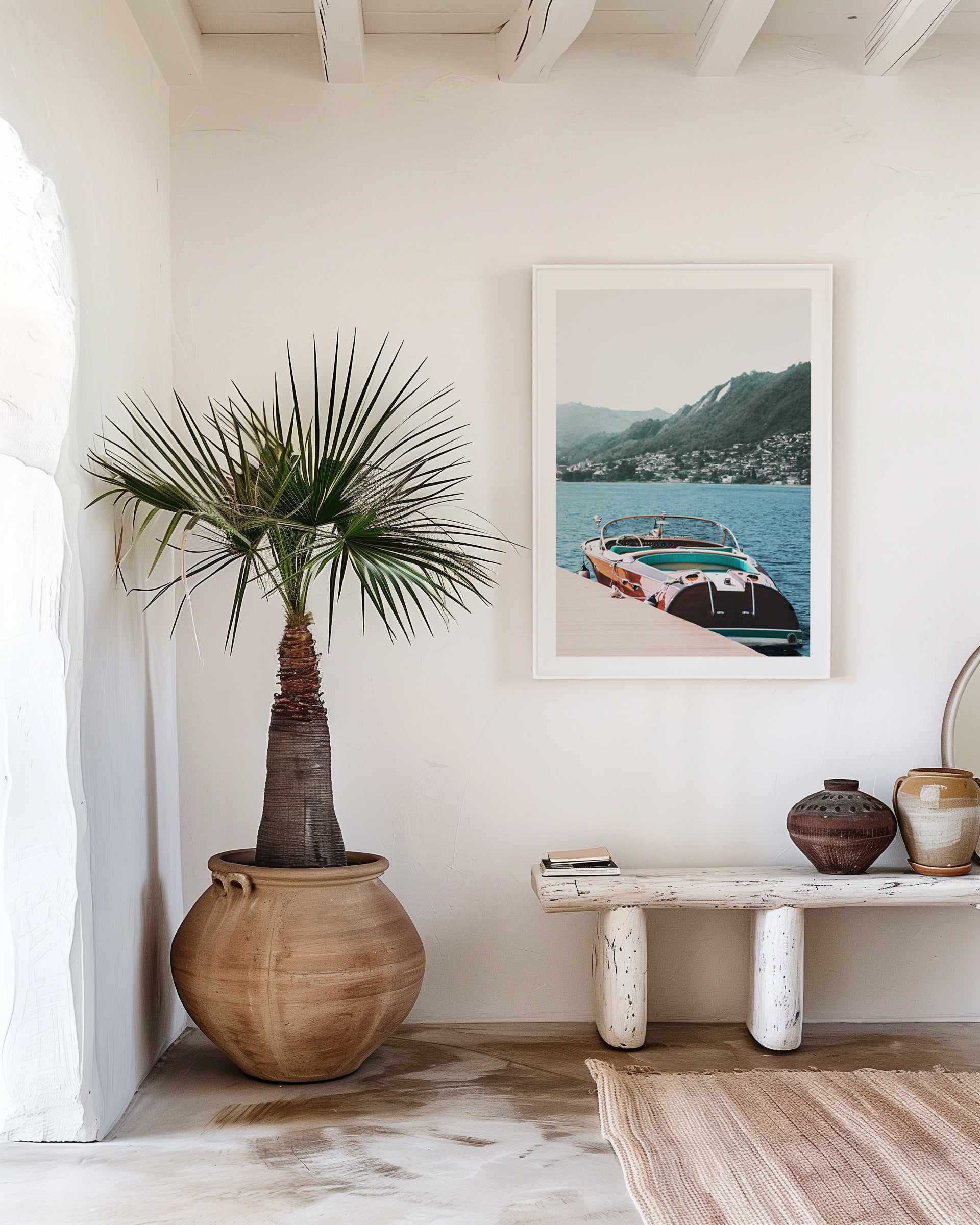
Riva Boat, Lake Como | Art Print · Sellicks II Art Print · Coffee Fix I by Mario Stefanelli Art Print
Why Large Photo Prints Work Where Other Art Struggles
Photography scales up better than almost any other art form. An abstract enlarged past its natural size can lose its intimacy, and a busy illustration can become overwhelming at two metres wide, but a photograph gains presence as it grows because detail keeps rewarding the eye: the texture of foam on a wave, mist between gum trees, the geometry of umbrellas seen from above. A large photographic print behaves like a window. It gives the room a view, and the psychology of that is powerful; rooms with a large landscape photograph consistently read as calmer and bigger than the same rooms with grouped small art.
There is also a proportion rule at work. Art should occupy roughly two thirds to three quarters of the width of the furniture beneath it, or of the wall section it owns. On Australian lounge and bedroom walls that maths almost always lands at 100cm wide or more, which is exactly the territory where a single large photo print outperforms a gallery wall of small pieces both visually and on cost per impact.
Getting the Size Right: A Practical Guide
- Above a sofa (2 to 2.5m): one 100 x 130cm portrait feels bold; a 120 x 150cm landscape orientation or a pair of 70 x 100cm prints fills the width properly. Hang so the bottom edge sits 15 to 25cm above the sofa back.
- Above a king or queen bed: 100 x 130cm landscape is the sweet spot; oversize 120 x 150cm suits high ceilings. Keep the centre of the image at about 145 to 155cm from the floor.
- Hallway end walls: a portrait-orientation 70 x 100cm or 100 x 130cm turns a dead end into a destination.
- Dining rooms: match the orientation to the table; a wide 120 x 150cm above a sideboard anchors the whole room.
- Double-height voids and stairs: this is extra large wall art territory; go a size beyond what feels safe, because volume swallows scale.
The reliable test: cut a sheet of kraft paper or baking paper to the candidate size, tape it to the wall, and live with it for a day. Almost everyone sizes up after this test, and nobody sizes down. For wide walls that no single ratio solves, a photographic pair or a panoramic artwork answers the format problem cleanly.
Framed Print, Canvas or Acrylic: Choosing the Finish
Framed fine art prints are the gallery treatment: archival photographic paper in a solid timber frame with oak, white or black finish. The frame adds a formal edge that suits bedrooms, dining rooms and any scheme with other framed pieces. Oak finish warms coastal and Scandinavian rooms; black finish sharpens monochrome photography; white finish disappears politely into Hamptons schemes.
Canvas drops the glass and the reflections, which matters opposite windows, and its lighter weight makes very large scales easier to hang on plasterboard. Photography on canvas reads softer and more relaxed; it is the finish we recommend most for living rooms and casual spaces. Print-your-own is also an option here: our photos on canvas service turns your own high-resolution images, weddings, travel, the dog, into the same large-format treatment.
Framed canvas splits the difference: canvas texture inside a floating timber frame, no glass, full formality. It has become our most popular large-format finish for exactly that reason.


Sellicks Sunrise II LS Art Print · Sellicks I Art Print
Choosing the Image: What Reads Well at Scale
Big walls want images with depth and a place for the eye to rest. Aerial photography is the most reliable large-format genre in Australian homes, all pattern and turquoise, which is why our aerial photography collection dominates our largest size sales. Landscape photography with atmospheric depth, mist, long horizons, layered ranges, gives a room the window effect at full strength; see the Australian landscape photography collection for home-grown horizons. Black and white photography is the safest large-scale choice in a room that already has colour to protect, and coastal and ocean photography remains the national favourite for a reason: water reads as calm at any size.
One designer rule: the larger the print, the quieter the palette should be. A two-metre image in six saturated colours will fight every other decision in the room. A two-metre image in sand, white and one blue will lift it.
Designer Tips for Hanging Large Photo Prints
- Centre at 145 to 155cm. Gallery height for the middle of the artwork, not the hook. Oversized art can sit slightly lower; it should relate to the furniture, not float towards the ceiling.
- Two hooks, always. Large prints on a single hook drift out of level within a week. Two wall hooks 30 to 50cm apart keep the top edge true.
- Use the right anchors. A framed 120 x 150cm print is heavy. Into studs is best; otherwise rated plasterboard anchors, never bare picture hooks.
- Mind the reflections. Framed-behind-glass photography opposite a window will mirror it all afternoon; choose canvas for that wall instead.
- Let it breathe. A large print needs clear wall around it. Resist flanking it with smaller pieces; the power of one big image is that it is one big image.
Where Large Photo Prints Earn Their Keep
Living rooms take the biggest scale in the house; this is where 120 x 150cm belongs, above the longest sofa or owning the wall opposite it. Bedrooms want the calmest image at 100 x 130cm above the bedhead. Dining rooms suit photography with a little formality, monochrome or architectural, hung above the sideboard. Home offices benefit most per dollar: one large horizon behind the desk transforms every video call background and gives your own eyes somewhere to travel between tasks. Entries and hallways reward a single portrait-format print at the end of the sightline, the first and last image the house shows you every day. In every case the rule is the same: one wall, one large image, no competition.
Frequently Asked Questions
What is the most popular size for large photo prints in Australia?
100 x 130cm is the workhorse: big enough to anchor a sofa or bed wall, manageable to hang, and our most ordered large format. 120 x 150cm is the statement scale for high ceilings and generous walls, and 70 x 100cm is the entry point that still reads as substantial.
Can I print my own photos as large wall prints?
Yes. Our photo printing service produces your own images as framed prints or canvas up to statement sizes. Resolution matters: for 100 x 130cm you want the original file at its full camera resolution, ideally 3000 pixels or more on the long edge. Modern phone photography from the last few years is generally sufficient.
Are large prints better as canvas or framed behind glass?
Canvas for casual rooms, walls opposite windows, and the largest scales where weight matters. Framed archival paper behind glass for the most formal, gallery-style presentation. Framed canvas gives you the frame without the glass and suits almost everything; all frames are solid timber with oak, white or black finish.
How do I hang a large photo print on plasterboard?
Find studs where you can and fix into at least one. Where you cannot, use rated plasterboard anchors (each carrying at least double the artwork's weight) and two hanging points for stability. Our largest framed pieces arrive ready to hang with the hardware fitted.
What photo looks best above a bed?
Something horizontal, calm and low in contrast: an aerial beach, a misty landscape, a soft seascape. Avoid busy detail and hard blacks above a bed; the wall behind you while you sleep should be the quietest image in the house.
Start With the Wall
Pick your biggest empty wall, tape up a paper template, and let the size decision come first; the image follows more easily once the scale is settled. Browse all photography for the full range, the exclusive Olive et Oriel photographic collection for images available nowhere else, or go straight to extra large wall art if your wall is the double-height kind. For more on scale itself, our panoramic wall art guide covers the widest walls of all.


