
Art Nouveau is having its loudest revival in a century. The style that wrapped Paris metro entrances in whiplash curves and put Alphonse Mucha's flowing goddesses on every wall in Europe is back in Australian interiors, driven by the same appetite that brought maximalism and vintage florals home: a hunger for ornament, for line work with life in it, for rooms that feel collected rather than catalogued. This guide covers what actually defines Art Nouveau, how it differs from the Art Deco it is constantly confused with, and how to bring it onto your walls through art and wallpaper without turning the living room into a museum diorama.
Every artwork and wallpaper here is printed to order in West Gosford on the NSW Central Coast, with framing done in-house: solid timber frames in oak, white or black finish.


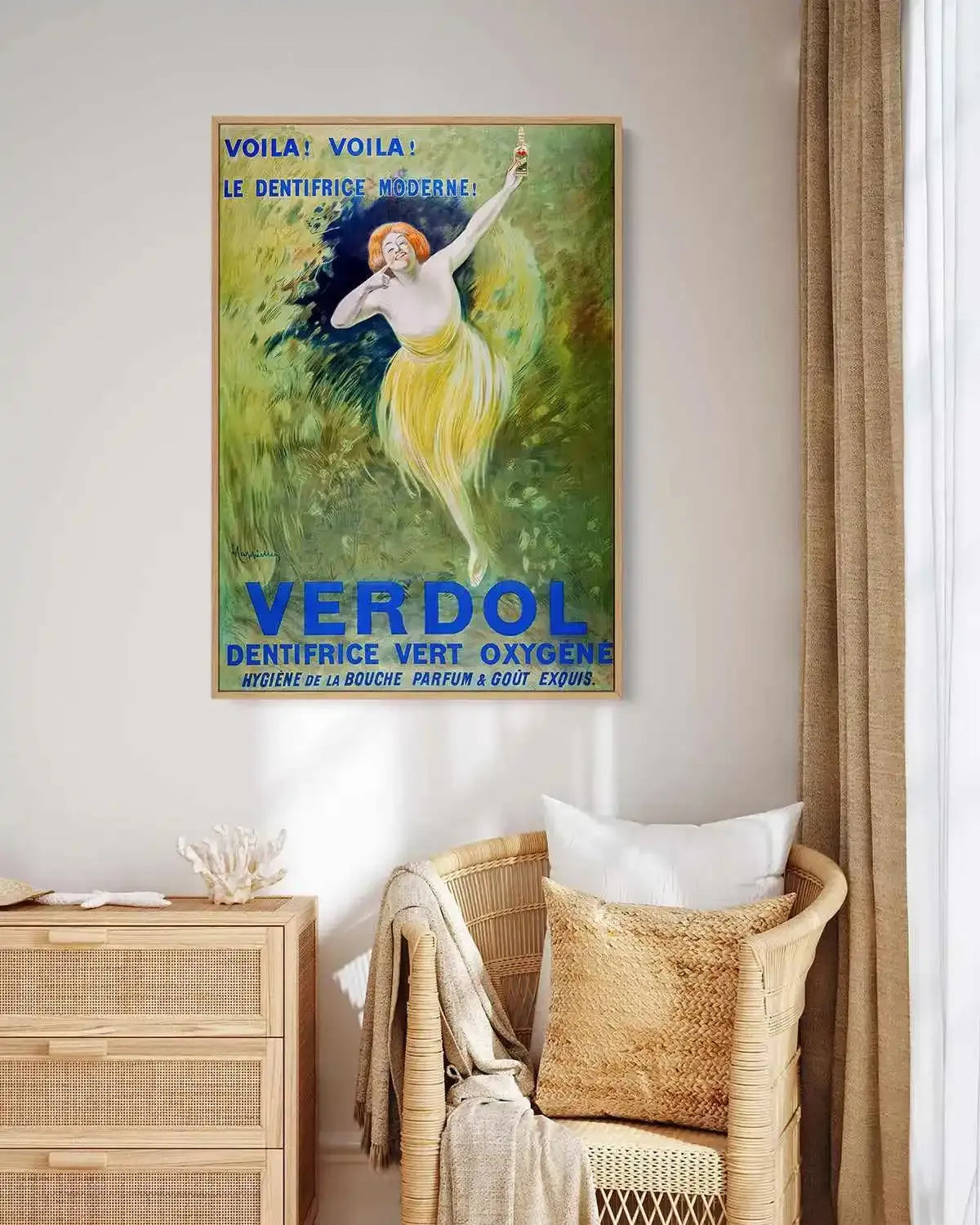
Verdol Vintage Poster | Framed Canvas Wall Art · Champagne Vintage Poster | Framed Canvas Wall Art · Job Vintage Poster | Framed Canvas Wall Art
What Is Art Nouveau, Really?
Art Nouveau flourished between roughly 1890 and 1910, and it was the first design movement to insist that everything, buildings, furniture, jewellery, posters, typefaces, should share one organic language. Its vocabulary comes from nature drawn in motion: stems that curve like smoke, hair and fabric that flow into pattern, irises, lilies, poppies and peacocks stretched into long sinuous lines. The signature is the so-called whiplash curve, a line that bends back on itself with the energy of a cracked whip. Where the Victorians stuffed rooms with ornament, Art Nouveau streamlined ornament into something that felt alive.
The names worth knowing: Alphonse Mucha, whose posters of women wreathed in flowers and golden halos define the style for most people; Gustav Klimt, whose gilded Vienna Secession portraits sit at the movement's fine-art peak; Hector Guimard of the Paris metro entrances; and Charles Rennie Mackintosh, whose Glasgow roses and elongated grids gave the style its most geometric dialect. When something today is described as Art Nouveau, it is usually reaching for one of those four accents.
Art Nouveau vs Art Deco: The Two-Second Test
The two get confused constantly, and the difference is easy once seen. Art Nouveau is curved, botanical and hand-drawn: vines, waves, women with impossible hair, asymmetry everywhere. Art Deco, which followed it after the First World War, is straight, geometric and machine-age: sunbursts, chevrons, stepped forms, symmetry everywhere. If the line flows, it is Nouveau; if the line marches, it is Deco. In styling terms Nouveau plays beautifully with vintage, cottage and maximalist rooms, while Deco belongs with brass, velvet and black marble glamour. Both reward commitment, but they are not interchangeable, and mixing them carelessly is the fastest way to muddy either look.
Bringing Art Nouveau Home: Wall Art
The most natural entry point is a framed print with the movement's line work at its centre: a Mucha-style figure, a botanical drawn in flowing contour, a peacock or iris study, or modern illustration that borrows the whiplash line. Because Nouveau artwork is inherently ornamental, it wants a frame with warmth; a solid timber frame with oak finish reads closest to the period's natural materials, while black finish sharpens the graphic poster heritage. Hang one large piece as the room's focal point rather than scattering several small ones; Art Nouveau posters were designed to command a street, and they still prefer to command a wall. Browse the Art Nouveau wall art collection for the current range, and the wider vintage posters collection for the poster-era tradition it belongs to.
Palette is half the period charm. Authentic Nouveau colours are vegetal and muted: olive and sage greens, ochre and mustard, dusty rose, cream, with gold as the lift. If your room already leans into those tones, sage walls, brass hardware, timber furniture, a Nouveau print will look like it has always lived there. See our green canvas art collection for companion pieces in the same palette family.


Grafton by William Morris Wallpaper · Tulip in Grey by William Morris Wallpaper
Art Nouveau Wallpaper: Pattern the Movement Was Born For
Art Nouveau was a wallpaper movement before almost anything else; its designers thought in repeats. Stylised florals with flowing stems, peacock feathers, pomegranates and thistles drawn in continuous curving line are all period-true, and their modern descendants sit in our William Morris vintage wallpaper collection alongside the damask wallpapers that carried ornament into the modern repeat. A full feature wall in an ornate flowing botanical is the single most transformative Nouveau gesture available to a modern room, and with removable wallpaper it is a weekend project rather than a renovation, rental-safe included.
Two styling routes work. The immersive route papers the whole room, then keeps furniture simple and palette-matched so the walls carry everything; this suits dining rooms, studies and powder rooms, the small dramatic spaces where maximalist pattern earns its keep. The measured route papers one wall behind the bed or sofa and hangs a single framed Nouveau print on an adjacent plain wall, letting pattern and poster speak to each other across the corner. Our maximalism styling guide covers the density decision in depth.
Styling Rooms Around Art Nouveau
- Bedrooms: the style's softness suits sleep. A flowing botanical wallpaper behind the bed, linen in cream or dusty rose, and one gilt-toned artwork. Keep lighting warm; Nouveau dies under cool white light.
- Dining rooms: the movement's natural theatre. Ornate wallpaper, timber table, candlelight; add a large framed print rather than a mirror above the sideboard.
- Studies and reading corners: Mackintosh-leaning prints with their more upright geometry suit desks and shelving walls without the full floral commitment.
- Powder rooms: the classic modern use for full-strength pattern; a small room wrapped entirely in peacock or iris repeat is a jewellery-box moment guests remember.
- Living rooms: take the measured route; one statement wall or one commanding print, with the palette repeated in cushions and a rug, keeps the room contemporary.
Designer Tips for Getting Nouveau Right
- Commit to the curve. The style lives in its line. One genuinely flowing, ornamental piece beats five timid nods to it.
- Ground it in timber and brass. Nouveau grew up beside carved oak and beaten metal; natural materials keep the revival from feeling like a print-out of the past.
- Mute the palette, gild the accent. Olive, ochre, rose and cream with one gold moment is period-perfect and easy to live with.
- Pair with plain generously. Every ornate wall needs a quiet neighbour; give pattern a solid-coloured wall or large plain textile to rest against.
- Do not mix in Deco geometry. Sunbursts and chevrons will fight the botanical line. If you love both movements, give them separate rooms.
The Australian Angle
Australia has its own quiet claim on the movement. Federation-era homes built between 1900 and 1915 absorbed Art Nouveau into their leadlight windows, pressed metal ceilings and carved verandah brackets, which is why a Nouveau print or ornate wallpaper feels so instantly at home in a Federation or Queenslander interior: the house already speaks a cousin of the language. In those homes, take cues from what the building gives you, echo the leadlight palette in the artwork, or paper the hallway the pressed ceiling looks down on. In new builds the style works as deliberate contrast, one ornate wall against clean plaster, and the flatness of modern surfaces makes the old line work look even more alive.
Frequently Asked Questions
What is the difference between Art Nouveau and Art Deco?
Art Nouveau (1890 to 1910) is organic, curved and botanical, all flowing stems and asymmetry. Art Deco (1920s and 30s) is geometric, symmetrical and machine-inspired, all sunbursts and chevrons. Flowing line means Nouveau; marching line means Deco.
Is Art Nouveau coming back in interiors?
Yes, as part of the broader swing back to ornament, vintage florals and maximalist pattern. Search and social interest in Art Nouveau design has climbed sharply through 2026, and it pairs naturally with the sage greens, ochres and brass finishes already dominant in Australian homes.
What colours are Art Nouveau?
Muted, nature-derived tones: olive and sage green, ochre, mustard, dusty rose, ivory and cream, with gold or brass as the accent. High-saturation primaries are not part of the language.
How do I use Art Nouveau in a small room?
Small rooms are the style's best modern stage. Wrap a powder room or entry in a full ornate repeat, or hang one large flowing print in a solid timber frame with oak finish above a hall console. Ornament at small scale reads as a gem rather than a commitment.
Does Art Nouveau work with modern furniture?
Very well, and the contrast is the point: one ornate patterned wall behind a clean-lined contemporary sofa lets each make the other look intentional. Keep the palette shared between wall and furniture and the century gap disappears.
Where to Start
Start with a single flowing statement: browse the Art Nouveau wall art collection, then explore the William Morris vintage wallpaper collection for the full-wall version of the same line work. For the adjacent traditions, our vintage florals guide and floral canvas wall art collection carry the botanical thread through the rest of the house. Everything prints to order on the NSW Central Coast and ships Australia-wide.


