
“Eco-friendly” in interior design is often a vibe, not a fact. A soft green palette, a fern print and some recycled-paper packaging can make any wallpaper feel sustainable — but the material underneath, the inks on top, the factory it came from and the way it reached your wall all matter far more than the aesthetic. A genuinely sustainable wall mural has specific, verifiable credentials — and knowing which questions to ask is the difference between a design choice you feel good about and a greenwashed one you don’t.
At Olive et Oriel we’ve been printing wallpaper from our Central Coast NSW studio for more than ten years, and sustainability for us isn’t a marketing layer — it’s baked into how we make things. This guide walks through what “eco-friendly wallpaper” actually means across four real dimensions (material, inks, manufacturing, shipping), the questions worth asking any mural seller before you buy, and the nature-led designs that naturally align with a quieter, more considered interior. No superlatives. Just what we can verify.


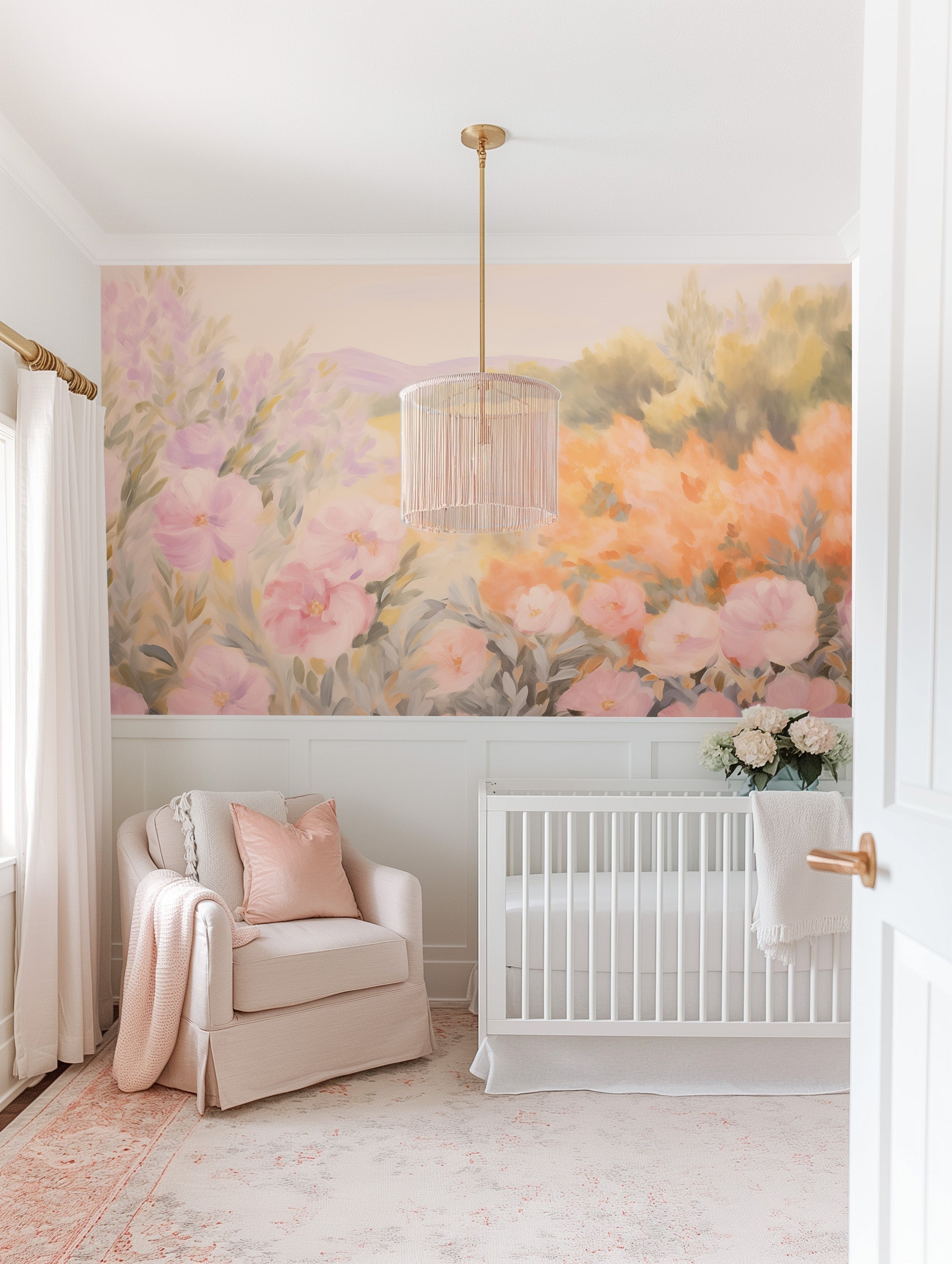
Luxe Wild Flowers Wallpaper Mural · Pink Fern Canopy Wallpaper Mural · Pink Jungle Leaves Wallpaper Mural
What “Eco-Friendly Wallpaper” Actually Means
The phrase is used loosely. Used precisely, it covers four distinct dimensions, and a wallpaper can score well on one while being poor on another. Look at all four before you decide.
- Material: what the wallpaper itself is made of. Traditional vinyl wallpaper is PVC-coated; a PVC-free non-woven substrate is the more considered choice.
- Inks: what’s printed onto the substrate. Water-based, low-VOC inks release fewer volatile organic compounds than solvent-based alternatives.
- Manufacturing: whether the wallpaper is printed on demand or mass-produced for warehouse inventory. Print-on-demand avoids the 10–20% of stock a typical inventory-held brand writes off each season.
- Shipping: where it’s printed relative to where it’s installed. A roll printed locally in Australia avoids the freight emissions of a European or US import.
A mural can meet all four of these standards or none of them. The label “eco” on its own tells you nothing — the underlying specifications do.
The PVC Question
Most commercial wallpaper is vinyl, which is shorthand for a polyvinyl chloride (PVC) surface bonded to a paper or non-woven backing. PVC is durable and wipeable, which is why it dominated wallpaper manufacturing for decades. The trade-offs are less flattering: PVC can off-gas plasticisers (phthalates) during its early life in the room, it’s difficult to recycle at the end of its life, and its manufacture involves chlorine chemistry that most sustainability frameworks flag as problematic.
“PVC-free” non-woven wallpaper replaces that vinyl surface with a polyester-cellulose blend — breathable, dimensionally stable, printable to a high resolution and free of the chlorine chemistry that defines PVC. It’s the substrate most premium European wallpaper brands have moved to over the last decade, and it’s the substrate we offer for our paste-the-wall mural options.

Pastel Palm Grove Wallpaper Mural
A PVC-free non-woven substrate, printed with water-based inks on demand, shipped from an Australian studio: that’s four eco credentials stacked on top of each other. None of them is a certification badge. All four are verifiable specifications.
Water-Based Inks vs Solvent-Based
The ink is where most of the volatile organic compounds (VOCs) in a wallpaper come from. Solvent-based inks use petroleum-derived carriers that evaporate as the ink cures, releasing VOCs into the room air; water-based inks use water as the carrier, which keeps VOC release low and dramatically reduces the “new wallpaper smell” that solvent inks are known for.
In practice, the difference shows up in three places: indoor air quality (lower VOCs are better for sensitive occupants, including children, pregnant women and anyone with asthma or fragrance sensitivities), cure time (water-based inks finish curing faster with less residual off-gassing) and safe installation in confined spaces (nurseries, bedrooms and small ensuites). Our printing uses water-based, low-VOC inks — one of the main reasons our murals are comfortable to install in a nursery or children’s bedroom.


Tropical Mist Wallpaper Mural · Tropical Cove Wallpaper Mural
Print-On-Demand vs Mass-Inventory Manufacturing
This is the sustainability dimension most customers never hear about, and it’s arguably the one with the largest environmental footprint. A traditional wallpaper brand prints thousands of rolls of each design in a single run, warehouses them, and writes off the unsold stock when the pattern is discontinued. Industry estimates commonly put that write-off figure at 10–20% of inventory per season — rolls that were printed, packaged, shipped, stored and then sent to landfill or recycling without ever meeting a wall.
Print-on-demand inverts the model. Every mural we print is made against a real order, cut to your exact wall dimensions, and shipped straight from our studio. There is no warehouse of unsold rolls. There is no discontinuation write-off. The environmental footprint of wallpaper you didn’t buy is zero, because we didn’t print it. It’s the same reason our custom photo-to-mural service is more sustainable than a stock pattern — the waste profile of a truly made-to-order product is structurally smaller.

Australian-Made and the Shipping Footprint
A wallpaper’s shipping emissions depend on two things: how far it travels and by what mode. A mural printed in Europe and shipped to Australia typically covers 15,000–20,000 kilometres by sea freight and road. A mural printed in the United States covers 12,000–15,000 kilometres. A mural printed in our Central Coast NSW studio and couriered to an Australian home covers hundreds of kilometres on domestic road freight.
For international customers the calculation flips — but “all import duties paid” still matters, because no customer in the UK, USA or Europe has a surprise customs fee added at the door. It’s a cleaner, simpler shipping relationship than most wallpaper imports offer in either direction.
Seven Questions to Ask a Mural Seller Before You Buy
If you want to cut through the marketing language, ask specific questions. A sustainable wallpaper brand will have specific answers; a greenwashed one will have vague ones.
- 1. Is this PVC-free? — A yes should be followed by naming the substrate (non-woven, paper, polyester-cellulose). A vague “it’s eco” is not an answer.
- 2. What inks do you use? — Water-based or latex (both water-carried) are what you’re looking for. Solvent-based is not.
- 3. Where is it printed? — An actual city or region should come back, not a country of headquarters. “Designed in London, printed in China” is not the same as “printed in London.”
- 4. Is it print-on-demand or inventory-held? — Print-on-demand brands can tell you the exact date your roll was manufactured. Inventory brands can’t.
- 5. What happens at end of life? — A PVC-free non-woven wallpaper is far easier to separate from paste and recycle than a vinyl one. Ask whether their substrate is recyclable through local paper-recycling streams.
- 6. What’s your packaging? — Cardboard tubes and paper tape are better than plastic sleeves and plastic strapping. Bio-plastics are better than traditional plastics if a sleeve is used.
- 7. Are there third-party certifications? — GREENGUARD, FSC, EU Ecolabel, Oeko-Tex and similar schemes are real third-party verifications. Badges the brand invented themselves are not.

Blushing Valley Wallpaper Mural
Olive et Oriel’s Credentials — Stated Honestly
Here’s what we can verify, plainly:
- PVC-free non-woven substrate on our paste-the-wall mural option. This is the substrate we recommend for customers prioritising material sustainability.
- Water-based, low-VOC inks across the entire range. Low odour during installation, minimal off-gassing after cure.
- Print-on-demand manufacturing. Every mural is printed against a real order at our Central Coast NSW studio. No warehoused inventory, no discontinuation write-offs.
- Australian-made with more than ten years of manufacturing experience. Domestic shipping for Australian customers; duties-paid shipping for the 40+ countries we ship to.
- Custom sizing cut to your exact wall dimensions — no offcut waste from a standard-roll format that doesn’t match your wall.
What we don’t claim: we don’t hold a blanket GREENGUARD or EU Ecolabel certification on every product, and we won’t claim we do. The credentials above are the ones we can stand behind. If a broader third-party certification matters to your project, ask us directly and we’ll tell you exactly what a given product carries and what it doesn’t.
Nature-Led Mural Designs That Align With the Aesthetic
Sustainable specifications are one half of the decision; the design is the other. Nature-led murals — botanical, forest canopy, coastal, landscape — visually reinforce the ethos of a considered, biophilic interior. They also tend to age slowly, which is itself a sustainability argument: a mural you keep for eight years has a lower annualised footprint than one you replace every two.


Jungle Retreat Wallpaper Mural · Dreamy Florals Wallpaper Mural
Across our mural collection these are the design families that tend to land well in eco-leaning interiors: soft botanical wildflower fields; fern canopies and tropical foliage in muted palettes; misty valley and mountain landscapes; coastal horizons and coves. Pair them with our broader guide to the 2026 mural trend for context on where these designs fit within the year’s interiors direction.

The Peel-and-Stick Eco Question
Removable peel-and-stick wallpaper is often marketed as the “greener” option because it doesn’t damage walls and can be taken down without paste residue. The honest answer is more complicated.
Peel-and-stick rolls typically rely on a self-adhesive backing bonded to a vinyl or polyester face. The material chemistry is generally less sustainable than a PVC-free non-woven paste-the-wall roll. Where peel-and-stick does win is in longevity of use at the wall level — renters who would otherwise replace wallpaper each lease can move it without stripping, which reduces replacement frequency. If you own your home and plan to keep a mural for five-plus years, a PVC-free non-woven paste-the-wall mural is usually the cleaner material choice. If you rent or move often, the adhesive convenience of a removable format may outweigh the material difference. Both options are offered across our peel-and-stick range and our paste-the-wall wallpaper — pick by how long the mural will live where it’s going.
End of Life: What to Do With a Removed Mural
A mural doesn’t last forever, and the end-of-life handling is part of the sustainability picture.
- PVC-free non-woven paste-the-wall: once dry-stripped from the wall, the substrate is a polyester-cellulose blend. Check with your local council’s recycling stream; many Australian councils accept it in mixed-paper recycling once paste residue is minimal. Where mixed-paper recycling isn’t available, it goes to general waste — still lighter-footprint than PVC vinyl in landfill.
- Peel-and-stick removable: the adhesive backing makes these harder to recycle. Most will go to general waste. Offsetting factor: the ability to move the mural rather than discard it, which extends its useful life.
- Offcuts during installation: keep small offcuts for future patch repairs. Larger offcuts can be repurposed as drawer liners, inside-cupboard finishes or craft project backings — reusable surface material is itself a quiet form of waste reduction.
Custom Eco-Commissions
Our custom wallpaper service extends the same substrate, ink and print-on-demand specifications to bespoke designs — photo-to-mural, original artwork, pattern repeats and commissioned pieces. Because every custom order is made to your exact wall, there is no stock offcut and no minimum run-length penalty. If a nature-led mural is the aesthetic but no existing design is quite right, a custom commission gets you the same eco specifications under an image chosen for your space.
Installation and Measuring
Sustainable specifications only matter if the mural is installed well and lasts. Our measure guide walks through getting dimensions right so the mural is custom-cut to the wall; our complete mural installation guide covers the paste-the-wall method step by step; and the wallpaper installer directory lists vetted professionals by Australian region if you’d rather hand the job to a specialist. For peel-and-stick specifically, our wall-prep guide covers the surface conditions that determine whether a removable mural actually stays put.

Before committing to a full roll, order a $4.99 wallpaper sample (48cm x 40cm / 19in x 16in). Taping it to the wall for a few days is the simplest honesty check you can run: you see the colour under your own light, you smell the inks under your own conditions, you can touch the substrate yourself. If a wallpaper brand won’t ship you a sample, that’s information too.
Frequently Asked Questions
Is all wallpaper toxic?
No. “Wallpaper” is a category that spans PVC vinyl with solvent inks at one end and PVC-free non-woven with water-based inks at the other — they’re materially different products despite sharing a name. The more specific answer is to ask about substrate (PVC-free non-woven is the cleaner choice) and inks (water-based, low-VOC). A wallpaper built on those two specs is comfortable to install in sensitive spaces including bedrooms and children’s rooms.
What are VOC emissions and why do they matter in Australian homes?
Volatile organic compounds are gases released by certain paints, adhesives, inks and furnishings. They contribute to indoor air quality issues ranging from odour to respiratory irritation. Australian homes often run closed up with air-conditioning through summer and heating through winter, which reduces natural ventilation and can concentrate VOCs indoors. Low-VOC inks and adhesives are one of the simpler ways to keep indoor air cleaner — along with ventilation during and after installation.
What is the difference between PVC and non-woven wallpaper?
PVC wallpaper has a polyvinyl chloride surface — durable and wipeable, but chlorine-based in manufacture and difficult to recycle. Non-woven wallpaper uses a polyester-cellulose blend that’s breathable, dimensionally stable, and much simpler to handle at end of life. Non-woven is also a paste-the-wall product, which makes installation faster and paste use lower than older paste-the-paper formats.
Can I recycle a removed wall mural?
It depends on the substrate. A PVC-free non-woven mural, dry-stripped with minimal paste residue, is often accepted in Australian mixed-paper recycling streams — check your local council. A PVC vinyl mural is generally not recyclable through household streams and will go to general waste. A peel-and-stick removable sits in between; the self-adhesive backing usually puts it in general waste too. If recyclability matters to you, the PVC-free non-woven paste-the-wall option is the cleanest end-of-life choice.
Are there GREENGUARD-certified wallpapers available in Australia?
Some imported wallpaper brands hold GREENGUARD or similar third-party certifications on specific product lines. Availability in Australia varies and is worth confirming per product rather than per brand — a brand may carry certification on its core range but not on a specific sub-line. If third-party certification is essential for a specification-sensitive project (early-learning centres, healthcare interiors), ask the supplier to cite the exact certification and the exact product it covers, and request the certificate.
Is eco-friendly wallpaper safe for kids’ rooms and nurseries?
PVC-free non-woven wallpaper with water-based, low-VOC inks is appropriate for nurseries and children’s bedrooms — which is why we specify it in our nursery design guide. Install with good ventilation, let the space air for 48–72 hours before the child occupies it, and you’re operating well within the comfort range for sensitive users. As with any installation material, confirm the specific product spec before committing.
Is wallpaper safe to install during pregnancy?
Water-based, low-VOC wallpaper is the safer installation choice during pregnancy for the same reason it suits nurseries — lower VOC release during cure. We’d still suggest the pregnant occupant not do the physical installation themselves (both for VOC minimisation and for the physical demands of the job), that the room is well ventilated during and after install, and that the space is aired before it’s slept in. For specific medical concerns, defer to your GP or obstetrician on what’s appropriate for your situation.
Where can I source eco-friendly wallpaper in Australia?
Look for Australian-based manufacturers that print on demand — the combination cuts shipping emissions and inventory write-off simultaneously. Ask the seven questions from the checklist above before committing. Our own wall mural collection, paste-the-wall wallpaper and broader eco wallpaper guide are the starting points we’d offer; our complete guide to wall coverings covers the underlying material science if you want the longer version.
Browse the full wall mural collection, explore our broader wallpaper range, or read more on On the Wall.


