

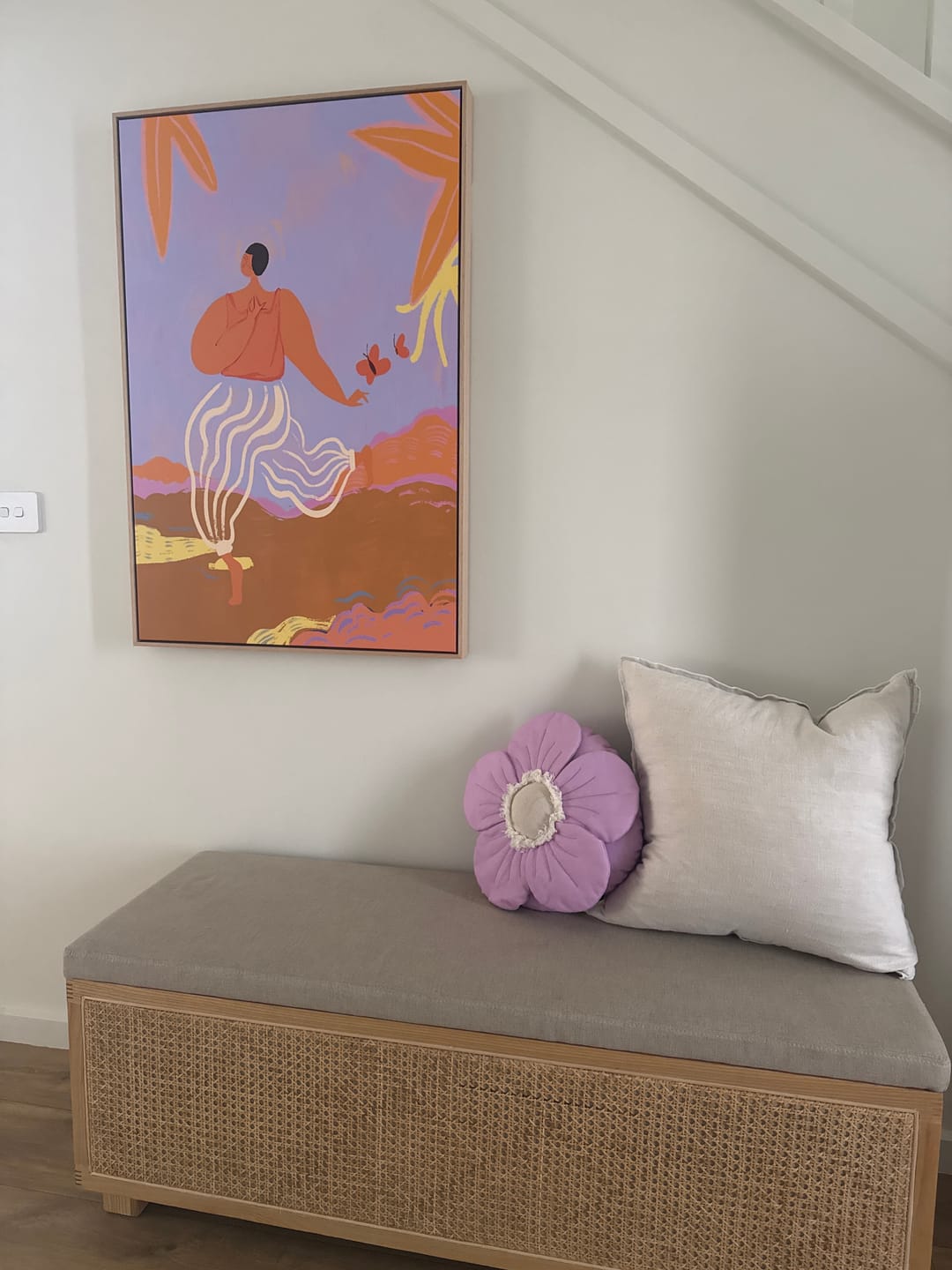
Canvas art occupies a specific and irreplaceable position in the spectrum of wall art formats. It is neither as formal as a framed print behind glass nor as casual as a paper poster pinned to the wall. It occupies a middle ground — tactile, unpretentious, inherently warm — that makes it the most versatile format for residential installation. The gallery-wrapped canvas, stretched over a timber frame with the image extending around the edges, is in particular a format that brings a dimensional quality to a wall that no framed print can replicate. Running your hand across a stretched canvas in a room where you have lived with it for months, you feel the texture of the surface, the slight give of the fabric, the realness of the object. That physicality is what distinguishes canvas from every other format. For the full range of gallery-quality pieces at accessible prices, explore affordable art prints — produced at our Central Coast NSW facility from $9.95.
At Olive et Oriel, we produce gallery-wrapped canvas at our Central Coast of New South Wales facility using archival-quality inkjet printing on artist-grade canvas substrate, stretched over solid timber frames. Every canvas we produce is manufactured to the customer's exact specified dimensions — there is no standard size that you are expected to make do with. This custom approach is what ensures the canvas fits the wall it is intended for, at the scale the composition requires, rather than at whatever size happened to be available. We have shipped canvas art to homes across Australia, New Zealand, the United Kingdom, the United States, and more than forty other countries.


Gallery-Wrapped Canvas vs. Framed Prints: Understanding the Difference
The decision between a gallery-wrapped canvas and a framed print is the first and most significant design choice in wall art selection. Both formats have specific strengths, and understanding the distinction prevents the most common mistake — choosing a format that is wrong for the room or the image.
Gallery-wrapped canvas presents the image without a frame, with the image extending around the side edges of the stretcher frame. This creates a dimensional, floating quality that suits contemporary and casual interiors. The absence of a frame means the art sits closer to the wall, with less visual separation between the image and its environment. Canvas has a natural texture (the woven weave of the fabric substrate) that adds tactile richness and differentiates it from print-on-paper. It is the format that reads most easily from a distance as genuine art rather than a reproduction.
Framed prints have a more formal presentation — the combination of mat board (where present), print surface, and frame creates a visual hierarchy that signals care and consideration. Framed prints on paper or card have greater resolution potential at very large sizes because the substrate is flatter and the ink sits more precisely on the surface. They suit formal rooms, gallery-style installations, and interiors where the frame itself is a design element.
The choice often comes down to the character of the room. Contemporary, casual, and coastal interiors almost universally suit gallery-wrapped canvas. Formal living rooms, studies, and dining rooms may benefit from the additional presence of a framed presentation.
Grouping and Sizing: The Formulas That Work
Canvas groupings are governed by a set of principles that, once understood, make every arrangement decision straightforward.
Consistent spacing. When hanging two or more canvases in a horizontal arrangement, the gap between them should be consistent — typically 5–8cm (2–3 inches). Larger gaps make a grouping look like individual pieces that happen to be near each other. Smaller gaps create the sense of a unified composition. The gap should be decided in advance and measured precisely, not estimated by eye.
Horizontal alignment. In horizontal groupings, align either the top edges or the bottom edges of the canvases consistently — not the centre-lines, which are harder to perceive visually. Top-edge alignment is most reliable. In vertical groupings, align the centre of each canvas on a single horizontal axis.
Scale relative to the wall. A single canvas above a sofa should span between two-thirds and three-quarters of the sofa's width. A pair of canvases together should meet this measurement. A grouping of three should approach this measurement as a combined width.
Odd numbers. Groupings of three or five almost always read more naturally than groupings of two or four. The odd number creates an inherent visual asymmetry that prevents the arrangement from feeling institutional.
The Visual Weight of Canvas
Canvas has more visual weight than framed prints of equivalent size. The dimensional quality of the stretched substrate — particularly when viewed from the side, where the depth of the frame is visible — creates a presence on the wall that paper prints lack. This is generally an advantage, particularly in rooms where you need the art to anchor a wall decisively. It is worth factoring into placement decisions: a canvas that would be the correct size as a framed print may read as too dominant when stretched over a deep frame.
Hanging Approaches
Canvas frames come with either hanging hardware pre-attached (D-rings on the sides, or a saw-tooth bracket across the top) or nothing, requiring you to add your own. D-rings with a hanging wire stretched between them are the most stable and most adjustable method — once the wire is in place, you can shift the canvas left and right by a few centimetres without changing the hook positions. Invisible French cleats provide the most secure connection for heavy canvases and allow very precise positioning, but require more precise installation. Picture-hanging strips (Command or similar) are appropriate for lightweight canvases in rental situations where wall damage must be avoided.
All canvases over 80cm in any dimension should be hung from two attachment points — a single point allows the canvas to rotate on the hook over time, creating a visible tilt that is difficult to fully correct.
How Canvas Ages
Gallery-wrapped canvas, properly hung and cared for, should last for decades without significant degradation. The canvas substrate is stable under normal indoor conditions. The inks we use at our Central Coast facility are archival-quality pigment inks rated for 75+ years lightfastness under gallery conditions — meaning no significant visible fading when protected from direct UV exposure.
The primary enemy of canvas longevity is direct sunlight. A canvas hung on a wall that receives direct sun for several hours per day will fade noticeably within five to ten years. Hang canvas on walls that receive indirect light only — the reflected and diffused light of a well-lit room rather than the direct beam of a window or skylight.
Room by Room
- Living room: The primary art placement in any living room is the wall most visible from the main seating. A single large canvas (100×150cm or similar) above the sofa or on the primary wall creates the decisive anchor the room needs. Supplement with smaller works on adjacent walls.
- Bedroom: Canvas above the bed — either a single large work centred above the headboard, or a pair flanking the bed on the side walls. The canvas's warmth and texture make it particularly well-suited to bedrooms.
- Hallway and entry: A strong single canvas in the entry makes an immediate impression. In a narrow hallway, a vertical format canvas rather than a landscape — it gives the impression of height and draws the eye upward rather than emphasising the corridor's narrowness.
- Home office: A canvas that relates to the work done in the space — or one that provides the deliberate contrast of natural imagery against the discipline of work. Large and confident. Not decorative — definitive.
Designer Tips
- If you want to sample first, order the artwork in its smallest size first — an A5 or A4 print (from $9.95) is made on the same 230gsm archival paper as the full-size piece, a true sample of colour and detail for your wall, then commit to the full canvas. For canvas specifically, the sample lets you assess the texture and the colour rendering of the print in your specific lighting conditions.
- Our canvases are manufactured to your exact dimensions, with 4 business days production time at our Central Coast facility. We ship globally to over 40 countries with all duties included. See our wall art hanging guide for detailed installation instructions.
- If hanging in a rental, French cleats or Command strips avoid wall damage. See our rental-specific guidance in the related articles section of this blog.
Browse our full canvas wall art collection, explore all wall art formats, or read our guide to hanging wall art.


