

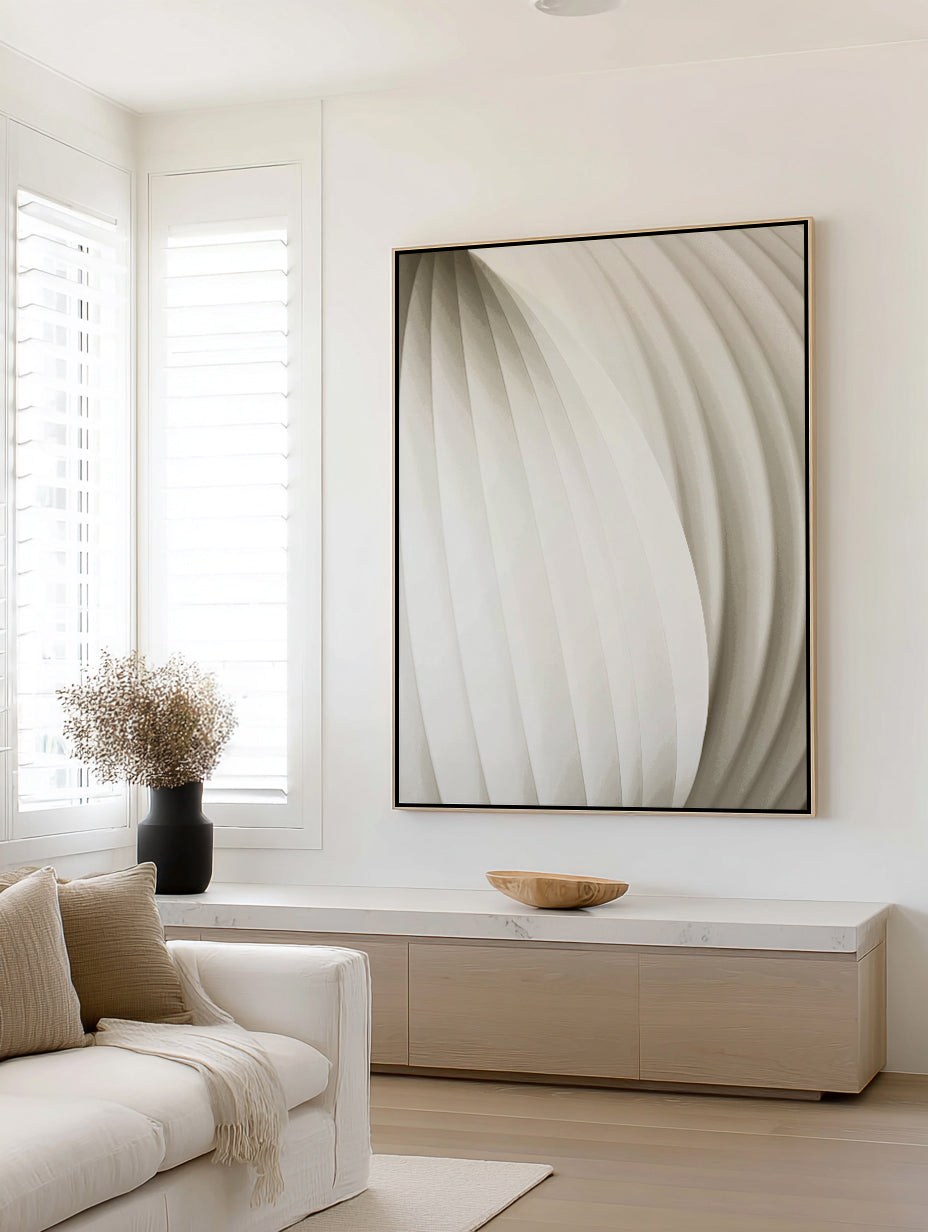
Japandi wall art is the quiet centre of the most sought-after interiors of the year — a fusion of Japanese wabi-sabi and Scandinavian restraint that turns a blank wall into a breath of air. It is the "calm money" aesthetic: considered, tonal, and unmistakably grown-up. If you have landed here because you are styling a Japandi bedroom, living room or studio and want framed canvas art that feels collected rather than decorated, you are in the right place.
This guide is written for people who are genuinely buying. We will cover what makes wall art read as Japandi rather than generic minimalist, the five visual languages the best pieces speak, how to size and hang them, which frame finish to choose, and which of our Japandi framed canvas prints work in which room. No padding, no style-essay detours — just the practical decisions a designer would make on your behalf.
Soft Flowing Curves by Christina Sillen · Paper Studies 11 by Mareike Bohmer · White Sand Dunes by Mei Xu

Soft Flowing Curves by Christina Sillen
What Makes Art "Japandi" — And What Doesn't
Japandi is not simply minimalism with a Japanese accent. It has its own vocabulary, and once you can name the elements, choosing the right framed art print becomes obvious rather than guesswork.
The five signatures to look for:
- Wabi-sabi imperfection: hand-drawn lines, dry-brush marks, paper grain, the sense that a person made this. Machine-smooth gradients and photographic realism sit outside the language.
- Negative space: as much empty canvas as subject. The void is the composition, not a mistake to be filled.
- Organic asymmetry: a single curve, a weighted corner, a floating horizon line. Symmetrical compositions read as Western classical rather than Japandi.
- Muted earth palette: mushroom, oat, fog grey, bone, smoked charcoal, soft terracotta. Saturated colour breaks the spell instantly.
- Handmade texture reference: fibres, paper, clay, ink, stone. Glossy, airbrushed, or digital-looking finishes are the fastest way to miss the brief.
Hold a piece up to those five tests. If it passes four or five, it is genuinely Japandi. If it passes two, it is probably just "minimalist" — a related but different room.
The goal is not to decorate the wall. It is to let the wall breathe, and place one perfect breath inside it.
For the broader style context — furniture, lighting, materials, room planning — our complete guide to Japandi interior design runs the full gamut. This article stays focused on the framed canvas art you hang in that room.
The Five Japandi Art Languages
Across our Japandi wall art collection, every piece belongs to one of five visual languages. Knowing which language a room needs saves you scrolling through hundreds of prints.
1. Abstract line and curve
A single ink line, a sweep of brush, a contour that suggests a figure or a horizon without resolving into one. These are the most versatile Japandi pieces — they hold their own in a bedroom above the bed or behind a console in an entry, and they read elegantly in any of the three frame finishes.

Look at Abstract Brush Strokes 126 by Mareike Bohmer and Soft Flowing Curves by Christina Sillen for the archetype — the gesture is the entire composition.
2. Paper studies and collage
Pieces that reference torn edges, folded paper, or layered neutral rectangles. They carry a slightly architectural quality — think of a Kyoto gallery wall, or a Copenhagen studio. Mareike Bohmer's Paper Studies series is a textbook example of this language.
Paper Studies 18 by Mareike Bohmer · Paper Studies 19 by Mareike Bohmer
3. Botanical minimalism — pampas, dunes, grasses
Softly backlit grasses, a single branch, the suggestion of pampas against fog. This is where Japandi meets coastal calm, and it reads elegantly in bedrooms and bathrooms where a nature reference softens hard surfaces.

Soft Pampas Light is the best single piece in this language — the grasses dissolve into haze, which is precisely the Japandi move.
4. Tonal landscapes and horizons
Dunes, cliffs, shorelines reduced to their tonal essentials. Often two bands of soft colour meeting at a horizon. The power is in the restraint — no figures, no narrative, just the feeling of distance.
Consider Abstract Wave Pattern for a water reference, or browse our coastal wall art collection for the wider language — the most Japandi-sympathetic coastal pieces are the ones stripped of figures and bright blues.
5. Textural and fibre references
Woven surfaces, fibres, raw linen, rope, stone. These pieces are less about an image and more about a material memory. They do the heavy lifting in neutral rooms where you need something on the wall without introducing a subject.

The Fibers No 4 framed canvas is the tactile anchor of this language.
Size and Scale — The Japandi Exception
If you have read mainstream wall art advice, you have been told that art should fill roughly two-thirds of the wall above a bed or sofa. Japandi is the exception. Japandi rooms prize negative space, so you intentionally size down and leave generous breathing room around the piece.
Working rules we use when styling Japandi interiors:
- Single statement piece: 60 to 70 per cent of the furniture width below, never more. Above a king bed (183 cm / 72 in), that means a single framed canvas around 110 to 128 cm (43 to 50 in) wide.
- Pair or trio: combined width no more than 65 per cent of the furniture below, with deliberate gaps between frames (4 to 6 cm / 1.5 to 2.5 in).
- Narrow wall or alcove: a single vertical piece at 40 to 50 per cent of the wall width — the empty space around it is part of the composition.
- Gallery wall (a Japandi rarity): maximum three pieces, strictly aligned on a single invisible axis, no chaotic clusters.
If you are unsure, choose the smaller option. A Japandi room with art that feels slightly understated always reads better than one that feels full.

Frame Finish — Oak, White, or Black
Every framed canvas art print we ship uses a solid timber frame, and you can choose from three finishes. In a Japandi context, the finish is the quiet decision that determines whether the piece leans Japanese, Scandinavian, or contemporary.
- Solid timber frame with oak finish: the Japandi default. Natural timber tone grounds the minimalism, echoes Japanese joinery and Scandinavian furniture, and reads warm in the winter and neutral in the summer. Choose this when the room features oak floors, linen upholstery, or rattan.
- Solid timber frame with white finish: leans Scandinavian. Use in brighter rooms with white walls and pale floors, or in a bathroom where you want the art to lift the light.
- Solid timber frame with black finish: the Japanese architectural edge. Crisp, graphic, and beautiful against off-white limewash or deep charcoal walls. Avoid in rooms that already have heavy dark joinery — it can tip into severe.
What to avoid: ornate mouldings, gilt, weathered distressed finishes, or anything with a profile more than 3 cm (1.2 in) deep. Japandi frames are thin, clean, and quiet.
STILLNESS I by Alma · STILLNESS II by Alma
Room by Room — Where Japandi Wall Art Lives
Japandi is not a one-room aesthetic. Each space has its own rhythm, and the art needs to respond to it.
Japandi bedroom wall art
Above the bed, a single soft piece at roughly 70 to 80 per cent of the bed width is the most elegant move. Pampas, paper studies, or a tonal horizon all work. Avoid a trio above the bed in a Japandi bedroom — it introduces visual rhythm where you want stillness. For a styling cross-reference, our most relaxing bedroom colours guide pairs elegantly with Japandi wall art. Also browse the bedroom wall art collection for the widest set of options.
Japandi living room wall art
Above a sofa, one large piece is the most Japandi choice. If you genuinely need more presence, a considered pair works — but never more than two. Keep the frame finish consistent with surrounding timber. Our living room wall art collection has the widest vertical and horizontal format range.
Japandi entry and hallway
Entries suit a single vertical piece — taller than wide — hung slightly higher than you would in a living room, because viewers see it from further back. A calligraphy-style abstract or a single pampas print is the Japandi entry signature.

Japandi study, reading nook, and home office
Study walls can take slightly more texture and ink, because you are closer to the art when seated. Paper studies and brush-stroke abstracts sit particularly well at eye-level above a timber desk.
Japandi bathroom and powder room
Small framed pieces bring genuine warmth to a stone or concrete bathroom. Keep the piece under 40 cm (16 in) on its longest side, and prefer a piece with handmade texture over photographic imagery. Ensure the frame is well sealed and not in direct splash zone.
Japandi dining room
Dining rooms suit the largest single piece you can comfortably centre on the wall, because the room is used from a seated position and art sits further from the eye. Tonal landscapes excel here.
The Japandi Colour Palette — And Which Pieces Live There
A Japandi room stays inside a tight tonal range. Think of wall art as the piece that sets the temperature of the whole room, and pick its dominant tone with intent.
- Mushroom and oat: the warmest, most forgiving Japandi base. Soft Pampas Light, Subtle Serenity, and the Rituals series live here.
- Fog grey and bone: the cooler Scandinavian register. Paper Studies pieces and Minimalistic Moon read elegantly in this palette.
- Soft charcoal and ink: the Japanese architectural register. Abstract Brush Strokes and Sumiya I bring this tone forward.
- Soft terracotta and clay: the warm accent register. Use sparingly — a single piece in this tone in an otherwise neutral room.
- Smoked sage: the most considered Japandi green, pulling equally from Japanese tea ceremony and Scandinavian summerhouse.
For a broader colour vocabulary, our mushroom and greige colour palette guide and our warm minimalism style guide are the two most useful companion reads — Japandi sits exactly at the intersection of the two.

Building a Japandi Gallery Wall (Without Breaking the Language)
Japandi galleries are rare, and when they work they follow very specific rules. If you are considering more than one piece on a single wall, here is the designer's shortlist.
- Maximum three pieces. Two is ideal. Four tips the room into eclectic.
- Single visual axis. Align tops or centres on an invisible horizontal line. No scattered arrangements, no stacked clusters.
- Same frame finish across every piece. The frame is the thread that holds the grouping together — mixing finishes breaks the Japandi language instantly.
- One visual language, or two sympathetic ones. A pair of paper studies works. Paper studies plus a floral photograph does not.
- Generous spacing. 4 to 6 cm (1.5 to 2.5 in) between frames. Any tighter and the grouping reads as one piece; any wider and it reads as two.
If you want a matched pair that does all of this for you, our matching wall art print sets collection pre-pairs pieces designed to hang together.
What Japandi Wall Art Is Not
The fastest way to ruin a Japandi room is the wrong piece of art. If you see any of the following, keep scrolling.
- Ornate or tropical florals, bright photographic blooms, or anything with saturated botanical colour.
- Bright primary colours, high-contrast pop art, or neon accents.
- Glossy, airbrushed, or overtly digital-looking finishes.
- Photographic realism — a Japandi room prefers suggestion and abstraction to documentation.
- Anything "busy" — dense pattern, detailed illustration, or compositions that fill every corner.
- Ornate frames — gilt, baroque mouldings, deep carved profiles. Japandi frames are thin, clean, and quiet.
- Mismatched frame finishes across a single wall or room.
For contrast, if your room leans more graphic or high-contrast, browse our abstract art collection — beautiful pieces, but a different conversation.
Commissioning Custom Japandi Art
If none of the available pieces match your exact brief — a specific photograph, a personal mood reference, a bespoke sized piece for an unusual wall — we print custom artwork on framed canvas at any size. Send a reference image and dimensions via our custom wallpaper and art service, and we will print it on canvas in your chosen frame finish. Turnaround is typically four to five business days, and every order ships with all import duties paid globally.

Sizing for Australian Homes — And Everywhere Else
Australian homes run wider than European apartments but lower than typical US new-builds, which changes the numbers slightly. These are the sizes we recommend most often.
- Apartment living room (2.4 m / 7.9 ft ceilings): single piece 90 to 110 cm (35 to 43 in) wide above a three-seater sofa.
- Detached home living room (2.7 to 3.0 m / 8.9 to 9.8 ft ceilings): single piece 120 to 140 cm (47 to 55 in) wide, or a pair totalling 140 to 160 cm (55 to 63 in).
- Queenslander or period home (3.0 m+ ceilings): size up the single piece to 150 cm (59 in) or consider a vertical piece at 120 cm (47 in) tall to respect the height.
- Master bedroom above a king bed: single piece 110 to 130 cm (43 to 51 in) wide, centred, bottom edge 20 cm (8 in) above the bedhead.
- Bedroom in a smaller apartment above a queen bed: 90 to 110 cm (35 to 43 in) wide.
- Hallway or entry: 50 to 70 cm (20 to 28 in) wide vertical piece, centred at 150 cm (59 in) from the floor to the middle of the piece.
For every other dimension question — framing around cornices, raked ceilings, pendant lights — our how to hang wall art page covers the installation detail and has the eye-level measurements for different viewing positions.
Hanging Japandi Art — Precision Matters
Japandi is unforgiving of sloppy installation. Because the room is quiet, any hanging error reads loud. Three rules we never break:
- Eye-level math: 150 cm (59 in) from the floor to the centre of the piece in standing rooms. 10 cm (4 in) above the bedhead bottom edge in bedrooms. Centre over the mid-point of the furniture below, not the mid-point of the wall.
- Level to within 1 mm: use a spirit level or a laser line — Japandi rooms show tilt instantly because the room has so few other lines competing for attention.
- Dead-centre on the wall it lives on: measure both sides from the frame edge to the nearest corner, not just eyeball it. Off-centre by even 3 cm looks like a mistake in a Japandi room.
For the full walk-through including hanging hardware recommendations and the full eye-level formula, the how to hang wall art page is the reference. It covers plaster, brick, timber and drywall.
Pairing Japandi Wall Art with Wallpaper
Many of our Japandi customers pair framed canvas art with a quiet wallpaper on the same wall — a textured oat-tone mural, a tonal dune photograph, a grasscloth-look print. The rule is simple: the wallpaper becomes the backdrop, and the art becomes the object. Never let both compete. If you go this route, order the $4.99 sample (48 cm x 40 cm / 19 in x 16 in) of any wallpaper before committing — the tone reads very differently in real light than on screen.
Why Buy Japandi Wall Art from Olive et Oriel
We have been producing framed canvas art on the Central Coast of New South Wales for over a decade. Every Japandi framed canvas print ships globally with all import duties paid — there are no surprise fees on arrival, anywhere. Production runs four business days on full-price orders, and our solid timber frames are finished in-house in oak, white, or black. For an Australian buyer, that means fast delivery and no customs friction. For an international buyer, it means an Australian-made piece at a landed price, no add-ons.
If you want the full visual context of the style — furniture, lighting, materials — our Japandi interior design guide is the companion read. If you lean slightly more Nordic in taste, our Scandinavian interior design guide covers the lighter, brighter end of the spectrum. For broader affordable framed art beyond Japandi specifically, browse our affordable wall art collection.
Frequently Asked Questions
What makes wall art "Japandi" rather than just minimalist?
Japandi wall art combines five specific elements: wabi-sabi imperfection (hand-drawn marks, paper grain), generous negative space, organic asymmetry, a muted earth palette (mushroom, oat, fog, charcoal, soft terracotta), and a reference to handmade materials like paper, ink, fibre, or clay. Minimalist art shares the restraint but often lacks the warmth and tactile texture that make a piece read as genuinely Japandi.
Which rooms suit Japandi wall art best?
Japandi wall art works in every room of the home, but it is most transformative in bedrooms (a single soft piece above the bed), living rooms (one large statement or a careful pair above the sofa), entries (a single vertical piece), and studies. It also excels in bathrooms where a small framed canvas adds warmth to stone and concrete.
What size should Japandi wall art be above a bed?
Size down from typical wall art guidance. Above a king bed (183 cm / 72 in), a single framed canvas 110 to 130 cm (43 to 51 in) wide is ideal. Above a queen bed, aim for 90 to 110 cm (35 to 43 in). Centre the piece over the bed and hang the bottom edge around 20 cm (8 in) above the bedhead.
What colours work in Japandi wall art?
Stay inside a muted earth palette: mushroom, oat, bone, fog grey, soft charcoal, ink, soft terracotta, and smoked sage. Saturated colours, bright blues, and high-contrast pop tones break the Japandi language immediately.
Which frame finish is most Japandi — oak, white, or black?
A solid timber frame with oak finish is the Japandi default — the natural tone grounds the minimalism and echoes both Japanese joinery and Scandinavian furniture. Choose the white finish for Scandi-leaning rooms with pale floors, and the black finish for the Japanese architectural edge against off-white or charcoal walls. Avoid ornate or deep profile frames entirely.
Can I mix Japandi wall art with wallpaper?
Yes — in fact, a quiet tonal wallpaper behind Japandi framed art is a designer-favourite layered move. The rule is to let the wallpaper be the backdrop and the art be the object, never both competing. Always order a $4.99 sample of the wallpaper before committing — the tone reads differently in real light. For inspiration, start with our Japandi interior design guide.
Is Japandi wall art made in Australia?
Our Japandi framed canvas prints are produced on the Central Coast of New South Wales. We print on canvas, stretch and mount in-house, and finish the solid timber frames in oak, white, or black. Every order ships globally with all import duties paid — there are no customs surprises on arrival, regardless of destination.
What is the shipping timeline for Japandi wall art?
Full-price framed canvas art is produced in four business days. After production, Australian metro delivery is one to three business days; international shipping runs five to ten business days depending on destination. All duties and taxes are included in the price you see on our site — no extra charges on delivery, anywhere in the world.
Start Styling Your Japandi Room
Browse the full Japandi wall art collection to see every piece discussed in this guide. For a matched pair or trio, our matching wall art print sets solve the alignment problem for you. If your budget is the driver, the affordable wall art collection includes multiple Japandi-friendly pieces at lower price points. And if you need something custom — a specific image, an unusual size, a personal mood reference — our custom art and wallpaper service prints on canvas at any size in any frame finish.


