

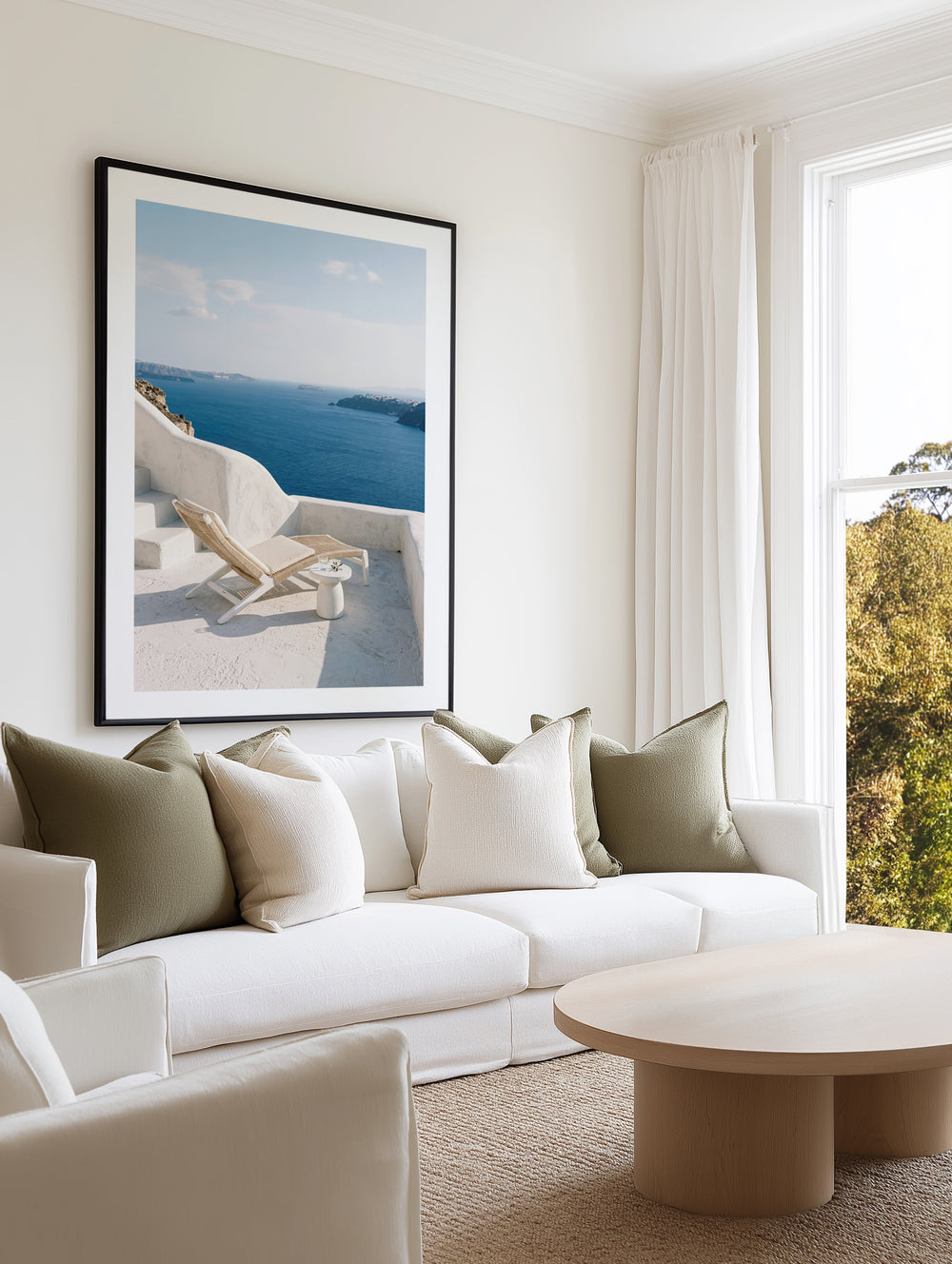
Coastal is Australia's default decorating language and also its most abused one, a look that swings between genuinely transporting and gift-shop nautical with nothing in between. The difference is editorial, not budgetary: which coast, which light, and how literal. This is the complete guide to buying coastal wall art that reads as considered, from a company on the Central Coast whose print floor is twenty minutes from the beach.
The coastal collection is our largest and longest-running range for a reason: it is what Australian walls ask for. Buying it well is what this guide is for.


Santorini Sun Lounger · Sea & Stone · Whitewashed Archway
The Three Coastal Styles
Coastal art splits into three families, and knowing which one a room wants prevents most misfires. Photographic coast is literal and place-based: surf lines, tidal flats, headlands. It brings a documentary calm and suits rooms that want a window more than a mood. Mediterranean coast, the Santorini-and-Aegean school of whitewash, pools and hard shadow, is aspirational and warm; it suits social rooms, dining zones and anywhere that hosts. Abstract coast carries the palette without the postcard: sea-glass blues, sand fields, salt-white brushwork. It is the most versatile of the three, at home in bedrooms and formal rooms where a literal beach would feel casual.
Rooms can mix these styles under the same rule that governs all mixing: one thread held constant. A photographic surf pair and a sea-toned abstract share a wall happily when the blues agree and the frames match; they argue when the photograph runs cool and the abstract runs warm. Blues have temperature, and matching it is the coastal buyer's one technical skill worth learning.
The coast is a palette and a light, not a props department.
Cliche Control: The Line Between Coastal and Kitsch
Every style has its failure mode, and coastal's is literalism stacked on literalism: the anchor motif beside the rope frame beside the shell arrangement beneath the BEACH letters. Each element is harmless; the accumulation is the theme park. The working rule from a decade of coastal orders: let exactly one thing in the room say "beach" out loud, and let everything else say it quietly through palette and material. One strong shoreline photograph plus linen, pale timber and sand tones out-coasts any amount of nautical merchandise.
The elevated version, what gets called coastal luxe, is mostly subtraction. Fewer, larger pieces; deeper blues over brighter ones; abstraction over depiction in the formal rooms; and genuine photographic art over generic stock imagery, the fine art photography range exists for exactly this job. Our coastal luxe guide maps the whole aesthetic; the art rules above are its wall chapter.


Aegean Blue Pool I · Aegean Blue Pool II
Room by Room
Bathrooms take coastal most naturally, water imagery belongs near water, and an A3 pair or single A2 above the bath is the classic placement, drawn from the bathroom decor range; the bathroom guide covers the humidity practicalities. Bedrooms want the calm end: misty shorelines, pale abstraction, the soft blues of the calming collection that settles a room, hung per the bedroom rules, low contrast, no glare, one statement then restraint. Living rooms carry the scale: a 70x100 seascape or a Mediterranean scene where the room needs warmth, keyed to the room's timber and linen rather than to a blue sofa.
The hallway deserves its own mention because coastal photography owns it in Australian homes: three or four shots in identical frames, even spacing, one horizon line running through them, the corridor becomes a gallery walk to the bedrooms, and the framing rules are in the framed art guide. And for the entry, one Mediterranean archway or pool scene sets an entire home's tone from the front door, arrival imagery for the arrival point, and the piece guests mention on the way out.


Aegean Escape I · Aegean Escape II
Series Thinking: Why Coastal Buys Best in Multiples
More than any other style, coastal art is series art. The sea photographs in sequences, the same water in changing light, and the strongest coastal walls use that: a pair from one series above the bed, a trio down the hall, the sets and pairs range arranged as one composition. Series work solves the temperature-matching problem automatically, one artist, one session, one blue, and it produces the rhythm that single mixed pieces struggle to fake.
The Aegean and pool sequences we print are bought in pairs roughly twice as often as singly, and the pair placements photograph better in every customer submission we receive. If the budget forces a choice between one larger single and a smaller matched pair, the pair wins on most coastal walls. Coastal is about horizontal rhythm, the water repeating, and two works make that point where one cannot. Hang coastal pairs slightly tighter than the standard, 5cm rather than 8, so the horizon reads continuous across the gap. It is a small adjustment with a visible payoff.
The Australian Light Problem (and Coastal's Answer)
Strong Australian light flattens delicate art, but it feeds coastal art, because these palettes were drawn from this light in the first place. Bright north-facing rooms that wash out pale minimalism make sea-blues sing; harsh western sun that punishes cool greys flatters sand-and-terracotta coastal warmth. It is the style most forgiving of the light Australian rooms actually have, which, beneath all the styling talk, is the practical reason it never leaves fashion here.
The one light rule: keep photographic work with fine water detail out of hours of direct hard sun, position it across from windows rather than beside them, as with all art. Archival pigment printing holds colour for decades, ours is guaranteed for it, but every artwork looks its best lit obliquely, and water detail especially rewards it.
Coastal Beyond the Coast: The Inland Room
The strongest demand for coastal art comes from postcodes without a beach, and the logic is sound: a sea horizon is a window where the architecture provides none. A western Sydney living room or a Canberra bedroom gains from a sea horizon exactly what it lacks, distance, light, the suggestion of air moving. No other kind of art performs that trick as reliably. Inland placement favours the atmospheric end: horizon abstraction and open-water photography over busy beach scenes, because the room is borrowing space, not documenting a holiday.
Holiday memory is the other inland driver, and it deserves honest handling. A print of the actual coastline you return to every January carries private meaning no stock beach can, which argues for choosing photographic work by place, our Australian landscape photography is organised by state and coastline for exactly this reason, and it is why the same image sells in clusters in the towns that holiday at that beach. Meaning is a styling material too; a wall that holds your own coast never rotates out, it accrues, each summer adding a layer the print quietly keeps, which is more than can be said for any passing trend.
The Coastal Buying Sequence
- Choose the style first: photographic, Mediterranean or abstract, decided by the room's formality and how literal you can stand daily.
- Match blue temperature second: hold your shortlist side by side on screen; warm aqua and cool navy do not share walls gracefully.
- Buy in series where the wall allows: pairs and trios out-perform mixed singles in coastal specifically.
- Scale by the standard rules: two-thirds of the furniture below, half the open wall, centre at 145cm, per the sizing guide.
- Preview the smallest size if torn: every work prints on the same archival stock at every size, so the A5, from $9.95, is an honest preview of the statement version.
Hamptons, Coastal Luxe and the Styles Next Door
Coastal borders several styles worth knowing by name, because the differences decide purchases. Hamptons is coastal formalised: navy over aqua, symmetry over spontaneity, and framing that leans black or crisp white; the Hamptons range suits homes whose architecture already carries panelling, shaker profiles and structured furniture. Coastal luxe is coastal quieted: deeper palettes, larger formats, more abstraction, less depiction. And Australian coastal proper, the style this guide mostly serves, is the loosest and warmest of the three, sand before white, eucalyptus notes allowed, surf photography welcome.
Homes rarely need to choose purely, but each room should. An entry can run Hamptons formality, the living room Australian coastal, the ensuite pure abstraction, provided the blues stay in temperature agreement as sightlines connect the rooms. What fails is whiplash inside one sightline: a formal navy Hamptons wall staring at a bright aqua surf collage reads as two houses arguing. Walk the sightlines before finalising any multi-room coastal plan; the hallway usually votes.
Canvas, Panoramics and the Formats the Sea Prefers
Coastal has format preferences worth honouring. Horizon works (open water, shoreline bands, sunset fields) were composed wide and want wide formats: the panoramic and the landscape-orientation large piece, where the horizon can run uninterrupted the way it does in fact. Cropping a horizon into a portrait frame fights the subject. Painterly seascape abstraction, meanwhile, moves to canvas more gracefully than almost any other genre; the weave reads as the physicality the brushwork implies, and at statement scale, canvas keeps the big coastal piece light enough for any wall.
Photography stays behind glazing as a rule, water detail rewards the crispness, with one exception: the very large photographic statement, where glazing at scale brings weight and reflection problems, and a canvas or framed-canvas finish trades a little crispness for a lot of practicality. For bathrooms, framed prints win outright as covered above. None of these preferences are laws, but they are the way the orders run when customers buy a second coastal piece, the format lessons get learned on the first one.
Frequently Asked Questions
What is coastal wall art?
Work that carries the coast's light and materials: ocean and beach photography, Mediterranean scenes, seascape abstraction, and the sand-salt-sky palette applied to any subject. It ranges from literal, waves and jetties, to purely atmospheric, a blue-and-bone abstract that reads as morning swim without depicting one.
How do I do coastal without the cliches?
Skip the anchors, ropes and BEACH lettering entirely and let palette do the work. One confident photographic or abstract piece in sea tones says coast more convincingly than a wall of nautical props, restraint is what separates coastal-luxe from theme-park.
What rooms suit coastal art best?
Bathrooms and ensuites naturally, bedrooms for the calm end of the palette, and living rooms where the palette cools strong Australian light. Coastal photography also owns the hallway run: three surf or shoreline photographs in identical frames is the classic Australian corridor.
Does coastal art only suit beach houses?
No, and its biggest audience is nowhere near the water. A sea-toned artwork in a suburban or inner-city room does what a window cannot: it opens the wall. The pieces work harder inland, not less.
What palette goes with coastal prints?
Warm sand neutrals, whites, pale timber and linen as the base; the art supplies blues from aqua to ink. Keep other strong colours scarce, coastal schemes fail by addition, one competing red and the calm collapses.
Framed prints or canvas for coastal art?
Photography suits framed prints, glazing gives water detail its crispness. Painterly seascape abstraction suits canvas, especially at scale. In bathrooms and humid coastal homes, properly framed prints handle the environment well away from direct splash zones.
What sizes work for coastal walls?
Coastal scales: A3 pairs in bathrooms, 50x70 and 70x100 in bedrooms and living rooms, panoramic formats for the horizon-line works they were made for. Series work in matching sizes builds the strongest coastal walls.
Start in the coastal collection, refine through Hamptons wall art and fine art photography, or build a wall from the pairs and sets. Printed on archival stock and framed in solid timber at West Gosford, shipped ready to hang worldwide, from a print floor that checks its own blues against the real thing at lunchtime.


