

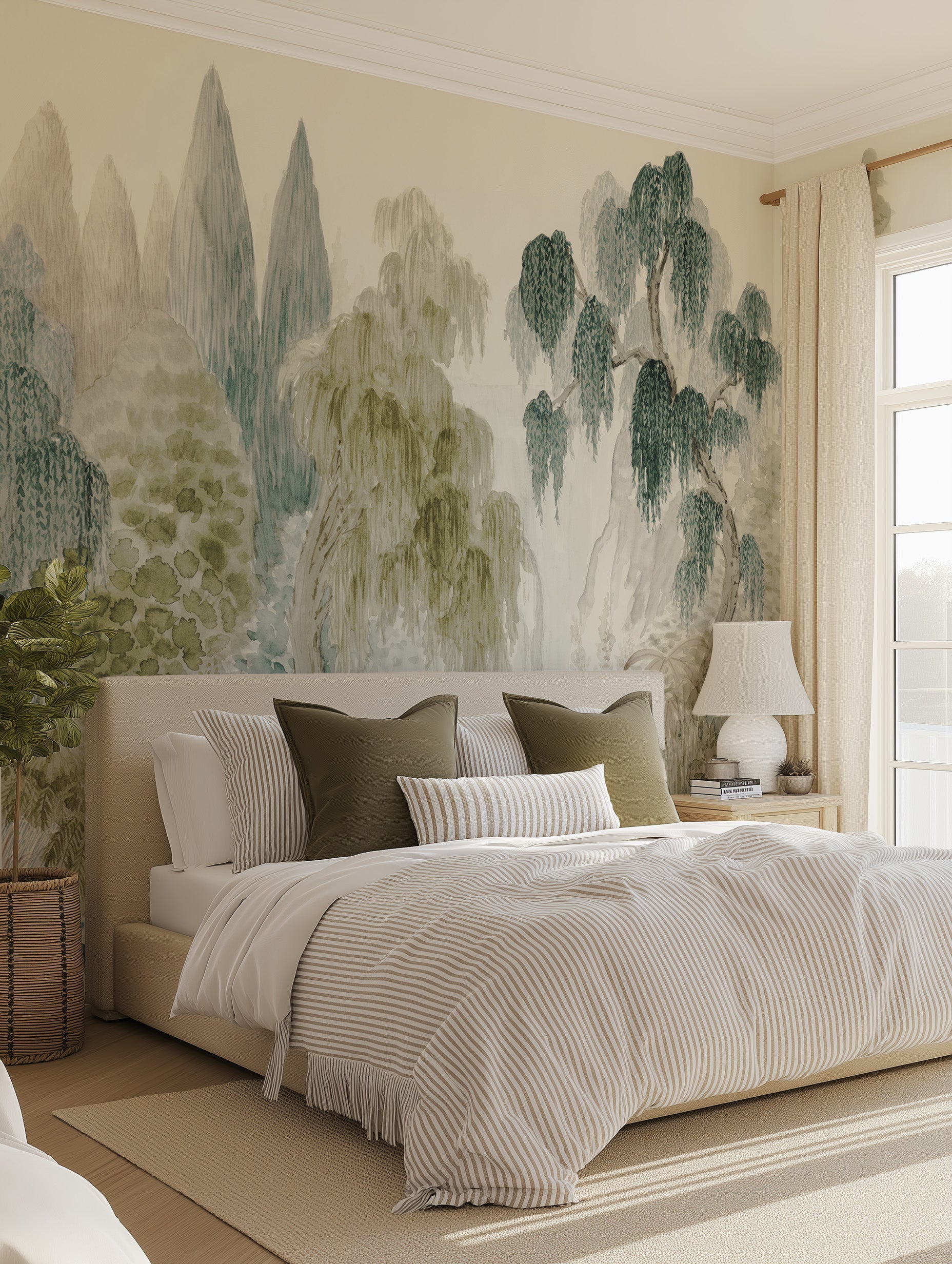
A mural and a repeat pattern wallpaper arrive in the same box, print on the same presses and hang with the same paste, yet they do opposite jobs on a wall. A mural is one single artwork scaled to your exact wall: a landscape, a painted sky, a garden scene that begins at one corner and finishes at the other, never repeating. A repeat pattern is a motif engineered to tile seamlessly in every direction: the trellis, the floral sprig, the lattice that reads as texture across the whole surface. Choosing between them is the first real decision in any wallpaper project, and it changes how the room feels, how the install goes and even which wall you should choose. This guide covers the difference properly, from design behaviour to measuring, cost and installation, so the roll that arrives is the right one.
We have printed both formats for more than ten years from our facilities in West Gosford on the NSW Central Coast, shipping to homes in over 40 countries with all import duties paid, so the comparison below comes from the production floor rather than theory. Both formats are made to measure here, which removes the biggest traditional difference (waste and leftover rolls) and leaves the decision where it belongs: on design.


Japandi Garden Panoramic Painted Mural Wallpaper · Aspen Sky Panoramic Painted Mural Wallpaper · Les Jardin Panoramic Painted Mural Wallpaper
What Is a Wall Mural?
A wall mural is a single continuous image produced at the size of your wall. Nothing repeats: the tree that appears on the left side of the design appears exactly once, and the composition is arranged across the full width the way a painting is arranged across a canvas. Because the image must fit the wall precisely, a mural from our wall murals collection is manufactured to your measurements, supplied in numbered 48cm (19 inch) panels that hang in sequence like pages of a book. The artwork is mapped onto your dimensions before printing, and our team adjusts scale and crop so the important parts of the scene land where you will actually see them, above the bedhead rather than behind the wardrobe. Complimentary colour and scale customisation is part of the service, because a mural is closer to commissioning an artwork than buying a roll.
The design language of murals runs to the scenic and the atmospheric: panoramic landscapes, painted skies, oversized botanicals, vintage tapestry scenes, watercolour horizons. The panoramic format guide covers the same visual logic in framed art: one wide image resolving one wide wall.
What Is Repeat Pattern Wallpaper?
Repeat pattern wallpaper is a motif designed to tile invisibly. The design is engineered so that when one drop hangs beside the next, the pattern flows across the seam without a visible join: the vine keeps climbing, the lattice keeps weaving, and the eye reads the wall as a single textured surface. The repeat is the distance before the motif recurs, and it is the reason a pattern can cover one feature wall or four walls of a powder room with the same roll of artwork. Everything in our main wallpaper collection that is not a mural works this way, from small-scale ditsy florals to bold oversized botanicals like those in the floral wallpaper guide.
Because the pattern is infinite by design, repeat wallpaper does not care how wide the wall is or how many windows interrupt it. It behaves like paint with personality: a surface treatment rather than a picture.
A mural is a destination: the wall becomes the artwork. A repeat pattern is an atmosphere: the wall becomes the backdrop. Decide which job the room needs before you fall for a design.
The Five Differences That Actually Matter
- One image versus infinite surface: a mural is a composition with a focal point, so it rewards an uninterrupted wall where the whole scene stays visible. A repeat pattern has no focal point by design, so it forgives doors, windows, bulkheads and switchplates: the pattern simply continues around them.
- Scale behaviour: murals are scaled to your wall, so the mountains stay mountain-sized whether the wall is 2.4m or 4.8m wide. A repeat pattern's motif stays the same physical size regardless of the wall, which is why a small sprig can disappear on a large wall and a giant motif can overwhelm a small one. The fix on our floor: we can adjust repeat scale on request as part of complimentary customisation.
- Focal command versus flexibility: a mural fixes the room's centre of gravity permanently to that wall, which is a commitment: furniture, art and lighting will all defer to it. A repeat pattern leaves the hierarchy open, so you can hang framed art over it, move the bed, or restyle the room without the wall arguing.
- The interruption test: count what breaks up the wall. A wall carrying two windows and a door chops a mural's composition into slices; the same wall wearing a repeat pattern looks intentional. Clean uninterrupted walls are mural territory.
- Reading distance: murals are composed to be read from across the room, like a view. Repeat patterns hold up at every distance, including the 30cm hallway pass-by, because there is no composition to stand back from.


Boheme Cheetah in Peach Wallpaper · Boheme Cheetah in Olive Green Wallpaper
Room by Room: Which One Wins
- Living room: the mural's home ground if you have one commanding wall behind the sofa or media unit. Choose a repeat if the room is open plan and the wallpapered wall reads from several angles, as covered in the feature wall guide.
- Bedroom: both formats work behind the bed. A mural turns the bedhead wall into a permanent horizon (painted skies and landscapes are the calmest choices); a repeat from the bedroom wallpaper collection keeps the room flexible and layers happily behind framed art.
- Nursery and kids' rooms: murals win childhood imaginations (a jungle scene, a map of the world, a sky of clouds), and the kids wallpaper and nursery murals collection carries both formats. Repeats age more gracefully through the teenage renovation years.
- Hallways and entries: repeat patterns, almost always. Hallway walls are viewed at close range while moving, interrupted by doorways, and too narrow to stand back from a composition.
- Powder rooms and bathrooms: either, and this is where murals surprise people: a small windowless powder room with one clean wall is a jewel box for a dramatic scene. Use the Paste the Wall Smooth finish here, which is water and humidity resistant.
- Dining rooms and studies: murals suit rooms where people sit still and look at the same wall for an hour. A repeat suits the study wall that sits behind you on video calls: presence without a scene competing for attention.
Cost, Measuring and Ordering: Less Different Than You Think
Traditionally murals cost more because repeats were sold in fixed rolls and murals were custom jobs. Because we manufacture both to your exact wall measurements, the price structure is the same for both formats: you pay for your wall's dimensions, not for a standard roll size that forces you to buy a quarter more than you need. Both arrive as numbered 48cm panels; both are printed on the same PVC-free, VOC-free stocks, fire-rated to Australian standards. The measuring process is identical too, and worth doing carefully: width at the widest point, height at the tallest, measured in two places because walls are rarely square. Our measuring guide walks through it in five minutes, and if your project needs something the catalogue does not show, the custom wallpaper service can print your own artwork or adjust any design, as the made to measure guide explains in full.
The one ordering difference that matters: with a mural, over-order height and width slightly (we build in trim allowance) because there is no spare roll to cut a patch from later. With a repeat, pattern-matched trim is built into the drop layout we supply. Either way, order the $4.99 sample first: 48cm x 40cm (19in x 16in), printed on the actual stock, large enough to show a mural's texture and a repeat's true motif size on your wall through a real day of light.


Vintage Garden Panoramic Painted Mural Wallpaper · Palisade Blue Palms Wallpaper Mural · Gilded Valley Wallpaper Mural
Installation: What Changes Between the Two
The mechanics are the same: both formats hang in either Peel and Stick (repositionable, removes cleanly, the renter's format covered in the peel and stick versus paste-the-wall guide) or Paste the Wall Smooth (permanent, humidity resistant), with Commercial Vinyl available for hospitality and commercial fitouts. The difference is sequencing. A mural's panels are numbered and must hang in order, level from panel one, because every panel is a different slice of the image: there is no hiding a crooked start. A repeat pattern is more forgiving of where you begin but asks you to match the pattern at every seam, aligning the motif drop by drop. Neither is beyond a patient DIYer with a weekend: the paste-the-wall installation guide and the peel and stick wall preparation guide cover both formats step by step. For stairwells, double-height voids or walls over 3m, the installer directory lists professionals who hang murals weekly.
Production and delivery are identical for both: printed to order in about 4 business days on full price orders, dispatched from the Central Coast, delivered worldwide with duties paid so there are no surprise fees at the border.
Designer Tips
- Order the $4.99 sample (48cm x 40cm) before committing either way. For murals it proves colour and texture; for repeats it shows the motif at true size, which is the thing screens misjudge most.
- Photograph your wall straight-on and study the interruptions. Two or more openings usually means repeat pattern; one clean wall means the mural is on the table.
- For murals, decide what furniture sits against the wall first. We adjust the crop so the scene's key moment lands above the sofa line, not behind it.
- For repeats, match motif scale to viewing distance: small repeats for hallways read as texture, oversized repeats for large walls read as intention.
- In humid rooms choose Paste the Wall Smooth for either format; in rentals choose Peel and Stick and keep your bond.
- If you love a repeat pattern but want mural drama, scale it up: complimentary scale customisation can enlarge a motif until one bloom spans half the wall.
Frequently Asked Questions
What is the main difference between a wall mural and repeat pattern wallpaper?
A mural is one continuous artwork printed at the size of your wall with nothing repeating, like a giant painting. A repeat pattern is a motif engineered to tile seamlessly in every direction, covering any amount of wall as a continuous surface. Murals create a focal point; repeats create atmosphere.
Is a mural more expensive than repeat wallpaper?
Not from a made-to-measure manufacturer. Because we print both formats to your exact wall dimensions in the same 48cm panels on the same stocks, the price structure is identical: you pay for your wall size, not a fixed roll count.
Can a mural work on a wall with windows or doors?
It can, but openings slice the composition, so the scene must be mapped around them before printing (which we do from your measurements). Walls with two or more interruptions usually suit a repeat pattern better, since the pattern simply continues around openings.
Which is easier to install?
They are comparable. A mural's numbered panels hang in strict sequence and reward a level first panel; a repeat asks you to match the motif at each seam. Both hang as Peel and Stick or Paste the Wall Smooth, and both are manageable DIY on standard-height walls.
Which is better for a rental?
Either, in Peel and Stick: it is repositionable and removes without damage. Renters often choose repeats for flexibility, but a peel and stick mural is one of the few ways to transform a rental completely and take the transformation back down at the end of the lease.
Do murals and repeat wallpapers use different materials?
No. Both print on the same PVC-free, VOC-free stocks, fire-rated to Australian standards, in Peel and Stick, Paste the Wall Smooth and Commercial Vinyl finishes. The difference is the artwork's behaviour, not the material.
Can I see either format before ordering a full wall?
Yes. Samples are $4.99 at 48cm x 40cm (19in x 16in), printed on the actual stock. Tape one to the wall and watch it across a full day of light before ordering.
How long does a made to measure mural take to arrive?
Both formats are printed to order in about 4 business days on full price orders from our NSW Central Coast facilities, then shipped Australia-wide and to more than 40 countries with all import duties paid.
Start where the room points you: browse the wall murals collection for the single-scene walls, the full wallpaper collection for repeats, or the green wallpaper range if the palette is already decided. Measure once, sample first, and the wall will tell you which format it wanted all along.


