

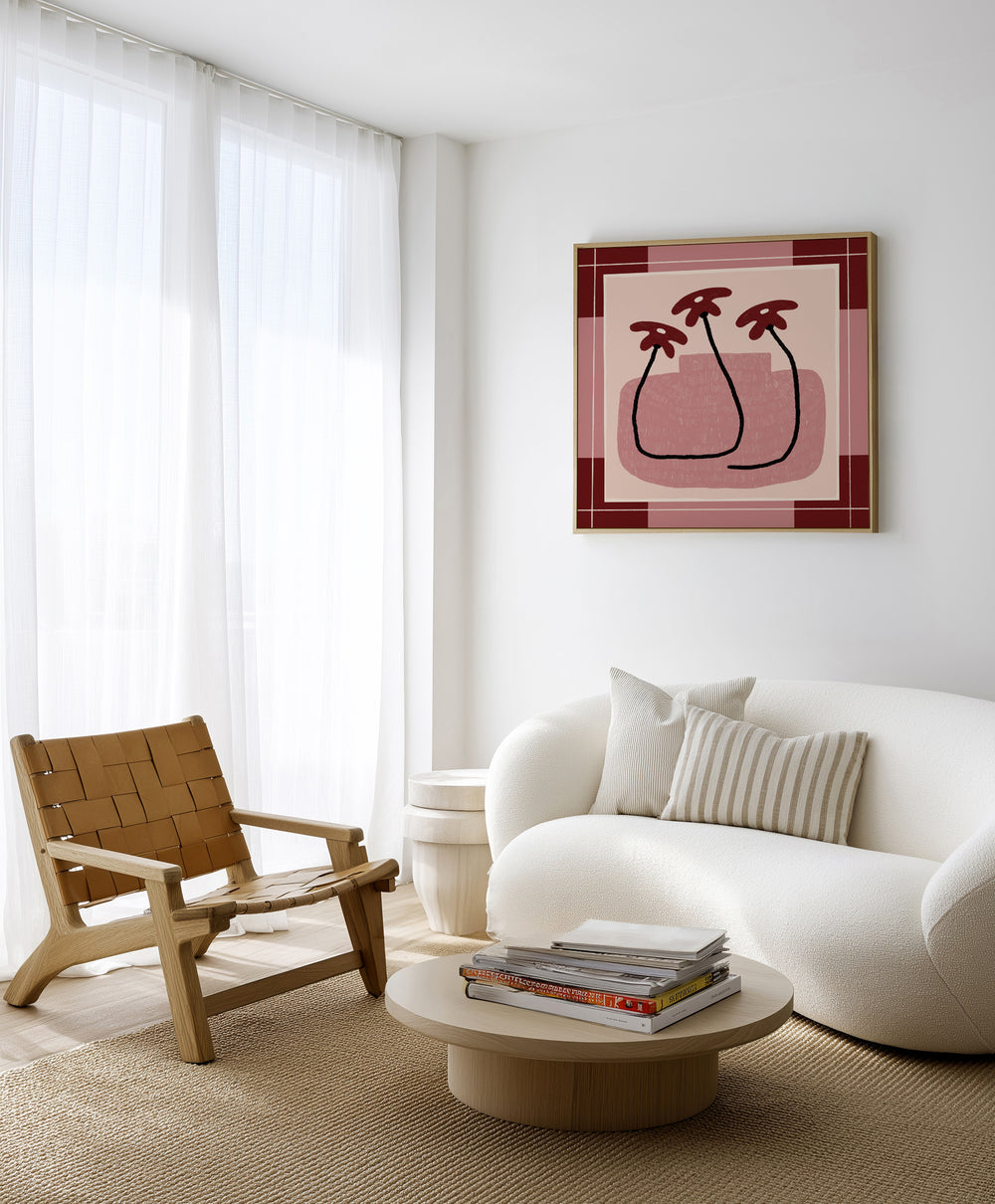
The living room is where art spending either pays off daily or quietly disappoints for years, and the difference is almost never taste. It is method: scale, height, format and palette, applied in the right order. This is the complete buying guide for the room guests judge and households actually live in, from the people who print and frame living room walls every working day.
Our living room collection is printed on archival stock and framed in solid timber at our West Gosford facilities; everything below is the advice we give across the counter with it.


Beyond The Vase Bloom 5 by Shatha Al Dafai · Sketched Form I Square Art Print · Flowering Pastels by Dani Heyward
Scale First: The Decision That Decides the Rest
Get the size right and an average artwork looks intentional; get it wrong and a masterpiece looks like an apology. The living room arithmetic is settled: above a sofa, art should span two-thirds to three-quarters of the sofa's width, a 2.4m sofa wants roughly 160 to 180cm of artwork, which is a 70x100 at minimum, a pair hung tight, or a genuine statement piece. On open walls, the artwork claims half to two-thirds of the visible width between interruptions. Anything less reads as a placeholder, and the room never quite settles, visitors cannot name what is wrong, but the wall tells them something was left unfinished.
Blue-tape the outline on the wall before buying and live with it for an evening; it is the five-minute discipline that prevents the one regret this room produces. When the tape looks slightly too big, it is right, ten years of "I wish I'd gone bigger" emails and effectively none in the other direction is the clearest data we own. The full method, including ceiling-height adjustments, lives in the large wall art guide.
Nobody has ever regretted the bigger artwork. The regret mail is uniformly about the smaller one.
Height: The Free Fix Most Rooms Need
Half the living rooms in customer photos would improve tonight with no purchase at all, just a rehang. The standard: centre of the artwork at 145cm from the floor. Hung above a sofa, the frame's bottom edge sits 15 to 25cm above the backrest, close enough that sofa and art read as one composed unit rather than strangers sharing a wall. Most Australian living rooms hang art a full 20 to 30cm too high, a hangover from standing-height instincts in a room experienced seated; galleries hang low for the same reason museums put benches in front of paintings, the art meets the resting eye.
The height guide has the numbers for every scenario, but the sofa-wall rule alone fixes most rooms. If your art currently floats in the top third of the wall with a band of empty plaster between it and the furniture, that band is the problem, and it costs one new hook to solve, tonight, before you spend a dollar on anything new.


Beyond The Vase Bloom 7 by Shatha Al Dafai · Duo No 2 Square Art Print
Format: Reading the Room's Light
Living rooms have the most complex light in the house, windows, downlights, lamps, screens, and format should answer it. The wall opposite the main window is reflection territory: glazed frames there hand you the garden's glare all afternoon, which makes it the natural canvas wall. Softly lit walls, and any wall the lamps rake obliquely, flatter framed prints from the framed range, where glazing adds a jewel-box finish to detailed work.
Mixing formats in one room works under the palette-thread rule: keep one colour note and one frame finish consistent and canvas can live beside framed paper without a seam. The format guide runs the full decision tree wall by wall.
Palette: Key to the Bones, Not the Cushions
The most expensive living room mistake is matching art to the current sofa, because sofas turn over every seven years and good art does not. Key the artwork to the room's permanent materials instead: the floor timber, the rug's base note, the stone or brick, the window joinery. Art chosen against those bones survives every furniture cycle and recolours the room each time the textiles change around it, the same abstract reads fresh against three successive sofas if it was never the sofa's echo in the first place.
Australian living rooms lean warm, timber floors, warm whites, sisal and linen, which is why warm-neutral abstraction from the neutrals collection and earth-toned landscape work anchor so many of them. Rooms with cooler bones, concrete, grey stone, black steel, take the monochrome range and blue-led work with more grace. One colour from the bones, repeated once in the art: that is the entire trick, and it is why the same artwork can look mediocre in the showroom and inevitable in your room, or the reverse.


Wild Orchids II · Beyond The Vase Bloom 9 by Shatha Al Dafai
The Three Living Room Wall Plans
- The single anchor: one large work over the sofa or facing wall, everything else stays quiet. Right for calm schemes, open plans and anyone decorating with restraint. Choose from the extra large range and let it govern.
- The pair or trio: matched works hung tight as one composition, scale plus rhythm, the most forgiving plan for first-time buyers, and the best answer for long walls. Same series, same frames, 5 to 8cm apart, per the pairs method.
- The gallery wall: six to nine works for collected, storied rooms, built by the composition method, one finish across all frames, floor-planned before hanging. The highest-effort plan and the most personal result.
Living With It: The Long Game
The living room is where art collections begin, usually with one properly scaled anchor bought after months of a bare wall, and the buying order matters more than the budget. Anchor first, at full scale, keyed to the bones. Companions second, a season later, once the anchor has taught you what the room wants. Personal layer last: the small found pieces, the photography, the things with stories, which fill the side walls and shelves over years. Rooms assembled in this order feel collected; rooms bought in one afternoon feel furnished, and the difference is visible from the doorway. It is also kinder to the budget: three considered purchases across a year, each one informed by the last, consistently outperform one big splurge both financially and on the wall.
Care is minimal, dust the frame tops, keep direct hard sun off glazed work where possible, straighten after the vacuum bumps things, but the one habit worth keeping is the annual edit: each year, one piece earns promotion to a better wall, one newcomer arrives, and anything that has stopped earning its place moves to a bedroom or the hallway. Living rooms whose walls evolve at that gentle pace never need the dramatic redecoration, and the art budget spreads into an ongoing pleasure instead of a renovation line item.
The Video-Call Corner and the Modern Living Room
The living room has quietly acquired a new wall with its own rules: the one behind the desk, the video-call backdrop, or simply the corner that appears in every family photo. That wall is now seen by more people than any other surface in the house, colleagues, clients, relatives overseas, and it rewards deliberate treatment: one composed piece at camera height rather than clutter, tonal work that flatters skin tones on camera, nothing so bold it becomes the meeting's topic. The video call wall guide treats it fully; the short version is that monochrome and warm-neutral abstraction are the reliable performers.
Screens changed the room's art in a second way: the television. The wall that holds the TV rarely takes art well beside it, competing rectangles, but the walls flanking and facing it matter more than ever, because that is where the eye escapes during the evening. A strong piece on the facing wall gives the room a second centre, which is the difference between a lounge room and a home cinema with sofas, and it is the placement we recommend planning before the TV wall gets its cabinetry. Households that hang that facing wall well report actually using the room differently, more reading, more conversation seated toward the art side, which is a larger return than any cushion has ever produced.
Common Living Room Misfires, From the Support Inbox
The same handful of problems produce most of the "something is off" emails, and all are cheap to fix. The floating postcard: a small print alone on a large wall, solved by scale or by grouping. The too-high hang: the band of bare plaster between sofa and art, solved with one hook moved down. The matching trap: art, cushions and throw all pulled from the same swatch card, which reads as a showroom and dates as one object; solved by keying art to the bones and letting textiles disagree politely. The frame argument: three finishes on one wall, solved by picking the room's single finish and letting odd frames migrate to other rooms.
And the subtlest one: the room with six good small artworks and no anchor, which feels busy yet unfinished simultaneously. The fix is almost always promotion rather than purchase, take the strongest piece, move it to the main wall at proper height, cluster three of the others into a tight group elsewhere, and retire the rest to bedrooms. Most living rooms own better walls than they display; the method above is usually rearrangement before it is shopping.
Frequently Asked Questions
What size art does a living room need?
Bigger than instinct says: above a sofa, two-thirds to three-quarters of the sofa's width, which means 70x100 minimum over a standard 2.4m sofa, or a pair hung as one composition. On open walls, half to two-thirds of the visible wall width. Undersized art is the single most common living room miss.
How high should living room art hang?
Centre of the artwork at 145cm from the floor, the gallery standard, which is lower than most people hang. Above a sofa, the frame's bottom edge sits 15 to 25cm above the backrest so furniture and art read as one composition.
Canvas or framed prints for the living room?
Both work; the light decides. Walls facing windows or downlights favour canvas, no glazing means no reflections. Softly lit walls suit framed prints perfectly, and the flat glazed surface flatters detailed work. Many living rooms use both, unified by palette.
Should living room art match the sofa?
Coordinate, never match. Pull one colour from the room's permanent materials, timber, rug, stone, into the artwork and let the rest of the palette breathe. Art matched to a sofa dates with the sofa; art keyed to the room's bones outlasts every furniture cycle.
One large piece or a gallery wall?
Big open wall and a calm scheme: one large piece. Storied, collected interiors: a gallery wall. The middle path, a matched pair or trio, gives scale with rhythm and is the most forgiving option for first-time buyers.
What art styles suit Australian living rooms?
The enduring styles: abstract work in warm neutrals, coastal and landscape pieces, botanical studies, and monochrome for rooms that need order. Australian light is strong and warm, and art with some tonal depth holds up in it better than very pale minimalism.
How do I choose art for a rental living room?
Removable hooks rated for the frame weight handle everything up to statement scale, and art is the highest-impact change a rental living room allows. Choose pieces keyed to your furniture rather than the rental's finishes, so the scheme moves intact to the next address.
Start with the living room collection, scale up through extra large art and living room canvas, or begin the collection with a matched pair. Printed and framed in West Gosford, shipped ready to hang to more than 40 countries, and sized honestly by a team you can send the wall photo to before you commit.


