

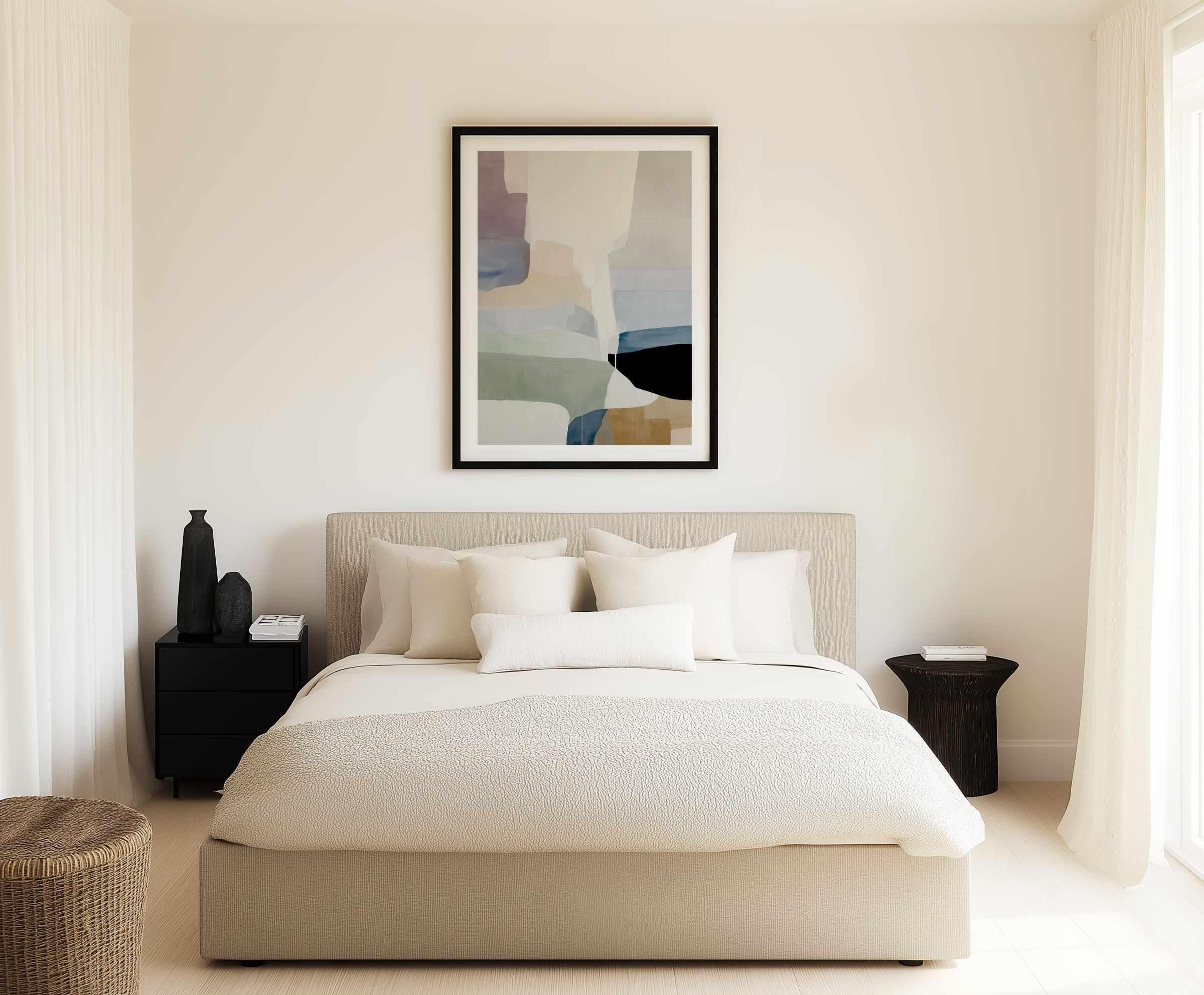
A gallery wall is the most ambitious thing most people ever do with art, and abstraction is its secret structural material. Figurative works on a shared wall compete, every subject asking to be read, while abstract pieces behave like rhythm and rest between the stories. The best gallery walls in published homes are usually a third to a half abstract, whether or not anyone planned it that way.
This is the full method: composition math, the abstract-to-figurative ratio, spacing, hanging order and the mistakes that make a wall look like a pinboard. We frame gallery walls' worth of art daily at our West Gosford facilities, and the same handful of decisions separates the walls that work from the walls that almost do.


Studio Haze II · Wetlands · Incised Long I
Why Abstraction Is the Gallery Wall's Skeleton
Every gallery wall needs three things a viewer never consciously notices: rhythm (repeated visual notes carrying the eye along), rest (places the eye can pause), and a palette thread (one continuity across different works). Abstract pieces supply all three without adding another story to read. A tonal field between two photographs is a rest; a gestural work repeating the palette of a botanical print two frames away is the thread. Remove the abstracts from most great gallery walls and they collapse into competing anecdotes.
Figurative works are the sentences. Abstracts are the punctuation. Walls without punctuation exhaust the reader.
The Composition Method
- Start with the anchor: the largest work, ideally abstract, placed just off the wall's centre at 145cm (57in) centre height. Everything else grows outward from it.
- Set the ratio: one-third to one-half abstract works, spread through the arrangement, never clustered in one corner.
- Hold one palette thread: a single colour family appearing in at least half the works. The thread can be as quiet as warm grey.
- Vary scale deliberately: the anchor at least twice the area of the smallest piece; three distinct sizes minimum, or the wall reads as a grid without meaning to be one.
- Unify the framing: one frame finish, oak, white or black, across the whole wall. Mixing finishes is the single fastest way to turn curation into clutter.
Lay it out on the floor first at full spacing, photograph it, and check the photo, arrangement flaws invisible at floor level are obvious on a screen.


Incised Long II · Organic Joy I
Spacing and Hanging Order
- Gap: 5 to 8cm between frames, consistent everywhere. Tighter reads as one composition; wider than 10cm and the works stop talking to each other.
- Outer shape: keep the arrangement's overall silhouette simple, rectangle or soft oval. Wild silhouettes photograph well once and annoy forever.
- Order: hang the anchor first, then the works diagonally adjacent to it, then edges. Working row by row compounds small errors.
- Fixings: every frame on a proper hook or anchor, two for anything above 80cm; the hanging guide covers wall types.
- Datum lines: align tops OR centres along each row, never mix the two systems on one wall.
Recipes That Work
- The tonal editorial: six to nine works, all abstraction, oat-to-charcoal palette, oak finish frames. The quietest and most foolproof wall; our neutral abstract guide supplies the register.
- The collected mix: abstracts, black and white photography and one line drawing, monochrome thread, black finish frames. See the monochrome guide for keeping it deep rather than stark.
- The colour-thread wall: varied works sharing one saturated family, blues, greens, with abstraction carrying the strongest hits; the blue guide and green guide map the families.
- The pair-and-trio shortcut: a matched pair plus a trio from one series, instant coherence with zero curation risk; method in the pairs and trio guides.


Designer Tips
- Buy the anchor first and build around it over months; gallery walls assembled in one afternoon usually look it.
- Series works, like Studio Haze II and Wetlands, give the palette thread for free.
- Leave growing room at one edge, the best walls are finished twice.
- Stairwell gallery walls follow the stair's diagonal with the same 145cm centre logic applied along the slope.
- All works framed in solid timber, oak, white or black finish, made to order at our facilities in a couple of business days, shipped worldwide with duties paid, order the whole wall at once and it arrives as one delivery.
Frequently Asked Questions
How many pieces should a gallery wall have?
Six to nine works suits most walls; below five reads as a grouping rather than a gallery, beyond twelve needs a large wall and real discipline. Odd counts arrange more naturally than even ones. Start at six with growing room left at one edge.
Should a gallery wall be all abstract art?
All-abstract walls work superbly, the tonal editorial recipe above is exactly that. Mixed walls need abstraction more: keep one-third to one-half abstract so the figurative works have rhythm and rest between them.
What is the correct spacing between frames?
Five to eight centimetres, kept consistent across the entire arrangement. Consistency matters more than the number itself; a wall at a uniform 7cm reads curated, a wall varying 4 to 12cm reads accidental.
Do all frames need to match on a gallery wall?
The finish should match, one of oak, white or black across the wall; sizes and orientations should vary. Matching finish with varied scale is the combination that reads collected-over-time rather than bought-as-a-set.
Where do I start hanging a gallery wall?
Anchor first, at just off wall-centre, 145cm centre height, then work diagonally outward. Floor-plan the whole arrangement first and photograph it; hang from the photo, not from memory.
Can I do a gallery wall in a rental?
Yes, with removable hooks rated honestly for each frame's weight, and a bias toward more, lighter framed prints over few heavy pieces. Test one hook on the least visible wall first and give adhesives their full cure time before loading.
How do I add to a gallery wall later?
Keep a photo of the current arrangement and the palette thread in mind when buying. New works join at the edges, extending the silhouette, rather than squeezing into internal gaps. This is why leaving growing room at one edge is part of the original method.
Build the wall from the abstract collection and abstract painting prints, or read how to choose abstract art first. Made in Australia; shipped to more than 40 countries, duties paid.


