

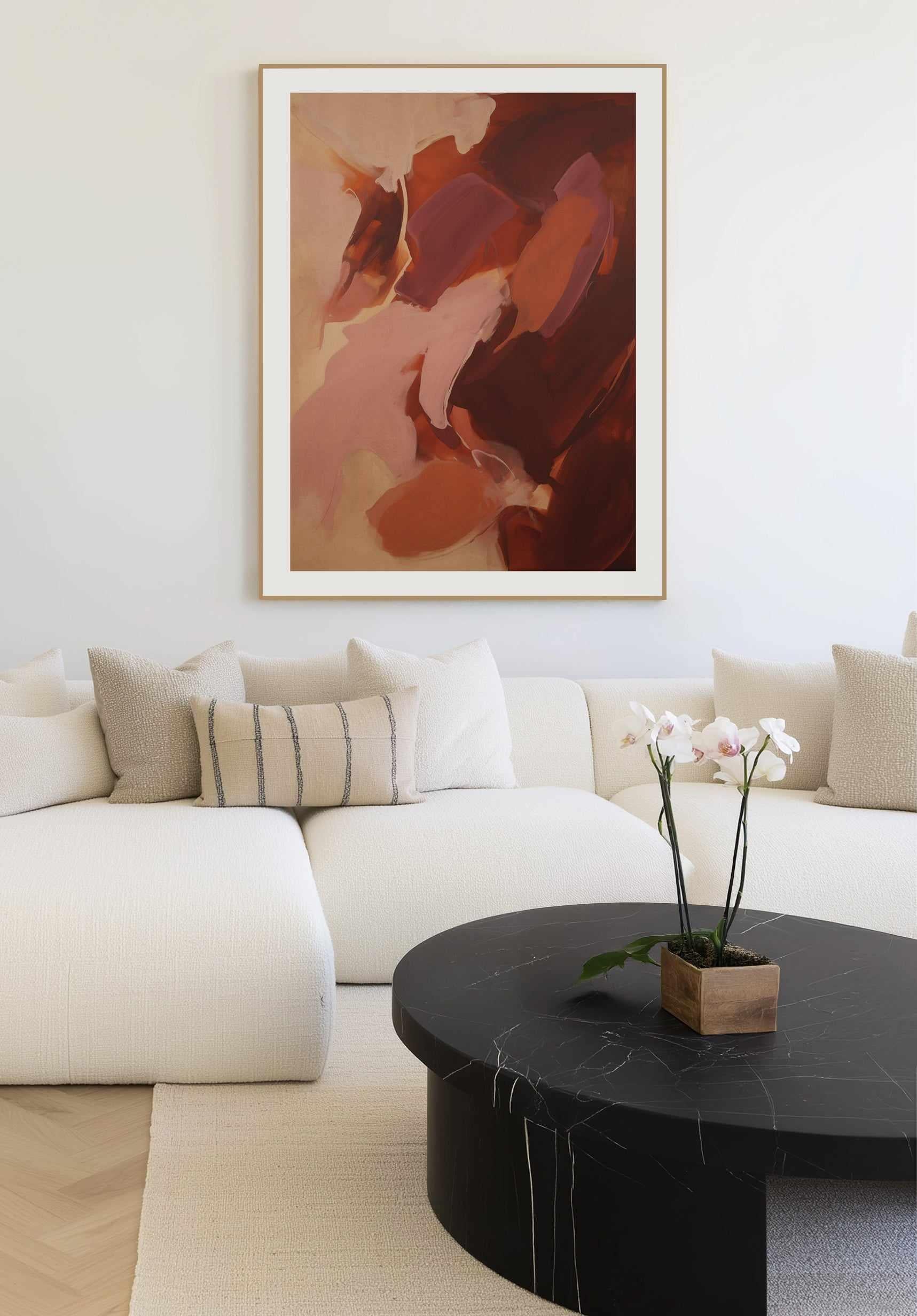
The bedroom is the last room most people get around to hanging art in, and the room where the right abstract work earns its keep nightly. Nowhere else does art work so directly on how a space feels to be in: the last surface your eye crosses before the lamp goes out, the first thing morning light finds. The brief is different here, and most art advice quietly ignores it.
This guide covers what makes abstraction the bedroom's natural genre, the registers that support rest rather than fight it, placement above the bed done properly, and the framing details that keep the room serene. From the makers: we design, print and frame these works at our two production facilities in West Gosford, NSW.


Almara II · Ocria I · Ocria II
Why Bedrooms Want Abstraction
A bedroom asks art to do one thing figurative work struggles with: lower the temperature. A photograph gives the mind a subject to process, a place, a face, a story, while a soft abstract gives it atmosphere with nothing to solve. The perceptual evidence supports the instinct: calm response tracks brightness and saturation more reliably than any particular hue, which is why a pale, low-saturation abstract of any colour reads quieter than a vivid image of the calmest lake on earth.
Abstraction also survives the decade better in this room. Bedrooms are redecorated least often; a work with no subject to date stays current through two or three bedding palettes, especially in the tonal and organic registers.
Bedroom art is judged at midnight and 6am. Choose for those hours, not for the listing photo.
The Registers That Work
- Tonal colour fields: soft planes of oat, stone, sage or chalk blue, atmosphere distilled. The safest and often the best choice.
- Organic and flowing forms: water-, cloud- and landform-adjacent rhythm; movement slow enough to rest on. Most of our abstract collection's bedroom favourites live here.
- Minimal line work: a few unbroken strokes, intimate and slightly personal, at home over bedsides and in small rooms.
- Soft figurative abstraction: the suggestion of a form brings warmth without narrative; well suited to the wall facing the bed.
- Low-contrast landscape abstraction: a felt horizon settles a room the way a window view does; see works like Sombra I.
What to avoid is equally short: high-contrast gestural drama, saturated reds and oranges, and dense busy compositions, all energising registers that belong in living spaces. Our monochrome guide covers how to keep even black and white gentle here: soft greys, wide tonal range, no stark extremes.


Above the Bed, Done Properly
- Width: art spanning 60 to 75 percent of the bedhead. Queen bed (1.53m): roughly 0.9 to 1.15m of art. King (1.83m): 1.1 to 1.4m.
- Height: bottom edge 20 to 30cm (8 to 12in) above the bedhead; in rooms with standard 2.4m ceilings err lower, the art should relate to the bed, not the cornice.
- Pairs: two related vertical works with a 5 to 8cm gap suit king beds superbly and solve the wide-wall problem; hang per the pairs guide.
- Fixings: anything above a sleeping head gets two proper wall anchors, never a single nail. The hanging guide covers fixings by wall type.
- The other walls: the wall facing the bed is the true prime position, it owns your first and last sightline. A single calm work there outperforms anything above the bedhead.
Palette by Bedroom Type
- The white-and-linen room: oat and sand tonal work deepens the softness; our warm minimalism guide is the full recipe.
- The moody room: charcoal or deep green walls take pale, high-key abstraction, the light the walls absorb, the art gives back.
- The coastal room: chalk and sea-glass blues, always low saturation; the blue abstract guide maps the registers.
- The blush room: dusty rose schemes want soft abstracts over florals for the grown-up version, see the dusty rose palette guide.
- Kids' and guest rooms: organic abstraction in mid-value colour survives changing tastes longer than any character or motif art.
Framing for Quiet
Bedrooms reward the gentlest framing decisions. Oak finish is the near-universal answer, warm, calm, at ease beside linen and timber. White finish suits pale works in pale rooms where the art should float. Black finish works only when the room already carries black accents deliberately. Every frame is solid timber in oak, white or black finish, cut and joined on Italian machinery by our own artisans in Australia. Canvas versus print matters less here than anywhere, reflections are rarely an issue, so choose framed fine art prints for their precision unless the work is oversized.
One bedroom-specific note: made to order means a couple of business days at our facilities, so redecorating momentum survives, order art with the new bedding, not after it.


Sunday Driving by Tamara Gonda Art Print · Carmel Central Coast by Jan Weiss Art Print
Designer Tips
- Test any candidate under your actual bedside lamps; warm 2700K light shifts every palette and flatters earth tones most.
- Repeat one artwork tone in the bedding or a throw, one echo, no more, and the room reads composed.
- Small bedrooms: one work, generously sized, beats three small ones; visual quiet comes from fewer decisions on the wall.
- Pairing with a wallpapered bedhead wall: keep the paper textural and the art tonal, or vice versa; the $4.99 sample (48cm x 40cm / 19in x 16in) settles it in your room's light.
- We ship worldwide, more than 40 countries, all import duties paid.
Frequently Asked Questions
What abstract art is best for a bedroom?
Low-saturation, low-contrast work in the tonal, organic or soft-landscape registers, compositions that read as atmosphere rather than event. Oat, sage, chalk blue, blush and warm grey are the reliable palettes. The test: imagine it at midnight; if it still asks for attention, it belongs in another room.
Is it OK to hang art above the bed?
Yes, with correct fixings, two anchors rated for the weight, never a single nail, and correct height, 20 to 30cm above the bedhead. Framed prints and canvas are both safe hung properly. If a large earthquake-anxious part of you disagrees, the wall facing the bed is an equally strong position.
Should bedroom art be calming?
The art should agree with the room's job, and a bedroom's job is wind-down. That does not mean bland: texture, depth and a felt horizon give the eye somewhere to rest, which is calmer than an empty wall. Save the energising registers, high contrast, saturated warm colour, dense gesture, for rooms built for waking hours.
What size art above a queen bed?
Roughly 0.9 to 1.15m wide (60 to 75 percent of the 1.53m bedhead), as one work or a pair totalling that span. Vertical pairs suit taller rooms; a single horizontal suits standard ceilings. Centre the composition on the bed, not the wall, if the two differ.
Canvas or framed print for bedrooms?
Either; bedrooms rarely have the reflection problems that decide this elsewhere. Framed prints carry fine tonal detail with mount-and-frame polish; canvas suits oversized statements. Choose by scale: prints to about 100cm, canvas beyond it.
What colour art for a dark bedroom?
Go pale and warm, bone, oat, blush, chalk, so the artwork returns light the room lacks, and frame in oak finish for warmth. Deep art in a dark room works only when the scheme is deliberately moody and well lamped.
Can abstract art help a small bedroom feel bigger?
Yes, three mechanics: a single large work reduces visual clutter (fewer edges than a gallery wall), landscape-derived abstraction adds felt depth the way a window does, and a palette matched to the walls dissolves the boundary between surface and art. One generous tonal piece is the small room's best friend.
Browse bedroom-ready works in the abstract wall art collection and abstract painting prints, or continue on On the Wall. Designed and made on the Central Coast of NSW; delivered worldwide, duties paid.


