

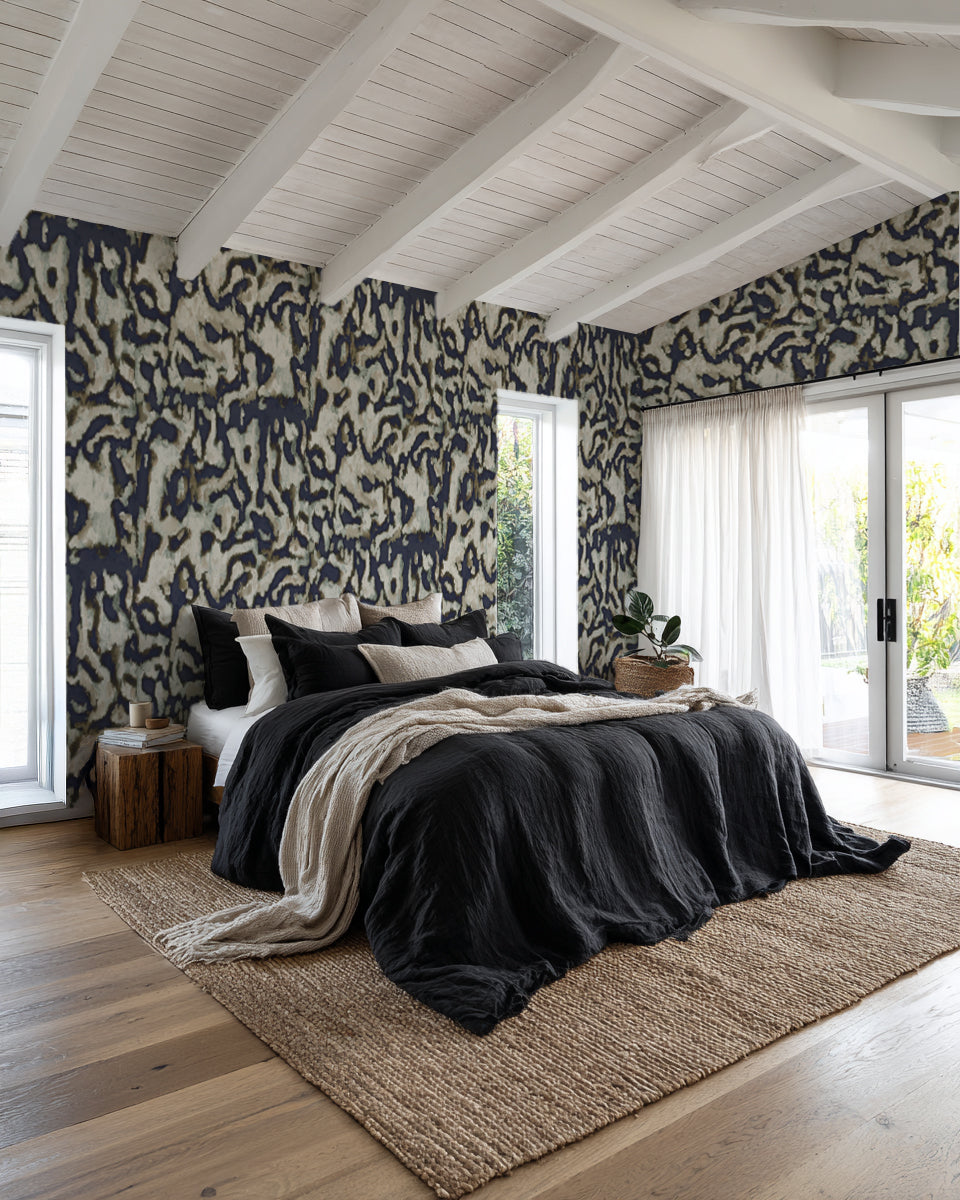
Wallpaper or paint is one of the most searched home decor questions on the internet — and one of the most inadequately answered. Most guides treat it as a binary choice between a bold permanent commitment and a simple reversible solution. The reality is more useful than that. Wallpaper and paint are not competitors; they are tools with different strengths, and knowing which strength serves your specific room determines which tool to reach for. This guide gives you the framework to make that decision correctly — for every room, every budget, and every living situation.


Shop Wallpaper · Luxe Tropical in Sand Wallpaper · White Luxe Palm Wallpaper in Sand
The wallpaper versus paint conversation has changed significantly in the past decade, primarily because wallpaper has changed. Peel-and-stick wallpaper — self-adhesive, repositionable, and removable without wall damage — has eliminated the primary historical objection to wallpaper: its permanence. A renter who would never consider traditional paste-the-wall wallpaper can now transform a room in an afternoon and remove it at move-out without touching the paint beneath. This changes the decision framework entirely. The question is no longer "do I want something permanent or flexible?" It is "what does this specific room need, and which tool delivers it most effectively?"
At Olive et Oriel, we manufacture custom-sized wallpaper shipped to customers across the US, UK, Europe, and 40+ countries globally. We have supplied every type of room in every type of living situation — owned homes, rentals, apartments, commercial spaces. The patterns in this guide reflect what we have observed across thousands of installations: where wallpaper consistently outperforms paint, where paint is the smarter choice, and where the decision is genuinely close.


Palm Escape Cream & Beige Wallpaper · Palisades Light Blue Wallpaper
Where Wallpaper Wins
When you need pattern. Paint cannot produce pattern on a wall without significant additional effort — stencilling, specialist techniques, or applied decorative elements. Wallpaper delivers pattern as its baseline offering. Any room whose design requires a botanical print, geometric repeat, textural surface, or large-scale mural should default to wallpaper without significant deliberation. This is the clearest case: wallpaper is doing something paint simply cannot do.
When one wall needs to be different. The feature wall — one surface wallpapered while the other three remain in a coordinating paint — is the most efficient design move in residential interiors. It creates focal depth, spatial interest, and pattern richness with minimum material commitment. A painted accent wall creates contrast but not the depth, texture, or pattern that a wallpapered feature wall produces. If the goal is a room that reads as designed rather than simply decorated, the wallpapered feature wall is the more powerful tool.
When texture matters. Flat paint is flat. Even eggshell or satin finishes produce a relatively uniform surface that reads as paint at any viewing distance. Wallpaper — particularly linen-substrate or embossed wallpaper — produces a surface with genuine tactile and visual depth that changes in appearance as light conditions change through the day. In rooms where the quality of the wall surface is part of the design intention, wallpaper's textural range exceeds paint's by a significant margin.
When you are renting — with peel-and-stick. The traditional objection to wallpaper in rentals was that it damages walls and costs the security deposit. This does not apply to peel-and-stick wallpaper. Properly installed on a prepared surface, peel-and-stick removes cleanly and leaves no adhesive residue. Renters who have used peel-and-stick as a feature wall treatment consistently report no wall damage at removal. This makes peel-and-stick wallpaper available to any renter, regardless of landlord restrictions on wall alterations.
When photos matter. Wallpapered rooms photograph better. The pattern and texture that wallpaper adds creates the visual interest that makes interior photography compelling — and that makes real estate listing photographs significantly more memorable. If you are designing a room to be sold, rented, or photographed, wallpaper's visual richness outperforms paint's uniformity in the medium that matters most: the image.
Where Paint Wins
When budget is the primary constraint. Wallpaper costs more than paint at the material level, and paste-the-wall installation is more labour-intensive. A full-room paint job is consistently less expensive than a full-room wallpaper installation. If the goal is a refreshed, well-coloured room rather than a pattern or textural statement, paint is the correct choice.
When colour is the whole point. Some rooms are best served by a single strong colour — a deep navy dining room, a warm terracotta bedroom, a forest green home office. In these applications, the goal is immersion in colour rather than pattern interest, and paint delivers saturated, consistent colour more economically and with greater range than wallpaper. Where a specific colour is the design move, paint is the more powerful tool.
When the surface is imperfect. Wallpaper requires a flat, smooth, primed wall surface. Imperfections — holes, cracks, uneven plaster — telegraph through wallpaper and are visible in raking light. Matte paint is more forgiving of wall imperfections. If the walls are in poor condition and replastering is not in the budget, paint will produce a better result than wallpaper on the same surface.
When flexibility is the highest priority. Even peel-and-stick wallpaper involves more commitment than paint. Paint can be repainted in an afternoon. If the design direction for a room is genuinely uncertain and the priority is the ability to change quickly and cheaply, paint is the more flexible tool.
The Feature Wall Decision
The most common resolution to the wallpaper versus paint decision is the feature wall: one surface in wallpaper, three walls in a coordinating paint colour drawn from the wallpaper's palette. This approach captures the primary advantage of each material — wallpaper's pattern and visual depth on the focal surface, paint's economy and flexibility on the supporting surfaces. It is the correct solution for the majority of rooms where the question arises, because it addresses the design need at a lower commitment level than full-room wallpaper.
The feature wall approach works in every room type. In bedrooms, the headboard wall in wallpaper with the other three walls in paint is the default for a reason — it focuses the pattern at the room's focal point without overwhelming the space. In living rooms, the wall the sofas face provides the same function. In dining rooms, the wall seen across the table. In entrance halls, the wall at the far end of the corridor. In every case, the wallpaper goes on the wall that already commands the room's attention, and the paint provides the quiet counterbalance that makes the wallpaper read as a design decision rather than a covering exercise.
"Wallpaper and paint are not competitors. They are tools with different strengths. The right question is not which one to choose — it is which one serves this specific wall's specific design need."
Materials
- Peel and Stick: The wallpaper option with the closest risk profile to paint — reversible, no professional installation required, and appropriate for rental properties. The correct starting point for anyone who has previously defaulted to paint out of concern about wallpaper's permanence. Visual impact is identical to paste-the-wall substrates.
- Paste the Wall Smooth: For feature wall applications where precision and print quality are the priority. Fine-line patterns, botanical illustrations, and geometric designs render with maximum sharpness on smooth substrate. The permanent installation is appropriate when the design direction is confident and the room is unlikely to change significantly.
- Paste the Wall Linen: Adds surface texture that paint cannot replicate. In rooms where the tactile quality of the wall is part of the design intention — a bedroom where the headboard wall's texture is felt as well as seen, a living room where the wall reads differently in morning and afternoon light — linen substrate provides a surface quality genuinely unavailable in paint.
Room by Room
- Living room: Feature wall in wallpaper, three walls in paint. The wallpaper creates the visual depth that makes a living room feel designed. The paint provides economy and the colour coordination that unifies the room. Browse the full wallpaper collection for living room feature wall options.
- Bedroom: Headboard wall in wallpaper, remaining walls in paint. The wallpaper creates the focal point that frames the bed; the paint provides the restful background the bedroom requires. Peel-and-stick is particularly appropriate here — the headboard wall is modest in scale and the decision can be updated as preferences evolve.
- Kitchen: Paint on the main walls, wallpaper on the splashback feature or the wall visible from the primary cooking position. Paint handles moisture and traffic on the main surfaces; wallpaper adds pattern interest in a lower-risk position.
- Children's rooms: Peel-and-stick wallpaper on a feature wall, paint on the remaining three. The peel-and-stick updates as the child grows. Paint on the other walls can be repainted to coordinate with each successive wallpaper choice, keeping the full refresh affordable.
- Home office: Paint on three walls, wallpaper on the wall behind the desk. That wall appears on every video call and sits in peripheral vision all day. A wallpapered feature wall creates an environment that reads as considered and professional. Paint on the remaining walls keeps the functional space calm.
Designer Tips
- When deciding between wallpaper and paint for a specific wall, ask first: does this wall need to be interesting, or does it need to be quiet? The focal wall needs to be interesting — wallpaper serves it. The supporting walls need to be quiet — paint serves them. The feature wall approach turns the either-or into a both-and.
- If uncertain whether wallpaper is right for a room, order the $4.99 sample (48cm x 18in). Hold it against the wall at the primary viewing distance. Assess at different times of day. The sample resolves most uncertainty more reliably than any amount of online research — it tests the actual product in the actual room's actual light. Get paint chips for paint at the same time and compare both on the wall before committing to either.
- Custom manufactured to your exact wall dimensions. No standard roll calculations, no pattern repeat waste. Ships to the US, UK, Europe, and 40+ countries. Production 4 business days. All import duties included. Also read: how to plan a feature wall and how wallpaper makes small rooms feel larger.


