

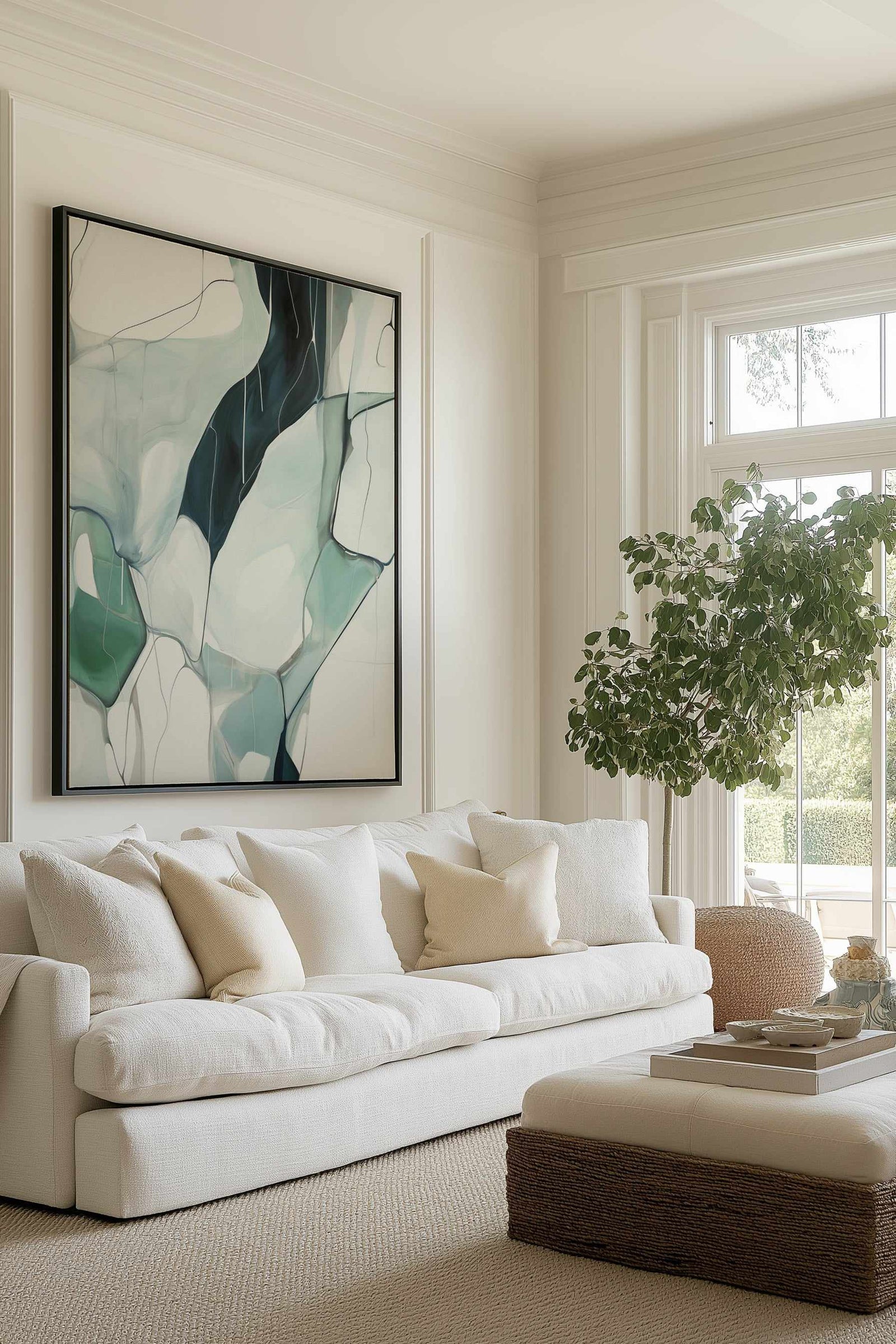
Canvas wall art is Australia's favourite way to hang art, warm, matte, glass-free, and forgiving of every light a room can throw at it. It is also a category with a quality range wide enough to fit a truck through: the same words describe a hand-stretched archival artwork and a sagging print from a discount bin. This is the complete buying guide, construction, sizing, styling and the honest differences the product pages rarely explain.
We print and stretch every canvas at our two production facilities in West Gosford, NSW, and frame them in solid timber floating frames made by our own team. Browse the range in our canvas wall art collection; what follows is how to buy it well, from us or anyone.


Abstract Seaglass I · Abstract Seaglass II · Abstract Seaglass III
Why Canvas Owns Australian Walls
- No glass, no glare: canvas reads perfectly beside windows, under downlights and across open-plan rooms where framed glazing turns into a mirror, and it is the native format for video-call walls.
- Warmth: the woven surface softens artwork the way linen softens a bed, the relaxed-premium register Australian interiors run on.
- Weight and safety: lighter than glazed framing at every size, which matters over beds and sofas, and at the extra large scale where glass becomes genuinely impractical.
- Durability: a well-made canvas wipes clean and survives decades; there is nothing to shatter, fox or fog.
Canvas is the barefoot luxury of wall art, dressed down on the surface, premium in the making.
Construction: Where Quality Hides
- The print: archival pigment inks hold colour for generations; solvent prints fade toward teal in a few Australian summers. Ask what inks a supplier runs, ours are archival, printed in-house.
- The stretch: hand-stretching over a solid timber frame keeps corners crisp and the face drum-tight; machine-batched imports ripple within a year.
- The float frame: a solid timber floating frame (ours in oak, black or white) finishes a canvas the way a border finishes a garden, the small shadow gap reads gallery instantly. Bare-edge canvas suits only the most casual rooms.
- The back matters: sealed, braced backs with fitted hardware are the tell of a maker; raw staples and no hangers are the tell of a warehouse.


Malibu summer · Martini on Pink
Choosing the Artwork
Canvas flatters texture, painterly abstraction (abstract canvas is the category's heartland), landscape atmosphere, and any work with visible gesture. Fine-line detail and crisp photography often prefer framed prints behind glazing; the five-minute decision method is our format guide. Room by room: living rooms take statements (living room canvas), bedrooms take calm (bedroom canvas, chosen per our bedroom art rules), and dining rooms reward the confident (dining canvas).
Sizing and Hanging
The 60-to-75-percent rule governs: canvas width at 60 to 75 percent of the furniture below, centre at 145cm per the hanging guide. Because every canvas is made to order, buy the wall's size, not the nearest stock size, and when a wall is genuinely wide, a pair or trio of canvases carries it with rhythm. Horizontal walls above sideboards and beds suit landscape-format canvas; square rooms love square works.
Designer Tips
- Choose the float frame in the room's timber family, oak with warm floors, black with monochrome schemes, white with coastal light.
- Canvas loves being lit: a warm picture light or angled downlight turns texture into theatre.
- In humid rooms, quality stretching is everything, our braced frames are built for Australian coastal air.
- Mix one large canvas with framed smalls rather than many mid-size canvases; scale contrast reads curated.
- Trade and volume buyers: the whole canvas range runs through the Designer Trade & Commercial Program at trade pricing with expedited dispatch.
Canvas by Room: Where the Format Wins Outright
Canvas has rooms where it is simply the correct answer, and knowing them saves the framed-versus-canvas agonising. Living rooms with big walls are canvas territory: the format scales to statement sizes at a weight a standard picture hook can still hold, which glazed framed art at the same scale cannot. Bedrooms suit canvas for a quieter reason, no glazing means no reflections, so a piece above the bed stays matte and calm under morning light instead of bouncing the window back at you; the bedroom canvas edit leans into that with softer palettes. Media rooms and the home-office video wall are the same logic taken further: zero glare under downlights or a ring light, which is why we point every work-from-home client at canvas before anything else.
Stairwells and double-height voids, the hardest walls in any house, are decided by weight and safety. A large canvas is light enough to hang confidently over a stair run, and if the worst ever happened there is no glass in it. Dining rooms swing either way on style grounds, the dining canvas collection runs from serene to sculptural, but the practical vote is still canvas wherever candles and downlights would strike reflections off glazing at seated eye level.
Reading the Artwork for the Format
Not every image wants to be a canvas, and this is the judgement we apply daily on the print floor. Painterly work, abstracts, landscapes with visible brush energy, colour-field pieces, gains from canvas texture; the weave participates in the illusion that you are looking at an original. Fine-line detail, delicate photography and typographic work generally read crisper behind the flat surface of a framed print, where nothing interrupts the line. Photography sits in the middle: moody, atmospheric imagery translates to canvas superbly, while high-detail architectural shots usually prefer paper.
Palette behaves differently on the two surfaces as well. Canvas softens contrast a touch, which flatters warm neutrals, sea tones and blush palettes, and it deepens saturated colour into something velvety, one reason our abstract canvas range skews rich. If you love a work in both formats, the honest tiebreaker is the room's light: hard cross-light or lamps at eye level argue for canvas; a softly lit wall lets either sing. And a pair rule from experience, in a matched set, keep both pieces in the same format; a canvas beside a glazed frame reads as an accident even when the artworks match perfectly.
The Long Life of a Canvas
A properly made canvas is a decades-long object, and the care routine is almost embarrassingly short. Dust it with a dry microfibre cloth or the soft brush of a vacuum on low, never a damp cloth on the printed face. Keep it off walls that take direct hard sun for hours daily; pigment inks are dramatically more fade-resistant than dye, but south of a window in full Queensland summer is a punishment no artwork deserves. In humid coastal homes, give the wall behind it an occasional airing, a canvas hung flush in a never-opened beach house can develop the same musty back that any fabric does in a closed room.
Transporting a canvas is the one moment of real risk: corners first, never lean anything against the face, and wrap it in a blanket rather than bubble wrap directly on the surface if the trip is long. If a corner does take a knock and the canvas dents, do not press it out from the front; a lightly damp cloth on the reverse of the dent will usually re-tension the weave overnight. These are small habits, but they are the difference between a piece that looks gallery-fresh at year ten and one that shows its removals history, and they apply to every canvas we send out of the collection, from A2 to full statement scale.
Framed Canvas: The Third Option Most Buyers Miss
Between the bare stretched canvas and the glazed frame sits the format that quietly outsells both at the top end of our range: the framed canvas, a stretched canvas set into a timber floating frame with a shadow gap between canvas edge and moulding. It solves the one aesthetic objection to raw canvas, the unfinished side profile, without adding glass, weight or glare. The shadow line gives the piece the finished authority of framing while the surface keeps every advantage of canvas, and in oak it slots into the same rooms as our framed paper prints without a visual seam between formats.
The buying logic is simple. If the room is casual, coastal or layered, bare canvas keeps things relaxed. If the room is finished to a higher polish, wainscoting, considered lighting, real joinery, the floating frame earns its modest premium immediately; a bare canvas in a formal room can read as the one unfinished thing in it. Nearly every canvas work in the collection, including the Seaglass series, is available framed this way, built in the same West Gosford workshop, in the same oak, white and black as the rest of the range, so a home can mix paper and canvas formats and still read as one collection.
Sizing Mathematics: The Numbers That Never Miss
Most canvas disappointment is size disappointment, so here is the arithmetic we give every caller who asks. Above furniture, the artwork should span two-thirds to three-quarters of the furniture's width: a 2.4m sofa wants roughly 160 to 180cm of art, which means a 70x100 landscape canvas is the floor, not the ceiling, and a pair hung as one composition often solves it more affordably than a single oversized piece. On an open wall, the piece should claim half to two-thirds of the visible wall width between interruptions, doors, windows, joinery. Centre-height is not negotiable: 145cm from floor to the centre of the artwork, the standard every gallery uses, which lands lower than most first-time hangers expect and is almost always the fix when a wall "feels off".
When in doubt, go one size up. In ten years of support conversations we have fielded hundreds of versions of "I wish I had bought the bigger one" and almost none of the reverse. Small art on a big wall does not read as restraint; it reads as an apology. The blue-tape trick settles it in five minutes, tape the artwork's outline on the wall and live with it through an evening, and our hanging guide covers the rest, hardware included, wall type by wall type.
Frequently Asked Questions
What is canvas wall art?
Artwork printed on woven canvas, stretched over a timber frame, hung matte and glass-free, usually finished with a floating frame. Quality varies enormously with inks, stretching and timber; construction, not the word canvas, determines how it looks in five years.
Is canvas or framed print better?
Canvas for warmth, texture, glare-free walls and large scale; framed prints for fine detail, photography and formal rooms. Most well-decorated homes run both registers deliberately.
How long does canvas art last?
With archival pigment inks and proper stretching, decades, ours are printed for it. Solvent-printed imports fade visibly within a few years of Australian light, which is where the price difference really sits.
Should canvas art be framed?
A solid timber floating frame lifts almost every canvas from casual to considered, and protects edges in busy homes. Bare edges suit only relaxed spaces and studios.
What size canvas should I buy?
Sixty to 75 percent of the width of the furniture beneath, centred at 145cm. Made-to-order sizing means the wall dictates the canvas, never the other way around.
How do I clean canvas art?
A soft dry cloth or feather duster, occasionally a barely damp wipe for marks. No sprays, no solvents, the matte surface asks only for gentleness it will repay for decades.
Do you make custom canvas sizes in Australia?
Yes, printed, stretched and framed to order at our NSW facilities in a couple of business days, delivered ready to hang Australia-wide, with international shipping available.
Start in the canvas wall art collection, or go straight to abstract canvas, living room canvas and the newest arrivals. Every canvas is printed, stretched and finished at our West Gosford facilities and shipped ready to hang to more than 40 countries, and if you want a second opinion on size or format before ordering, send the wall photo through, the people who answer are the same people who build them.


