

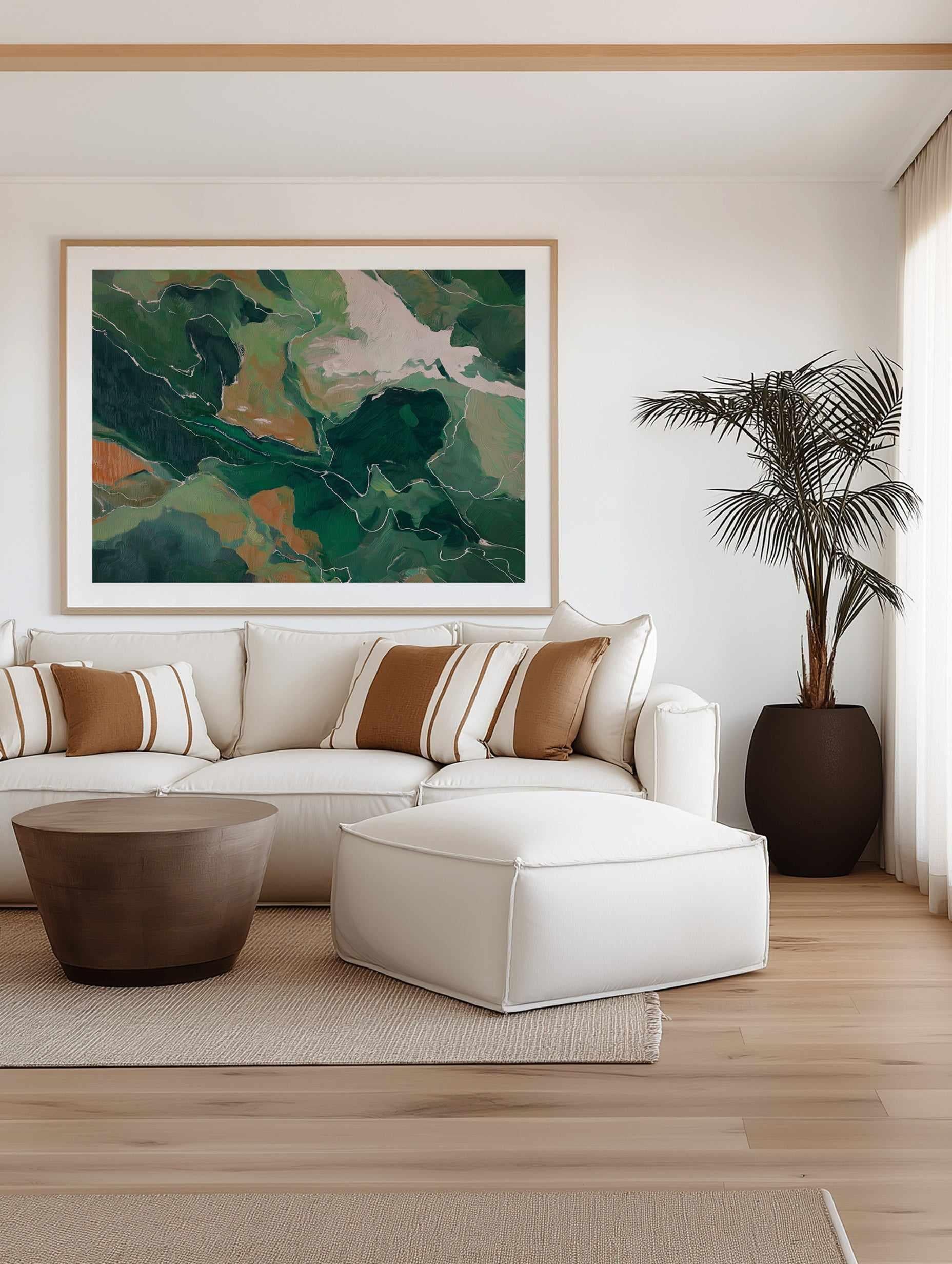
Abstract art is the art of feeling before naming. Where a landscape shows you a place and a portrait shows you a face, an abstract work gives you colour, gesture, texture and composition with nothing standing between them and you. That is precisely why it works so hard in a home: it sets a mood without dictating a subject, and it keeps rewarding attention years after a literal image has gone quiet.
This guide explains what abstract art actually is, where it came from, the major styles you will encounter when shopping for it, and how designers use it to finish rooms. We design and make abstract art every week at our two production facilities in West Gosford on the Central Coast of NSW, printing, hand trimming and framing works for homes in Australia and more than 40 countries, so this is written from the workbench as much as the design desk.


Forest Vein I · Forest Vein II · Midnight Current I
What Is Abstract Art, Exactly?
Abstract art is any artwork that does not attempt to represent the visible world accurately. Instead of depicting a recognisable subject, it uses the raw elements of picture-making, colour, line, shape, form, texture and scale, as the subject itself. Some abstract works begin with something real, a shoreline, a fig leaf, a body in motion, and simplify it until only the essential rhythm remains. Others are entirely non-representational, built from nothing but the artist's decisions.
The useful distinction for your home is not academic purity but degree. Abstraction sits on a spectrum. At one end is abstracted realism, where you can still sense the horizon line in a layered colour field. At the other is pure geometric or gestural work with no external reference at all. Neither end is better; they simply do different jobs on a wall. A softly abstracted landscape reads as calm and grounded. A hard-edged geometric composition reads as deliberate and architectural.
An abstract work never tells you what to see. It tells you how to feel, and lets the seeing be yours.
A Short History, From Radical to Domestic
Abstraction was a genuine revolution. In the early 1910s, painters including Wassily Kandinsky, Kazimir Malevich and Piet Mondrian, and before all of them the Swedish painter Hilma af Klint, abandoned the centuries-old assumption that a painting must depict something. Kandinsky, a trained musician, argued colour and form could work on the viewer the way music does, directly, without translation.
By the late 1940s, abstract expressionism had moved the centre of the art world to New York. Jackson Pollock's poured skeins of paint made the act of painting itself the subject; Mark Rothko's floating fields of colour aimed at something closer to meditation than decoration. Colour field painting, minimalism and lyrical abstraction followed through the 1950s to 1970s, and Australian painters, from Ralph Balson and Grace Crowley onward, built a distinctly local abstraction alongside them.
What began as radical is now the most livable of all art genres. Because abstraction carries no fixed subject, it does not date the way figurative trends do, and it does not argue with the room around it. That is why you will find it in almost every professionally designed interior published today.
The Major Styles of Abstract Art (and What They Do in a Room)
When you browse our abstract artwork collection you are really browsing several distinct traditions. Knowing them makes choosing far easier.
- Gestural and expressionist: visible brushwork, energy and movement, the artist's hand unmistakably present. Brings life to quiet rooms; one confident gestural piece can carry an entire neutral interior.
- Colour field: large, soft planes of colour with minimal drawing. The most calming style, suited to bedrooms and any room where you want atmosphere over incident.
- Geometric: hard edges, grids, arcs and blocks. Reads as ordered and architectural; pairs naturally with mid-century and contemporary furniture.
- Lyrical and organic: flowing, nature-adjacent forms without literal subjects, think water, stone and botanical rhythms. The easiest style to layer into relaxed Australian coastal and Japandi homes.
- Minimalist and line work: restrained compositions, often a few strokes or a single form. Ideal where the architecture is strong and the art should whisper.
- Textural abstraction: works about surface itself, plaster-like layers, sculptural paint, tonal washes. These carry enormous warmth in monochrome schemes.


Midnight Current II · Ochre Ridge I
Why Abstract Art Works So Well in Homes
There is real evidence behind the designer instinct here. Research in neuroaesthetics suggests people consistently prefer moderate, organised visual complexity, and that curved, organic forms are experienced as more pleasant than sharp, chaotic ones. Abstract art is the genre most able to deliver exactly that dose of complexity, tuned to the room, because it is not obliged to depict anything.
Abstraction is also personal in a way figurative art cannot be. A photograph of Positano is the same place on everyone's wall. An abstract work completes itself differently in every viewer, you bring your own associations, which is why the piece you connect with feels genuinely yours. A blank wall is a room holding its breath; the right abstract work is the exhale, and it is your exhale specifically.
Finally, abstraction is the great mediator. Because it has no subject to clash with, it bridges eras and styles, a gestural canvas warms a minimal room, a geometric print sharpens a traditional one. If you are unsure what art a space needs, abstraction is almost always a safe first answer and rarely a boring one.
How to Choose an Abstract Work You Will Not Tire Of
- Lead with feeling, not matching. Shortlist works that stop your scroll before you think about the cushions. You are choosing a daily mood, not a paint swatch.
- Then check the palette does a job. Echo two or three tones already in the room for a cohesive scheme, or deliberately contrast a neutral room with saturated colour as the focal point. Our room-by-room guide to choosing art prints covers both strategies in depth.
- Match energy to purpose. Gestural work energises living and dining spaces; colour fields and soft organic forms suit bedrooms; disciplined geometry suits studies and home offices.
- Go larger than instinct suggests. Undersized art is the most common styling error we see. A single work should hold roughly two-thirds the width of the furniture beneath it.
- Consider pairs and sets. Two related works, like Forest Vein I and Forest Vein II, give a wall rhythm a single piece cannot. Our guide to matching wall art pairs shows how to hang them correctly.


Ochre Ridge II · Sculpted Clay I
Framing and Format: the Art Around the Art
Abstraction is unusually sensitive to presentation. A raw gestural work in a heavy ornate frame fights itself; the same work floating in a slim solid timber frame becomes gallery-calm. Every frame we make is solid timber, cut and joined on Italian machinery by our own artisans here in Australia, in oak, white or black finish. Oak finish warms tonal and organic abstraction; black finish sharpens geometric and monochrome work; white finish disappears politely behind colour.
Format matters as much as frame. A framed abstract canvas carries painterly texture and needs no glass, which suits large statement walls. A framed fine art print on paper, hand trimmed and mounted, reads more editorial and suits considered groupings. For open-plan spaces with long sightlines, browse extra large wall art, scale is the single cheapest luxury in decorating.
Room by Room
- Living room: the statement wall. One oversized gestural or colour-field work above the sofa, hung so its centre sits about 145cm (57in) from the floor.
- Bedroom: calm over drama. Soft organic abstraction or muted colour fields above the bedhead; avoid high-contrast work where you want rest.
- Dining room: energy and conversation. Saturated colour or confident gesture earns its place here.
- Home office: ordered geometry or restrained line work behind the desk reads composed on camera and keeps focus.
- Hallways and entries: pairs and trios create procession. See our guide to three-piece wall art sets.
- Bathrooms: yes, art belongs here. Framed prints handle powder rooms well; choose tonal abstraction to keep the small space serene.

Designer Tips
- Hang art so the centre of the work, or the centre of a grouping, sits 145cm (57in) above the floor. Full method in our how to hang wall art guide.
- In a neutral room, repeat one accent tone from the artwork somewhere at floor level, a cushion, a throw, a vase, and the whole scheme clicks into place.
- Mixing abstraction with photography and line drawing adds depth; keep one palette thread running through the group so it reads curated, not collected.
- If you are pairing art with wallpaper, order the $4.99 wallpaper sample (48cm x 40cm / 19in x 16in) first and hold your shortlisted print against it in the room's own light.
- Made to order is not slow. We produce custom framed art in a couple of business days, the fastest custom art turnaround in Australia, and ship worldwide with all import duties paid.
Frequently Asked Questions
What is the difference between abstract and contemporary art?
Contemporary simply means made now; it describes when, not what. Abstract describes the approach, art that does not represent the visible world literally. A contemporary work can be figurative or abstract, and most abstract art sold today is also contemporary. When decorating, ignore the labels and look at the degree of abstraction, since that is what sets the mood on the wall.
Is abstract art harder to style than other art?
It is usually easier. Because there is no subject to clash with the room's contents, abstraction only has to agree with a room on palette and energy. That is two variables instead of three, and it is why designers reach for abstraction when a scheme refuses to resolve.
How do I know if an abstract artwork is good quality?
Look for a confident, resolved composition rather than random marks, a considered palette, and honest information about who made it and how it is produced. On the physical side, quality shows in the printing (archival inks on heavyweight fine art paper), the trimming, and the frame joinery. Our frames are solid timber, made in Australia and cut on Italian machinery, and every print is trimmed by hand.
What colour abstract art should I choose for a neutral room?
Two reliable routes. Tonal layering keeps the art within the room's own oat, sand and stone family and adds texture instead of contrast, a look our warm minimalism guide explores fully. The focal route introduces one saturated colour, deep blue, ochre, burgundy, and lets the artwork own the room. Both work; choose based on whether you want the wall to soothe or to speak.
Should abstract art be framed or unframed?
Framing finishes a work the way tailoring finishes cloth. Framed canvas suits large statement abstraction and needs no glass; framed fine art prints suit groupings and smaller walls. Choose oak finish for warmth, black finish for definition, white finish for quiet. Whatever you choose, keep the framing consistent within any one grouping.
Does abstract art suit traditional homes?
Superbly, and the contrast is the point. A single confident abstract work in a period room, a Federation hallway, a Queenslander living room, signals that the home is curated rather than preserved. Keep the frame classic (oak or black finish) and the palette sympathetic to the room's existing tones.
Where should I start if I have never bought art before?
Start with the room you use most, measure the wall, and shortlist three works that make you feel something. Check the palette against the room, size up rather than down, and begin with a framed print rather than agonising over a forever piece. Art confidence is built by living with art.
Ready to look? Browse the full abstract wall art collection, explore abstract painting prints, or continue reading on On the Wall. Every piece is made to order at our Central Coast facilities and ships to more than 40 countries with all import duties paid.


