

On the Wall

What Size Wall Art Do You Need? The Complete Sizing Guide by Wall and Room
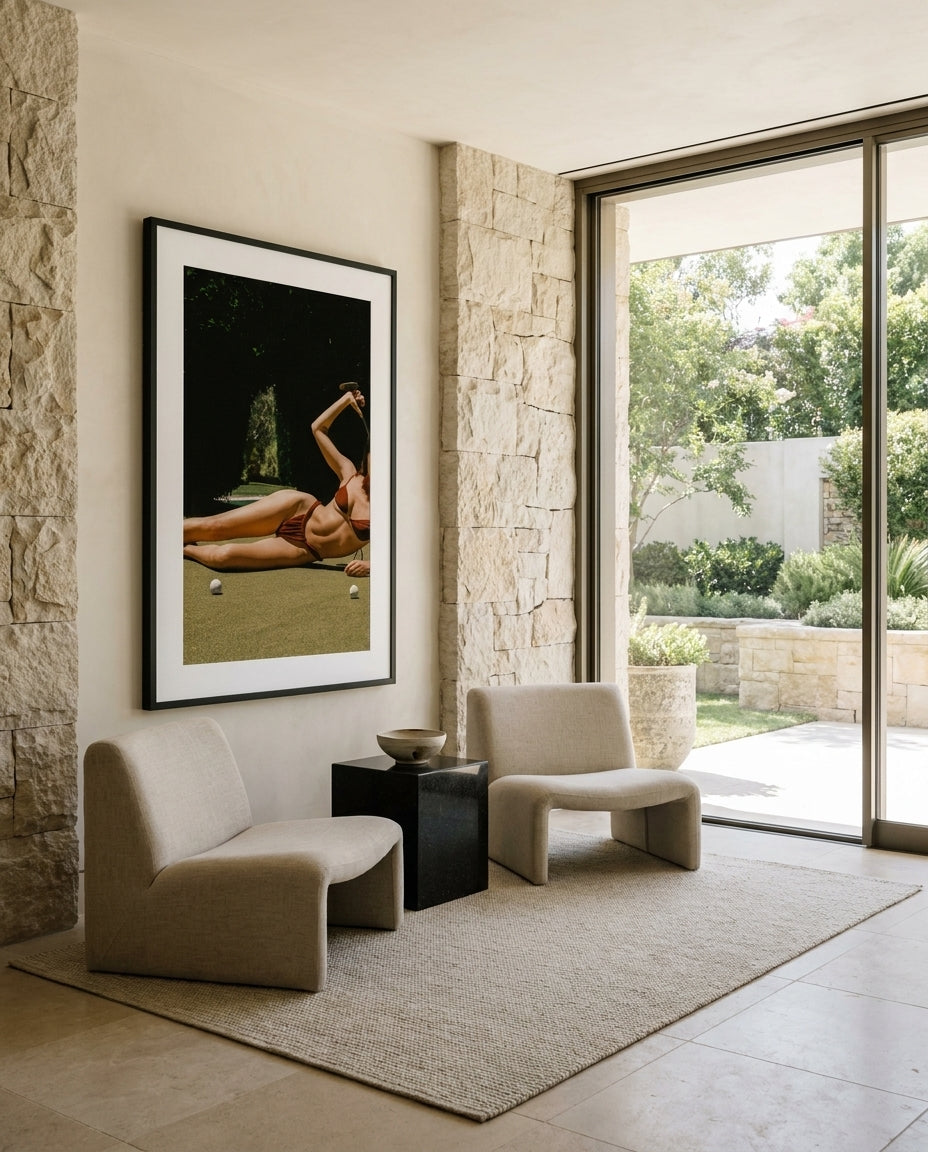
What size wall art do I actually need? It's the question hovering behind almost every hesitant cart on our site, and honestly, you deserve better than the vague advice floating around the internet, something about two-thirds of something, measured from somewhere. After framing tens of thousands of artworks at our West Gosford facilities, we can tell you exactly which sizes end up on which walls, and which orders come back with a wistful "I wish I'd gone bigger", which is, for the record, the only sizing regret we ever hear. In this guide you'll find the working formulas, wall by wall and room by room, in centimetres and inches, so you can order once and love it. Here's the short answer for the impatient: your art should fill 60 to 75 percent of the visible wall width above furniture, the centre of the piece should sit around 145 to 152 cm (57 to 60 inches) from the floor, and when a wall is wider than 2.5 metres, one large piece or a considered set will always beat a scatter of small frames. Now for the detail, because no two walls in your home are quite the same. Amalfi by Carson Grzegorczyk | Art Print · Apres by Carson Grzegorczyk | Art Print · Cali Cowgirl by Carson Grzegorczyk | Art Print The Formulas That Actually Work The furniture rule: above a sofa, bed, buffet or console, your artwork (or the outer edges of a set) should span 60 to 75 percent of the furniture's width. A standard 2.2 metre sofa wants roughly 130 to 165 cm of art width, which is why our 100 x 130 cm and 120 x 150 cm framed pieces hang above so many Australian sofas. Go under 60 percent and the art floats awkwardly above the couch; go over 85 percent and it crowds the furniture's silhouette. The empty wall rule: when there's no furniture to anchor to, work from the wall itself: your art should span 50 to 65 percent of the wall width. A 3 metre wide wall wants roughly 150 to 195 cm of artwork. This is exactly where a single 120 x 150 cm landscape piece, a 70 x 140 cm panoramic, or a considered three-piece set really earns its keep. The eye-line rule: hang so the centre of your artwork sits 145 to 152 cm from the floor. Galleries hang at 152 cm (60 inches); homes read slightly better a touch lower because you tend to sit more than you stand. Above furniture, a different rule takes over: leave 15 to 25 cm between the furniture top and the bottom of the frame, and let the eye-line rule step aside. Our hanging guide walks you through the mechanics, hooks and heights in detail. The viewing distance rule: the further away you're standing, the bigger the art needs to be to hold the wall. From a hallway, you're viewing at about 1.5 metres; from a kitchen island you might be looking across the living room from 6 metres away. As a working rule, your art width should be at least a quarter of the viewing distance, which is why open-plan Australian homes eat small art alive, and why customers in them consistently size up. In ten years of framing, no customer has ever told us their art turned out too big. Every sizing regret we've ever heard runs the other way. See Your Art on Your Wall Before You Spend a Cent Formulas take the guesswork out of dimensions, but a piece of art you're going to live with deserves more certainty than arithmetic, and this is where buying directly from the maker changes everything. Send our team a photo of your wall with the width and height, and we'll mock your shortlisted artworks onto your actual wall, at true scale, free, usually within a business day. Not a generic room render: your wall, your light, your furniture, with the exact piece in the exact size you're weighing up. Customers tell us this is the moment a maybe becomes an order, because you're no longer imagining the artwork, you're looking at it. It stacks nicely with everything else that makes the decision safe. Every product page zooms right in to print resolution, so you can inspect brushwork and detail before committing to a 150 cm piece. The paper-template trick we'll get to below costs nothing and settles the size question in an afternoon. And if the finished piece still isn't quite right in the room, our 30-day exchange policy means the decision is adjustable, not final. Between the mockup, the zoom and the template, choosing art unseen stopped being a leap of faith some time ago; the tools exist, and they're all free. Start a shortlist from the living room collection or the extra large pieces, then send us the wall. The Wall Width Cheat Sheet Under 1.5 metres (hallway ends, powder rooms, between windows): one 50 x 70 cm or 60 x 90 cm piece, portrait orientation. Small walls love a single strong image far more than a cluster. 1.5 to 2.5 metres (bedroom walls, dining nooks): a 70 x 100 cm as the single hero, or a pair of 50 x 70 cm prints hung 5 to 8 cm apart. Our bedroom wall art collection is built around exactly these dimensions. 2.5 to 3.5 metres (living room feature walls): this is 100 x 130 cm and 120 x 150 cm territory, or a 70 x 140 cm panoramic above furniture. For a 3 metre wide wall specifically, a 120 x 150 cm piece or a triptych spanning about 170 cm sits right in that 50 to 65 percent band. Over 3.5 metres (open-plan spaces, double-height voids): one oversized piece with breathing space around it will always beat any attempt to fill the wall. A 120 x 150 cm hero with generous margins reads intentional; six medium frames scattered across it reads like a waiting room. Start at the extra large wall art collection and trust the scale. Citrus Sun by Carson Grzegorczyk | Art Print · Game, Set, Match by Carson Grzegorczyk | Art Print One Piece, a Pair, or a Triptych? Choosing between one large artwork and a set is really a proportion decision, not a taste decision. A single piece concentrates attention and suits walls with one natural focal point. A pair introduces rhythm and suits symmetrical rooms, either side of a bedhead being the classic case. A triptych, three related pieces hung together as one composition, solves the specific problem of very wide walls: it covers a span a single frame can't, while keeping one unified image or palette across the wall. Here's how to size a triptych for a feature wall: treat the three frames plus their gaps as ONE artwork and apply the 60 to 75 percent furniture rule to the total span. Three 50 x 70 cm portrait frames with 6 cm gaps span 162 cm, right in the sweet spot above a 2.2 to 2.4 metre sofa. Keep your gaps consistent at 5 to 8 cm; wider gaps dissolve the composition into three unrelated pictures. Hang all three centres at the same height, and if you own one, use a laser level rather than a spirit level, because three frames will multiply any drift. Browse our 3-piece art sets, which are composed as triptychs from the start, so the palette and flow across the frames is already resolved for you. Pairs deserve one specific tip: hang them so their combined span plus gap follows the same 60 to 75 percent rule, and match your frames exactly. Mixed frame finishes work in eclectic gallery walls; in a pair they just look like a stocktake mix-up. Our guide on sizing art above a king bed works through the pair maths for the most common bedroom case. Room by Room Living room: the largest wall usually faces the sofa or holds the TV. Opposite the sofa, size for the 4-plus metre viewing distance, which means going large. Above the sofa, the furniture rule takes over. Explore living room wall art sized for both cases. Bedroom: above the bedhead, art should span 60 to 75 percent of the bed width: roughly 110 to 135 cm of art above a queen, 120 to 150 cm above a king. Portrait pairs work beautifully when the ceiling is high; a single landscape piece calms the room, which is rather the point of a bedroom. Dining room: art here is viewed sitting down, so drop your centre height to about 140 cm. A buffet wants the furniture rule; a bare dining wall takes a confident single piece from the dining room collection. Hallway: viewing distance here is under 2 metres, so this is the one place small art really shines. A run of same-size frames at consistent spacing turns a corridor into a gallery. Keep the centres at 150 cm; hallway art hung too high is the most common mistake we see in customer photos. Home office: size for the camera, not the room. On video calls the wall behind you is cropped tight: one 70 x 100 cm piece centred in frame reads considered without shouting. Our abstract collection is the customer favourite here because it adds colour without legible content over your shoulder on the Zoom call. Kids' rooms and nurseries: hang lower. Children experience their rooms from lower eye-lines, so nursery art centred at 120 to 130 cm reads correctly to the room's actual audience. The nursery wall art collection pairs naturally with a lower hang. Clover by Belinda Stone | Framed Canvas Wall Art · Gather by Belinda Stone | Framed Canvas Wall Art · Forever by Belinda Stone | Framed Canvas Wall Art Framed Print or Canvas at Each Size? Size interacts with format more than most guides let on. Framed fine art prints, printed on 230gsm archival paper and set in solid timber in oak, black or white, carry a border and a glass-fronted, gallery-style presentation that suits considered, formal hangs; the frame adds around 3 to 4 cm to each dimension, which matters when you're working to a tight 60 to 75 percent target. Framed canvas reads softer and more contemporary, sits slightly prouder of the wall, and at large sizes weighs less than a framed glass-front print, which your wall anchors will thank you for at 120 x 150 cm scale. The practical rule we give customers is this: under 70 x 100 cm, choose on aesthetics alone. At 100 x 130 cm and above, canvas earns extra points for weight and framed prints earn extra points for formality, and either choice is right if the size is right. What actually spoils walls isn't the format, it's undersizing, hanging too high, and skipping the paper-template step we're about to walk you through. Designer Tips to Get It Right Before You Order Make a paper template. Tape newspaper or butcher's paper cut to the exact artwork dimensions on the wall, and live with it for two days. This costs nothing, and it has saved more customers from undersizing than every formula in this guide combined. Start small if you're nervous, on paper only. The smallest sizes of any artwork print on the same 230gsm archival paper with the same inks as the largest, so an A5 or A4 print from $9.95 is a genuine material and colour sample. Check it in your room's light, then order the wall-sized piece with confidence. Use the product page zoom. Every artwork on our site zooms right in to print resolution, so you can answer the will-it-be-sharp-at-150cm question honestly before you buy. Measure the wall, not the memory of the wall. Width at the widest point, height floor to ceiling, and note anything the art has to clear: light switches, architraves, that one power point in the awkward spot. Two minutes with a tape measure beats an exchange email later, though our 30-day exchange policy exists for exactly those moments. Custom sizes exist for the walls in between. If your wall sits awkwardly between our standard dimensions, we print custom sizes at West Gosford: the artwork is scaled properly to YOUR wall, not cropped to squeeze into a stock frame. When you're torn between two sizes, always take the larger. Ten years, tens of thousands of framed artworks, zero too-big complaints. The statistics are in, and they're on your side. We frame every piece to order on the NSW Central Coast, dispatch framed art within 24 hours on standard sizes, and deliver Australia-wide, with international shipping available to more than 40 countries. Whether you're sizing one hallway print in Melbourne or a whole open-plan wall in London, the formulas are the same, and the free digital styling service exists so you never have to buy blind: send us a photo and your measurements, and we'll mock your shortlisted artworks onto your actual wall to scale before you commit a dollar. Once it arrives, the hanging guide will get it on the wall straight, first go. Frequently Asked Questions What size wall art should I hang above my sofa? Span 60 to 75 percent of your sofa's width, and leave 15 to 25 cm between the sofa back and the bottom of the frame. For a standard 2.2 metre sofa, that works out to roughly 130 to 165 cm of total art width: a single 100 x 130 cm or 120 x 150 cm landscape piece, a 70 x 140 cm panoramic, or a triptych spanning the same range. What's the best canvas print size for a 3 metre wide wall? Aim for 50 to 65 percent of the wall width, which comes out at roughly 150 to 195 cm of artwork. A single 120 x 150 cm framed canvas in landscape orientation is the cleanest solution; a three-piece set spanning about 170 cm including the gaps gives you the same presence with a little more rhythm. If there's furniture against the wall, size to the furniture instead: 60 to 75 percent of its width. How high should I hang wall art? Centre your artwork at 145 to 152 cm (57 to 60 inches) from the floor on open walls. Above furniture, leave 15 to 25 cm of space above the furniture line and let that rule take priority. In dining rooms, drop the centre to about 140 cm because you're viewing seated, and in children's rooms hang at 120 to 130 cm. Is it better to have one large piece or several small ones? On walls wider than 2.5 metres, one large piece or one considered set almost always reads better than several small frames, because viewing distance grows with wall size and small art loses its presence beyond about 3 metres. Small pieces really do shine in hallways and tight walls where you're standing close. How do I size a triptych or 3-piece set? Treat all three frames plus their gaps as one artwork, and apply the same rules: 60 to 75 percent of furniture width, or 50 to 65 percent of wall width. Keep the gaps consistent at 5 to 8 cm, and hang all three centres at exactly the same height. Sets composed as triptychs from the start have already resolved the colour flow across the frames for you. Can I get a custom size if my wall is unusual? Yes, absolutely. Every artwork is printed and framed to order at our Central Coast facilities, and custom dimensions are available when the standard sizes don't quite fit your wall. Your artwork gets properly rescaled to your measurements, not cropped to fit. What if I order a size and it looks wrong in the room? Our 30-day exchange policy covers change of mind on standard-size artworks: exchange or store credit, with return shipping at your cost. The paper-template test and the free digital styling mockup exist to make that unnecessary, and between them they almost always do. Can you help me choose the right size for my specific wall? Yes, that's what our free digital styling service is for: send us a photo of your wall with the width and height, and our team will mock your shortlisted artworks onto the photo at true scale, usually within a business day. It's the closest thing to trying art on at home without dragging a ladder around. Size sorted? Start with our extra large wall art, browse the full wall art collection, or dip into more sizing and styling guides over on On the Wall.
Learn more