

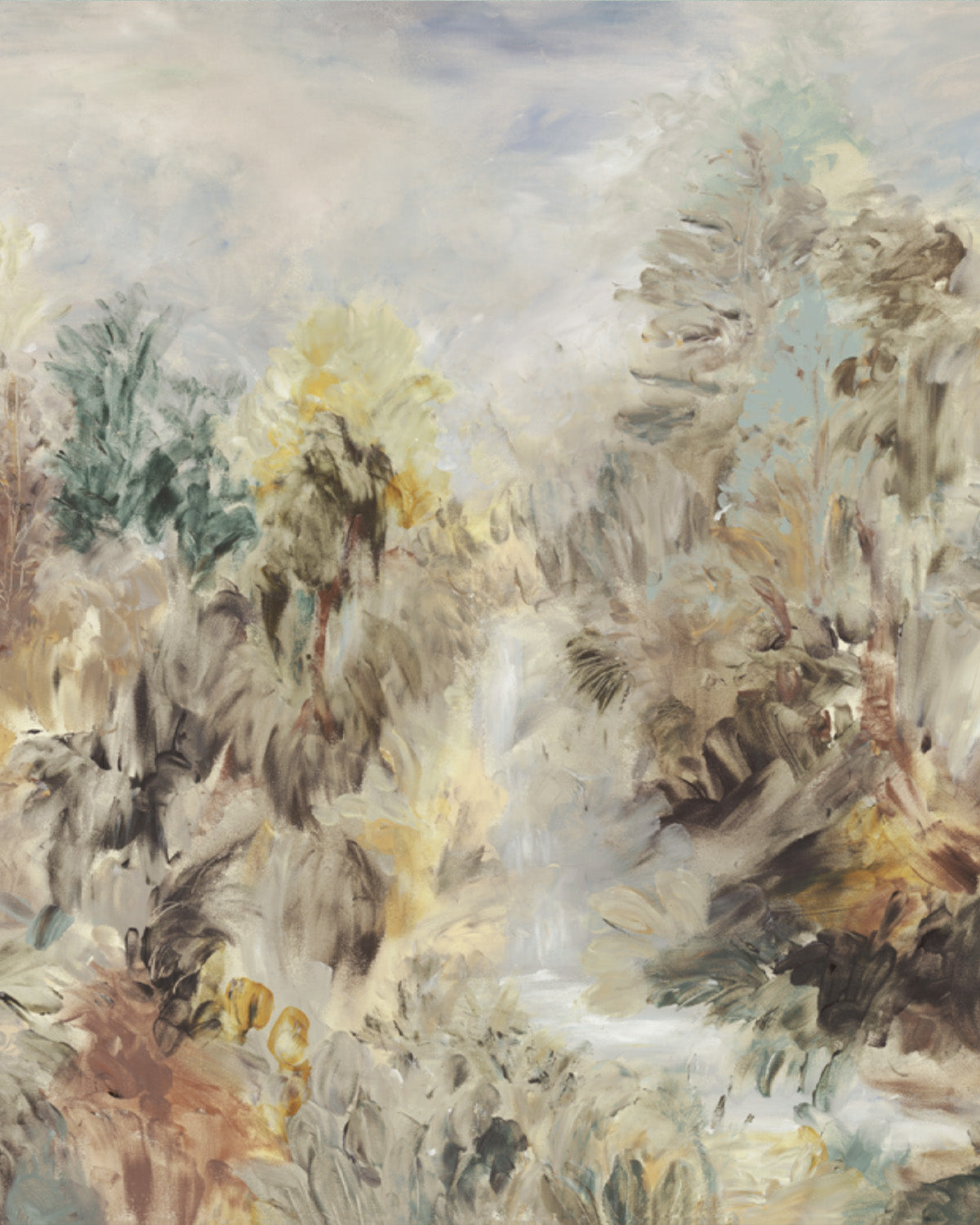
The living room is where a mural earns its price. It is the biggest wall in the house, the one most guests see, the one on the back of every Zoom call. If any room can carry a hand-painted panoramic wallpaper, it is this one — and yet most Australian living rooms still default to a safe wall colour and a framed print, settling for a space that looks politely like everyone else's.
A mural is the single move that changes that. Not a loud move, not a kitsch one — a composed, intentional swap of flat paint for a painted world. This designer's guide covers the six mural moods that work in living rooms, the scale rules that stop a good mural from overwhelming a space, and the real-life considerations Australian homes throw at you — from Queenslander verandahs to Sydney terraces to coastal glare.


Windswept Valley Hand Painted Mural Wallpaper · Daintree Botanical Panoramic Mural in Sand Beige Wallpaper · Chinoiserie Garden Panoramic Painted Mural in Sage Green Wallpaper
Why the Living Room Is the Right Room for a Mural
Bedrooms are intimate, hallways are brief, dining rooms are usually smaller. The living room is the only space in most homes with the three things a mural needs: a generous wall, a long sightline, and a reason for people to actually look at it. You sit in a living room. You entertain in one. You watch the light shift across the wall over the course of an afternoon. A mural rewards that kind of attention.
It is also the room that takes the most design punishment. Television, sofa, rug, lighting, shelving, coffee table, console, art — the visual budget fills up fast, and the standard response is to keep the walls quiet so nothing argues. A well-chosen mural inverts that logic: it becomes the anchor, and the rest of the room falls into supporting roles. Suddenly the sofa does not need to make a statement, the rug does not need a pattern, the shelving does not need styling gymnastics. The wall does the heavy lifting. This is the same principle behind our broader 2026 mural trend guide — but the living room is where the thesis is proven.
The Six Living-Room Mural Moods
Every successful living-room mural belongs to one of six moods. Pick the mood first, then pick the design within it. The mood decides how the room feels; the design decides how it looks.
1. Panoramic Landscape — the "view you don't have"
The most powerful mural move in a living room is to hang the view the house cannot otherwise give you. A terrace in Redfern gets a mountain horizon. A suburban brick veneer in Adelaide gets a misty valley. An apartment in Melbourne gets a rolling country road. This is not escapism — it is compensation. The mural delivers the single feature the architecture withholds, and the room stops feeling boxed in. Panoramic landscapes work best on the longest uninterrupted wall, usually behind the sofa or opposite the main window; the eye reads them as an opening rather than a pattern. Windswept Valley Hand Painted Mural Wallpaper has the soft, windblown feel of an Australian ridgeline at dusk; Homestead Trail Panoramic Wallpaper Mural Wallpaper reads more like a walk through a cleared paddock at golden hour.
2. Botanical Forest / Canopy — cocooning and nature-in-the-home
Where a panoramic landscape opens the room outward, a botanical canopy closes it inward. Painted trees and overhead leaves wrap the space, giving the living room the quality of a clearing — a protected place to sit. This mood is especially powerful in homes surrounded by concrete, traffic, or the relentless flat light of a suburban street. Sand and stone palettes keep the effect sophisticated; green and khaki tones push it tropical. Try Daintree Canopy in Sand Beige for a warm, pared-back botanical — a living room that reads like linen and still air. Daintree Canopy in Khaki Green is the same composition with a deeper rainforest temperament, better suited to homes with plenty of natural light.


Vintage Landscape Panoramic Painted Mural Wallpaper · Vintage Willow Garden Panoramic Mural Wallpaper
3. Architectural / Heritage Grand Living
This mood swaps wilderness for history. Painted villages, stone bridges, columned gardens, terracotta rooftops — the mural becomes an old-world backdrop that lifts the living room into something quietly ceremonial. It works particularly well in period homes: Federation, Victorian terrace, Art Deco apartment, Hamptons-style renovation. Vintage European Countryside is the classic example — a painted horizon line with rooftops and cypress, reading almost like a mural you would find in a 19th-century salon. Vintage Willow Garden is softer and more pastoral, with a willow-framed garden path that gives the wall depth without pulling the eye too hard. Both pair with linen sofas, brass lighting, and restrained art.
4. Heritage Chinoiserie — classic grand living
Chinoiserie is the most enduring mural tradition on earth — painted garden scenes with birds, blossoms and trailing branches, originally hand-painted onto silk for European drawing rooms. The contemporary version is less literal, more atmospheric, and scales down to modest Australian living rooms without looking like a costume. Done well, a chinoiserie mural ages better than almost any other wall finish — it is already "vintage" on day one, which means it cannot date. Sage green, soft blue, and navy are the three palettes that read modern: Chinoiserie Garden in Sage Green keeps the tone light and garden-room in feel, while Chinoiserie Garden in Soft Blue has a cooler, more Hamptons sensibility.
5. Abstract / Textural — the modern gallery-wall alternative
Not every living room wants a painted forest. Abstract and textural murals — gradient washes, painterly colour fades, mineral-inspired striations — give you the scale of a mural without a literal scene. Think of them as a single enormous painting sized to your wall: one generous gesture replacing twelve small framed pieces. Mineral Fade in Stone Taupe is a near-neutral example, warm taupe bleeding into soft sand, reading as texture rather than pattern. Mineral Fade in Grey runs cooler, closer to limewash, and pairs easily with black joinery and chrome.


Mineral Fade Panoramic Painted Mural in Stone Taupe Wallpaper · Mineral Fade Panoramic Painted Mural in Grey Wallpaper
6. Moody Dark Landscape — drama and contrast
The final mood is the one that turns a living room into a room you want to be in after dark. Moody, low-light landscapes — misty forests, deep waters, fog-softened horizons — give a living room gravity. They are particularly effective in south-facing rooms with cool light, or in any room used mostly at night under warm lamps. Misty Blue Forest pushes the room into a quiet, fog-at-dawn palette; Moody Seagrass is the coastal cousin — deep teal carrying the memory of water and reed. Both carry a charcoal or inky-blue sofa well, and both reward a single warm light source more than an overhead.


Moody Seagrass Panoramic Painted Mural Wallpaper · Daintree Botanical Panoramic Mural in Khaki Green Wallpaper · Homestead Trail Panoramic Wallpaper Mural Wallpaper
Scale Rules for Australian Living Rooms
The average Australian living-room feature wall is around 3 metres wide and 2.4 to 2.7 metres tall. New-build project homes push toward 3.5m wide with 2.55m ceilings; older Queenslanders, Californian bungalows and warehouse conversions run to 4 or 5 metres. Exact wall dimensions are non-negotiable — every OEO mural is printed custom to the measurements you supply, so there is no cropping, no awkward repeat, no trimmed-off tree. Our how-to-measure guide covers the process, including the 5cm overhang we build in for wall imperfections.
The right mural does not fight the room — it reassigns it. The mural becomes the subject; the furniture becomes the foreground.
- Leave 10–15cm of wall breathing above the sofa. If the sofa is 85cm tall, start the mural at roughly 95–100cm from the floor, not at the back of the cushion. The gap lets it read as a wall, not a headboard.
- Do not centre the mural on the television. If the TV is on the mural wall, plan the composition around it — often by offsetting the TV and letting the mural dominate the centre. Otherwise, pick a different wall entirely.
- Avoid wrapping around external corners. Panoramic landscapes in particular look best on a single flat plane. Internal corners are fine; external corners fight the scene.
- Consider ceiling height. A tall mural with a clear horizon line reads calmer in rooms under 2.5m; a dense botanical canopy suits higher ceilings because the top half has room to breathe.
Where the Mural Goes
There are four reliable positions for a mural in a living room, and the right one depends on the layout of the rest of the space.
- Behind the sofa. The most common and usually the correct choice. The sofa frames the mural; the mural grounds the sofa. Works with panoramic landscape, botanical canopy, abstract textural, heritage chinoiserie.
- Fireplace wall. In period homes with a working or decorative fireplace, the mural can wrap the whole wall around the mantel — this is where moody dark landscapes shine, creating a painted hearth effect.
- Feature end-wall. In long, narrow rooms (classic terrace living rooms), the short end-wall is often the most visible. A mural here closes the sightline elegantly and stops the room feeling like a corridor.
- The longest panoramic wall. In open-plan homes, find the longest uninterrupted run of wall and let the mural travel its full length. This is where wide panoramic landscapes pay off — you get an entire painted horizon instead of a cropped scene.
Art Pairings — When to Layer, When to Let It Be
The instinct with any wallpaper is to hang something in front of it. With murals, resist that instinct until you have lived with the wall for a week. Panoramic landscapes and dense botanical canopies are already the art — adding a framed piece over the top usually weakens both. Abstract textural murals and heritage chinoiserie can carry a single framed piece more gracefully, especially a small portrait or a crisp black-and-white photograph that reads as a punctuation mark rather than competition.
If you do layer, the safest move is a single solid timber frame with white finish or oak finish, hung lower than you normally would (around 120–130cm centre-height rather than gallery-standard 150cm). Our full approach to mixing wallpaper with framed art is covered in All Four Walls: when to wrap a room in wallpaper, or not.

Misty Blue Forest Panoramic Painted Mural Wallpaper
Sofa, Furniture and Lighting With Murals
Once the wall becomes the main event, the furniture briefs itself.
- Sofa. Solid, low-contrast upholstery works best: linen, boucle, washed cotton, brushed velvet. Oatmeal, bone, chalk, dove, inky navy, charcoal and olive all sit well in front of any of the six moods. Busy patterned sofas almost always fight the wall — save them for rooms with plain paint.
- Coffee table. Round or organic shapes soften the straight lines of a framed mural. Solid timber, travertine, or a dark stone like pietra grey all work; glass disappears in front of a busy botanical, which is often welcome.
- Rug. Plain or tonally textured. A second pattern on the floor compounds visual load quickly. If the mural is abstract you can push the rug a little harder; if the mural is a painted scene, stay quiet underfoot.
- Lighting. Warm 2700K lamps at eye level — floor lamps, table lamps, wall sconces — bring a painted mural to life after dusk. Cool overhead downlights flatten it. Plan for two lamp-height light sources on the mural wall at minimum, ideally three.
Open-Plan Living Rooms — Using a Mural to Define the Zone
Modern Australian floorplans put kitchen, dining and living into a single room. The design problem is always the same: how do you signal that this corner is the living zone, not an extension of the dining area? A mural is the cleanest answer. Walls define rooms more powerfully than rugs or furniture; a single painted wall reads as an "enclosed" space even when no physical enclosure exists. Keep the mural on the wall behind the sofa and do not extend it into the dining or kitchen zone — the contrast between painted mural wall and plain-painted kitchen wall is what does the zoning work. For more on matching a mural to the living-room role specifically, see our guide to choosing the right living-room wallpaper.
Coastal Australian Homes and Queenslander Living Rooms
Coastal and sub-tropical homes throw two specific challenges at mural design: very bright natural light, and wide, open living areas running from one end of the house to the other. Bright coastal light favours softer, lower-contrast murals — ultra-dark moody landscapes can feel oppressive under a midday sun streaming through louvres, while a heritage chinoiserie or a pale abstract mineral fade will hold up from breakfast through sunset. Matte-finish wallpaper (OEO's default on every mural) is the right choice for coastal interiors; anything satin or semi-gloss will bounce light unevenly.
For Queenslander living rooms in particular, the long central wall between the verandah doors is usually the ideal mural canvas. A wide panoramic landscape or a pale botanical canopy creates a "second view" to balance the real view outside, keeping the room feeling layered rather than empty. Our coastal art collection works alongside, if you want to bring framed pieces into adjacent rooms.

Chinoiserie Garden Panoramic Painted Mural in Soft Blue Wallpaper
Inner-City Apartments — How Murals Read at Close Range
A smaller living room does not rule out a mural — it just changes which mural. In a 3-metre-wide apartment lounge, you sit 2 to 2.5 metres from the wall and the mural reads almost like a painting you are standing in front of. That proximity favours abstract textural murals (forgiving at any distance) and tightly composed botanicals (which reveal detail as you move closer). Wide panoramic horizons can still work, but they lose some "view" quality when the viewer cannot step back far enough to take the whole scene in.
The other apartment consideration is light. Inner-city apartments often have a single window on one wall and almost no natural light on the opposite wall — which is usually the mural wall. Lean into it. A moody dark landscape in a low-light apartment living room carries; a pale pastel in the same spot can look anaemic. Light the room for the mural, not against it.
Peel-and-Stick Murals for Renters
If you rent, you can still have a mural. Every OEO mural is available as peel-and-stick wallpaper — a removable, repositionable vinyl that installs without paste and comes off cleanly when you leave. The finish matches our paste-the-wall option; the difference is installation method and removability. For a living-room wall, peel-and-stick is a legitimate choice, not a compromise. Wall needs to be smooth, clean, and fully cured (new paint needs 4 weeks). Our wall preparation guide covers every step. Get the prep right and the mural sits flat for years; skip it and you will see every bump.
Installation Realities
A living-room mural is usually a single large panel (or matched set). Not difficult to install, but unforgiving — you have one chance to align the panels, and living-room walls are the most visible in the house, so any error shows. Two install choices:
- DIY with paste-the-wall or peel-and-stick. Realistic if you are confident with a straightedge, a plumb line and a wallpaper smoother. Budget a full day for a 3-metre mural with two people. Our step-by-step mural hanging guide covers every stage, including the corner-trim work.
- Hire a professional installer. For any mural over 3 metres wide, or any wall with multiple electrical outlets, switches or irregular architraves, a professional installer will save you time, paste and grief. Our wallpaper installer directory lists vetted installers across Sydney, Melbourne, Brisbane, Perth, Adelaide, Gold Coast, Canberra and regional Australia.
Either way, order a $4.99 wallpaper sample (48cm x 40cm) before committing. Hold it against your living-room wall for a full day — morning, afternoon and evening — because mural tones shift more between light conditions than flat paint, and you want to see exactly how the colour behaves before it is printed at full size.
Custom Murals — Your Own Landscape, Your Own Memory
Some of the most memorable living-room murals we produce are custom, not from the existing collection. A photograph of the coastline where you grew up. A painted rendering of the view from a honeymoon apartment. A family sketch scanned and scaled up. A commissioned artwork by a local artist, produced as a full-wall mural. Every OEO mural is printed custom-sized to your wall anyway, so the step to a fully custom scene is smaller than you think — our custom wallpaper service covers the process from image brief to file preparation to final print. If you have a scene that means something to you, the living-room wall is where it deserves to live.
Frequently Asked Questions
Is a mural too dominating for a living room?
A mural becomes dominating when it fights the room, not when it fills the wall. Chosen as the anchor with a quiet palette around it — oatmeal sofa, plain rug, warm lamps, restrained art — the mural settles in rather than shouting. The rooms that feel overwhelmed are almost always the ones where the mural was layered on top of an already-busy space.
Can I hang framed art over a mural?
You can, but usually should not. Panoramic landscapes and dense botanicals are already the art. Abstract textural and heritage chinoiserie murals carry a single framed piece more gracefully — particularly a small solid timber frame with oak finish, white finish or black finish, hung a little lower than gallery height. When in doubt, live with the bare mural for a week first.
Does a mural date faster than paint?
No — most murals age better. Painted landscapes, heritage chinoiserie and abstract fades do not belong to a single trend year the way a bold graphic pattern might. They are derived from centuries-old traditions (painted drawing rooms, botanical hand-painting, mineral fresco) and already read as timeless the day they go up. Paint colours, by contrast, shift with the trend cycle.
Is peel-and-stick viable for a living-room mural?
Yes, when the wall is properly prepared. Our peel-and-stick vinyl is removable and repositionable, and matches the visual finish of the paste-the-wall option. For renters it is the only way to have a living-room mural without losing the bond. Limiting factor: wall condition. Smooth, clean, fully cured paint only — textured, freshly painted or damp walls will reject the adhesive.
How much mural do I need for a living-room wall?
Measure the full wall width and height in centimetres, add 5cm overhang to each edge, and order the mural printed to those exact dimensions. Every OEO mural is custom-sized — you are not buying pre-cut rolls to piece together. Our how-to-measure guide covers skirting, architraves and corners.
What does a living-room mural cost?
OEO murals are priced per square metre, so the total depends on wall size. A typical 3m x 2.5m feature wall runs well below the cost of a commissioned artwork at the same scale, and covers the whole wall rather than a fraction. The $4.99 sample comes off the final order. We ship globally with all import duties paid — Sydney, Auckland, London or Los Angeles, the price you see is the price you pay.
What if I love the mural but my partner hates it?
Start with two samples of two shortlisted murals — not a single wall of a single mural. Shared living-room decisions rarely come down to yes-or-no; they come down to choice. Taping two 48cm x 40cm samples on the wall for a few days (morning light, evening light, TV on, TV off) almost always surfaces the one both people can commit to. Often the answer is a softer mood than either of you first pictured.
How do I clean and maintain a living-room mural?
Both our paste-the-wall and peel-and-stick murals are wipe-clean. Soft microfibre cloth, barely damp with water and a drop of mild detergent, handles everyday marks. Avoid abrasive sponges and strong solvents. Keep direct sunlight off the mural where possible — not because the pigments fade (they are UV-stable) but because hard direct sun wears any finish faster than indirect light. Treat it like a well-made piece of furniture; it will outlast the sofa.
Ready to find your living-room mural? Browse the full painted wall mural collection, explore the broader wall murals range, or read on with the dusty rose colour palette trend and the Japandi wallpaper guide for more colour and mood direction. Every OEO mural ships from our Central Coast facility with all import duties paid globally — the price you see is the price you pay, in Sydney, Auckland, London, Los Angeles, or anywhere else.


