

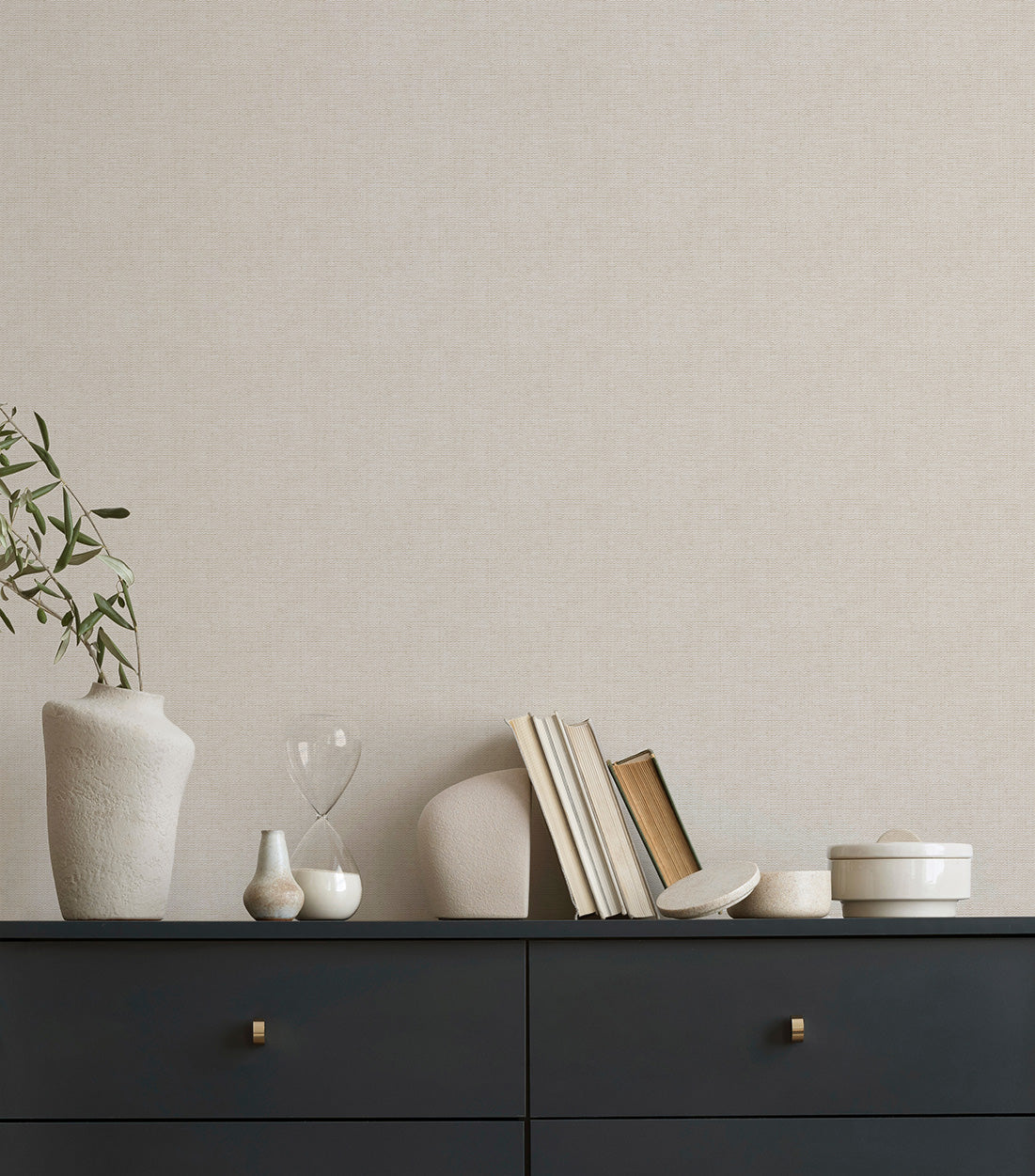
"Australian made" on a wallcovering or artwork is either a manufacturing fact or a marketing garnish, and commercial specifiers are right to ask which. The difference shows up in lead times, colour control, replacement certainty, compliance documentation and what happens when something goes wrong at floor eleven of a fitout. This guide sets out what local manufacture actually changes on a project, and how to verify the claim.
Our position first: we design and make everything, artwork, fine art printing, canvas stretching, solid timber frames and Type II commercial vinyl wallcoverings, at our two production facilities in West Gosford, NSW. The argument below is the one we make with dispatch dates rather than flags.


Ashsa in Oat Commercial Vinyl Wallcovering · Banksia II Art Print · Citrus Tree Luxe in Soft Grey Wallpaper
What Local Manufacture Changes on a Project
- Lead time truth: made-to-order production in a couple of business days against import cycles measured in months. On fitout programs this is the difference between walls on the critical path and walls that simply arrive.
- Colour control as conversation: colour-directing a wallcovering or art series to a scheme is an iteration loop with our design team and samples, not a request lodged with an overseas mill's minimum-run queue, per the custom service.
- Replacement certainty: files and substrates held here mean a damaged panel or artwork reprints exactly, years later, in days. Import-supplied walls die by discontinued batch.
- Documentation without the chase: composition, emissions and origin paperwork (ours: no formaldehyde, no heavy metals, no solvents or latex inks, low VOC, Greenguard GOLD certified inks) from the people who actually made the product.
- Accountability with an address: when something needs fixing, the manufacturer, not a distributor's supplier's agent, answers, one contact through the trade program.
Every import step between a wall and its maker adds a week to the fix and a party to the phone call.
Verifying "Australian Made" Properly
The claim spans a spectrum: designed here, printed offshore; imported base stock, finished here; or manufactured end-to-end locally. For specification purposes, ask three questions. Where is the substrate produced and converted? Where does the printing physically happen? And who holds the production files? The answers determine everything above, and suppliers doing genuine local manufacture answer in one sentence. (Ours: printing, finishing and framing at West Gosford on state of the art equipment; frames cut and joined here by our own artisans on Italian machinery.) The specification-sheet method in our Type II guide pairs with this, construction facts plus origin facts is the whole diligence.
Where It Pays Off Most
- Compliance-led sectors: childcare, healthcare and education, where documentation and reprint provisions are project requirements, not preferences.
- Staged and multi-site programs: campus masterplans, hotel brands (per the hotel guide) and franchise fitouts that need stage four to match stage one exactly, per the volume guide.
- Fast-turn projects: staging (the stylist's guide), display suites and venue openings living on dispatch dates.
- Custom-heavy briefs: murals, brand-led wallcoverings and colour-directed art series, iteration is local manufacture's home ground.


Iconic Bondi B&W Art Print · Ashsa in Camel Commercial Vinyl Wallcovering
Designer Tips
- Write the origin question into your specification template, one line ("state manufacturing location of substrate, printing and finishing") ends the garnish problem.
- Use local iteration speed early: sample rounds cost days here, so run the colour loop at design development instead of compromising at tender.
- Put reprint provision into maintenance schedules on every project, it costs nothing with a local manufacturer holding files.
- For international projects, local manufacture plus duties-paid delivery (we ship to more than 40 countries) gives the QS one landed price with Australian accountability behind it.
- Tour the facility if you can, we host trade clients at West Gosford, and ten minutes beside the printers answers every diligence question at once.
Frequently Asked Questions
Why does Australian-made matter for commercial walls?
Lead time, colour control, replacement certainty, documentation and accountability, five project-mechanical advantages, not sentiment. Each one converts to schedule and budget protection on a real fitout.
How do I verify a wallcovering is actually made in Australia?
Ask where the substrate is converted, where printing physically happens, and who holds the files. Genuine local manufacturers answer immediately and specifically; a supply chain that cannot name its own factory has answered too.
Is Australian-made wallcovering more expensive?
Line-item pricing is competitive with quality imports, and whole-of-project pricing usually favours local: no minimum-run hostages, no freight-cycle buffers, no deadstock, and repairs that cost a panel instead of a redecoration. The economics of our whole-of-life guide compound with origin.
Are your frames made in Australia too?
Yes, every frame is solid timber, cut and joined at our facilities by our own artisans on Italian machinery, in oak, white and black finishes. The framing is manufacturing, not assembly.
Can local manufacture handle large commercial volumes?
Volume is scheduling, not strain: production parallelises across a program and sequences to fitout dates, per the volume programs guide. Our two facilities exist precisely for commercial scale.
Do you export Australian-made walls?
To more than 40 countries, with all import duties paid, international projects get local manufacture's control with none of the customs arithmetic.
What does "designed and made in-house" include at Olive et Oriel?
Design (in-house team plus our artist community), fine art printing with archival pigment inks, canvas stretching, hand trimming, solid timber framing, and Type II commercial vinyl manufacture, end to end at West Gosford, NSW.
Specify with the makers: the Designer Trade & Commercial Program, Type II commercial vinyl, art in neutrals and custom wallpaper. Made in Australia, provably.


