
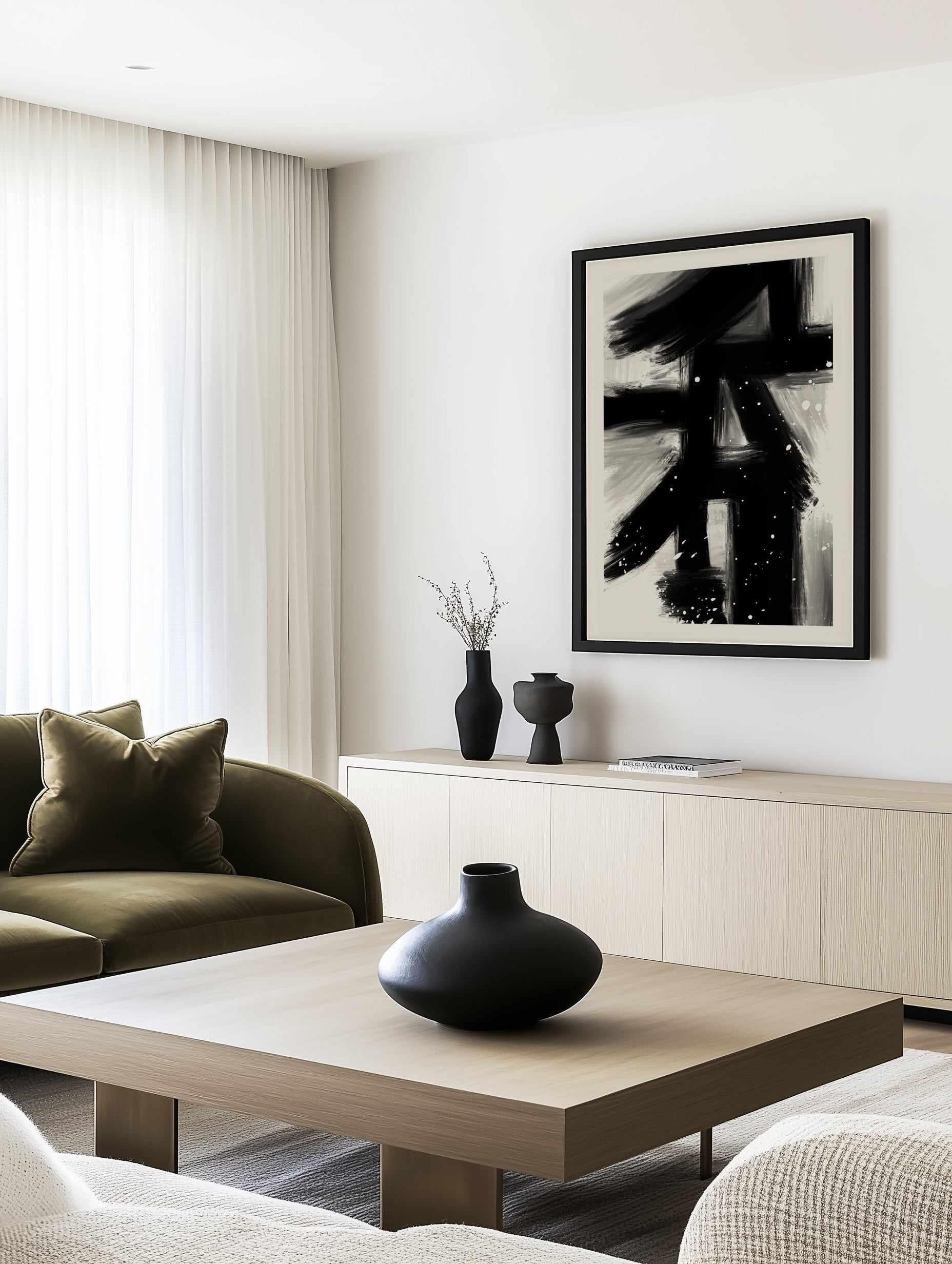
"But what does it mean?" is the question abstract art has been asked for a century, and the reason many people hesitate to hang it. The honest answer is better than the question deserves: an abstract work does not carry one hidden meaning waiting to be decoded. It carries an invitation, and the meaning is completed by the person looking. Once that clicks, choosing and living with abstraction stops feeling like a test you might fail.
This guide is about looking: what abstract artists are actually doing, how to read a work without a decoder ring, why your response is the point, and how meaning changes once a work lives on your wall. It comes from people who make abstract art daily, at our two production facilities in West Gosford, NSW, and who have watched thousands of customers find the work that means something to them.


Winter in Paris II · Blurred 13 · Acrylic Circles
What Abstract Artists Are Actually Doing
An abstract artist is composing with the same raw materials every artist uses, colour, line, weight, rhythm, tension, release, but without lending them to a subject. Kandinsky, one of abstraction's founders and a trained musician, made the comparison that still explains it best: music. Nobody asks what a chord progression means, yet everyone knows what it does to them. A minor key does not depict sadness; it produces something adjacent to it, directly. Abstraction is painting run on the same principle: colour and form working on you without translation.
This is why the standard anxieties dissolve on inspection. There is no vocabulary you are missing. The work is not laughing at you. What it asks for is not knowledge but attention, thirty seconds of actual looking, which is more than most walls ever get.
Nobody asks what a chord means. They ask how it feels. Abstract art wants the same question.
How to Look at an Abstract Work
A practical sequence, useful in a gallery and just as useful browsing the abstract painting collection:
- First response (three seconds): before analysis, notice what happened. Drawn in, unsettled, calmed, nothing? That reflex is data; roughly 95 percent of our responses run ahead of conscious reasoning, and first feelings are rarely wrong about fit.
- The eye's journey (thirty seconds): follow where the composition sends you. Good abstraction steers the eye deliberately, an entry point, a route, places to rest. If your eye keeps moving, the work is working.
- Weight and balance: notice where the visual mass sits and what answers it. Tension held in balance is the quiet engine of most compositions.
- The making: look for the decisions, a stroke that stops, a colour that almost clashes, an edge left rough. Knowing a work's marks were chosen changes how it feels; research on how people value art shows that beliefs about effort and intention measurably raise the experience.
- The title, last: titles are doors, not answers. Read the title after looking and notice what it opens.
Meaning Lives in the Viewer, and That Is the Design Feature
A photograph of the Amalfi coast means the Amalfi coast, on every wall it hangs on. An abstract field of blues means something different to a surfer, a pilot and someone who grew up beside a lake, and all three are correct. Philosophers of art describe this open, interpretive quality as central to how art communicates: the work signals more than one thing at once and is not literally true, so the viewer completes it.
For a home, this is not a bug but the entire point. The work you choose becomes yours in a way no literal image can, because half of what it means arrived with you. It is also why abstraction outlasts figurative trends on a wall: the meaning renews as you do. The blank wall it replaced was a room holding its breath; what the right work exhales is, precisely, you.


Abstract and Contemporary 9 · Aqua Strokes by Antonia Tzenova Art Print
Does the Artist's Intention Matter?
It matters the way a composer's intention matters: it shaped the thing, and knowing it can deepen the experience, but the experience does not wait for it. Some abstract works begin somewhere specific, a shoreline, a season, a piece of music, and abstract away from it; others begin in pure form. When we share an artist's starting point in a work's story, customers often report the work snapping into focus. Just as often, someone loves a work for a reason the artist never had. Both are the system functioning.
What matters more than intention is honesty about the making. A named creator, a real process, an original composition, the knowledge that a person made decisions, is part of what you feel when you look. That holds across our whole range, from our artist community to our in-house design team: an original work, a name and an eye behind it, made for your wall.
Living With Meaning: the Wall Changes the Work
The least discussed fact about abstract art: it keeps working after you hang it. A work seen daily at breakfast becomes a different work in winter light, after a hard week, beside a new sofa (scale rules in the living room guide). Owners routinely report noticing a passage of colour for the first time years in. This is the practical meaning of meaning in abstraction, not a puzzle solved once, but a relationship that keeps paying attention back. Choose the work that provokes a genuine first response, size it properly per our choosing guide, and let the rest accrue.


Dreams by Antonia Tzenova Art Print · Spiral by Antonia Tzenova Art Print
Designer Tips
- Shortlist by response, not explanation, the works you can't scroll past are the shortlist.
- Read the work's story after shortlisting; let it confirm or intrigue, never veto a genuine response.
- Hang meaningful work where you actually pause, facing the bed, over the reading chair, at the end of a hallway, not just where decorating convention points; the hanging guide covers heights.
- Revisit before replacing: a work gone quiet usually wants a new wall, not retirement. Rotation renews attention.
- Made to order at our facilities in a couple of business days and shipped to more than 40 countries with duties paid, when the right work appears, the logistics are the easy part.
Frequently Asked Questions
What is abstract art supposed to mean?
Nothing singular, and deliberately so. Abstract art composes colour, form and gesture to work on the viewer directly, the way music does, and leaves the specific meaning open for the viewer to complete. The right question is not what does it mean but what does it do to me, and any honest answer to that is correct.
How do I appreciate abstract art if I don't understand it?
Drop the word understand and give one work thirty seconds of actual looking: first feeling, then the eye's route through the composition, then the visible decisions in the making. Appreciation is attention, not education. The knowledge can come later and deepens rather than gates the experience.
Is abstract art meaningless?
No, it is multi-meaninged, which critics of the genre mistake for the same thing. A work with no fixed subject can still be precise about feeling: a composition holds calm, tension, energy or rest as deliberately as music holds a mood. Meaning that varies by viewer is meaning functioning as designed.
Why do people pay so much for abstract art?
For originality, the maker's hand, and the experience the work produces, the same reasons as any art. Interestingly, the research runs deeper: originals are consistently valued above perfect copies because we experience the artist's essence in them, and works we believe took skill and effort genuinely feel better to look at. The story of the making is part of the object.
Do I need to know art history to buy abstract art?
No. History enriches, our guides to the nine types and modern versus contemporary are short cuts, but the qualification for buying is having a wall and a response. Every confident collection started with one work someone simply liked.
What if my partner and I read an abstract work differently?
You will, and it is the best argument for abstraction in a shared home: one work, two private meanings, no argument required. Agree on palette, scale and energy, the room's needs, and let the meanings stay personal.
Can abstract art be wrong for a room even if I love it?
Only in scale or energy, both fixable at ordering time. A beloved palette in the wrong size is re-ordered in the right one; a high-energy work loved for the living room should simply not migrate to the bedroom. Love plus the sizing rules covers everything else.
Begin looking in the abstract wall art collection, or go deeper with what is abstract art. Designed and made on the Central Coast of NSW; shipped worldwide, all import duties paid.


