
Chinoiserie wallpaper is the most aspirational traditional pattern in American interior design. The hand-painted botanical panels that line the dining rooms of the most celebrated American homes represent the pinnacle of a design tradition continuous since the 17th century. Chinoiserie is not a historical artefact. It is a living design language with the deepest roots of any wallpaper category. Understanding its history, its visual logic, and its contemporary applications allows you to use it in a modern home with genuine confidence and without the sense of pastiche that underprepared use of traditional patterns can produce.
The term chinoiserie describes Western interpretations of Chinese decorative arts, a tradition that emerged in 17th century Europe as trade routes brought Chinese porcelain, silk, and lacquerwork to Western markets. European and American designers created their own interpretations: exotic birds in flowering trees, pagodas in landscape settings, and botanical scenes with a distinctly Eastern visual grammar rendered through Western compositional conventions. The result was a design language that has proved more durable than either of its source traditions. Chinoiserie reached its first peak in American interiors in the colonial and Federal periods. Its current moment is driven by the grandmillennial aesthetic, which has reintroduced traditional patterns to a new generation of American homeowners with the authority of design history behind them.
The American colonial interpretation of chinoiserie represents a genuinely new development in the tradition. American colonial designers and manufacturers, working in the late 18th and early 19th centuries, took the exotic botanical vocabulary of Chinese export wallpaper and applied it to the botanical content of the Western hemisphere: palms, plantain trees, magnolias, and the flowering trees of the Eastern seaboard. The result was a distinctly American chinoiserie rooted in the specific botanical environment of colonial America. Our colonial palm and plantation wallpaper patterns including Gilded Palm, Midnight Palms, and Savannah Blue draw directly on this American chinoiserie tradition, referencing the 18th century design language while using colour palettes and compositional choices that read as genuinely contemporary rather than period reproduction.


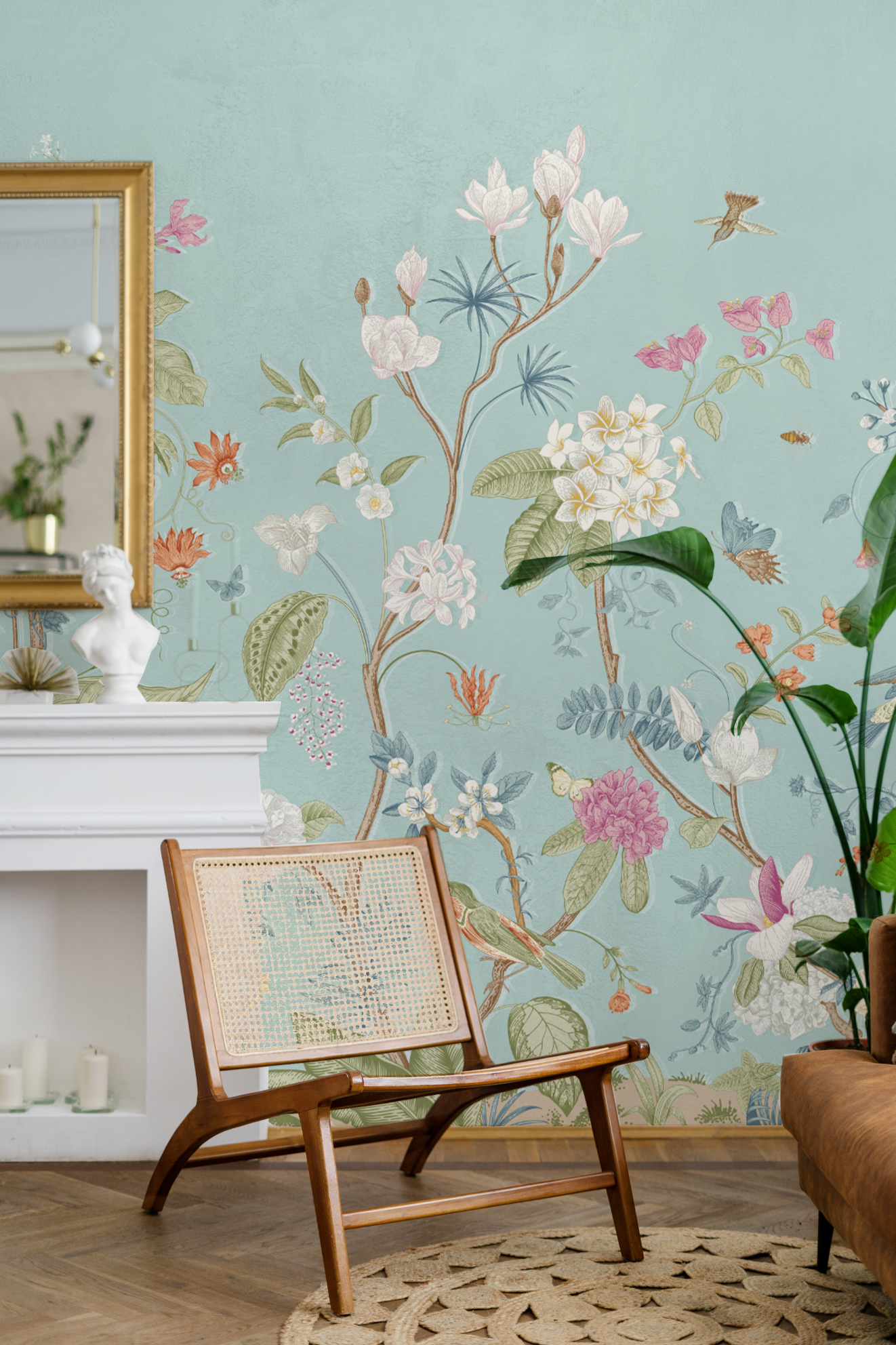
Vibrant Chinoiserie in Blue Wallpaper . Chinoiserie Garden in Teal Wallpaper . Chinoiserie in Spring in Blue Bird Wallpaper
Chinoiserie and the American design tradition have a relationship that goes beyond pattern preference. When chinoiserie first arrived in American homes in the colonial period, it was a marker of wealth, international connection, and cultural sophistication. Chinese wallpaper panels were among the most expensive decorative items available to wealthy American colonists, and their presence in a dining room or entrance hall communicated the owners access to global trade networks of the 18th century. This social dimension of chinoiserie has never entirely disappeared. The pattern continues to carry associations of cultivated taste, historical awareness, and the kind of design confidence that comes from understanding a tradition well enough to use it deliberately rather than merely decoratively. When you choose chinoiserie wallpaper for a room, you are placing the room in a tradition that connects American interior design to three centuries of East-West cultural exchange filtered through the specific social and architectural contexts of American domestic life from the colonial era to the present day.
The relationship between chinoiserie and the rooms it occupies is a relationship between equals. The pattern is strong enough to transform any room it enters, but it requires the room to meet it with equally strong architectural and material choices. A chinoiserie wallpaper in a room with inadequate ceiling height, poor moulding detail, or cheap furniture will not produce the effect that the pattern promises. The room must earn the wallpaper. Before choosing a chinoiserie pattern, assess the room architectural quality honestly. The moulding profile, the ceiling height, the quality of the floor material, and the proportions of the windows all contribute to whether the room will carry chinoiserie wallpaper with the authority the pattern requires and the weight the tradition deserves.
The practical question of pattern direction is particularly important with chinoiserie because of the pattern strong compositional character. Non-repeating chinoiserie wallpaper has a top and a bottom that must be hung correctly for the composition to read as intended. Panels must be installed in the correct sequence, from the correct starting position, with the correct orientation. The 48 hour acclimatisation period before installation is particularly important for chinoiserie patterns because the substrate expansion and contraction that occurs during acclimatisation can affect the alignment of the non-repeating composition at the panel joins. Allow the full 48 hours without exception. Maintaining chinoiserie wallpaper over time requires dusting with a soft brush two to three times a year and addressing any marks immediately with a barely damp cloth using gentle circular motion. Do not use cleaning products that contain bleach, abrasives, or alcohol on the wallpaper surface. A well-maintained chinoiserie wallpaper installation should remain in excellent condition for ten years or more with normal care and attention.


Chinoiserie Bamboo in Blue Wallpaper . Chinoiserie Garden in Blue Wallpaper
The Visual Language of Chinoiserie
The most common chinoiserie motif is the flowering tree or botanical composition with birds, insects, and botanical elements in a non-repeating or loosely repeating composition. Our Gilded Palm Wallpaper captures this tradition in a contemporary palette with warm gold and cream tones that reference 18th century chinoiserie while reading as sophisticated in a modern room. The most enduring chinoiserie colour palettes reference the original mineral pigments of Chinese export wallpapers: indigo blue, verdigris green, warm gold, terracotta, and ivory. Navy and cream is the most searched chinoiserie colour combination in the US market. Gold and black references the lacquerwork tradition. Pale green and cream is the softest and most contemporary interpretation, suitable for rooms where the pattern visual weight needs to remain light enough to coexist with other pattern elements in the space.
Where Chinoiserie Works Best
The dining room is the most celebrated chinoiserie application in American interior design history. The pattern non-repeating composition means that diners at different positions around the table see different elements of the botanical composition, a visual experience that changes with position and over time. Commit fully to all four walls from wainscot to ceiling. This is the application where chinoiserie is most itself and most historically correct. The entrance hall in chinoiserie is the traditional American home boldest design statement. In a period home with original moulding, the botanical chinoiserie entrance hall is the most historically correct restoration choice available. The bedroom in chinoiserie on all four walls with coordinating textiles creates the most enveloping of the traditional American bedroom treatments. At the close viewing distance of the bedroom, the detail of chinoiserie botanical illustration is fully visible, rewarding sustained attention over time. A single chinoiserie feature wall in the living room provides the pattern visual richness without the full room commitment, with remaining walls in a paint colour drawn from the pattern palette completing the room without overpowering it.
Chinoiserie is the wallpaper pattern that has been aspirational for three centuries. It is the pattern every level of American interior design returns to when it wants to signal that it takes design seriously.
Materials
- Paste the Wall Linen: The correct substrate for botanical and palm chinoiserie patterns. Linen texture adds warmth and connects the wall to the natural material context of the traditional American interior. For heritage botanical and palm patterns, linen substrate is the most historically resonant and visually appropriate choice available in our range.
- Paste the Wall Smooth: For high illustration detail chinoiserie patterns where fine botanical drawing, precise bird and insect motifs, and complex colour gradations are the primary design value. Smooth substrate renders detail with maximum clarity and keeps fine lines sharp at room viewing distance.
- Peel and Stick: Available for all chinoiserie patterns in our collection. Appropriate for rental properties and single feature wall applications where the full room commitment is not the design direction. The visual quality of the chinoiserie pattern is equivalent across all substrates.
Designer Tips
- Chinoiserie requires deliberate furniture choices because its visual authority is strong. Furniture should be either clearly traditional in antique or antique style dark timber with brass hardware, or clearly contemporary in a way that creates productive dialogue with the pattern. Mid range furniture that is neither traditional enough nor contemporary enough is the most common mistake in chinoiserie rooms and the one most likely to make the wallpaper feel period costume rather than a designed environment.
- Order the $4.99 sample and assess it at room scale before ordering. Chinoiserie patterns that appear delicate on a small sample often read as bold and commanding at full wall scale. The sample at room scale is the only reliable test and the step that separates a confident installation from an expensive miscalculation made at arm length viewing distance rather than the room distance at which the wallpaper will actually be experienced every day.
- Custom manufactured to your exact wall dimensions. Ships to all US states with import duties included. Production 4 business days. Browse the full colonial and chinoiserie collection. Read companion guides: toile wallpaper and grandmillennial style decorating. For period home restorations, contact us directly and we can advise on the most historically appropriate pattern and substrate for your specific room type and architectural period.


