
On the Wall
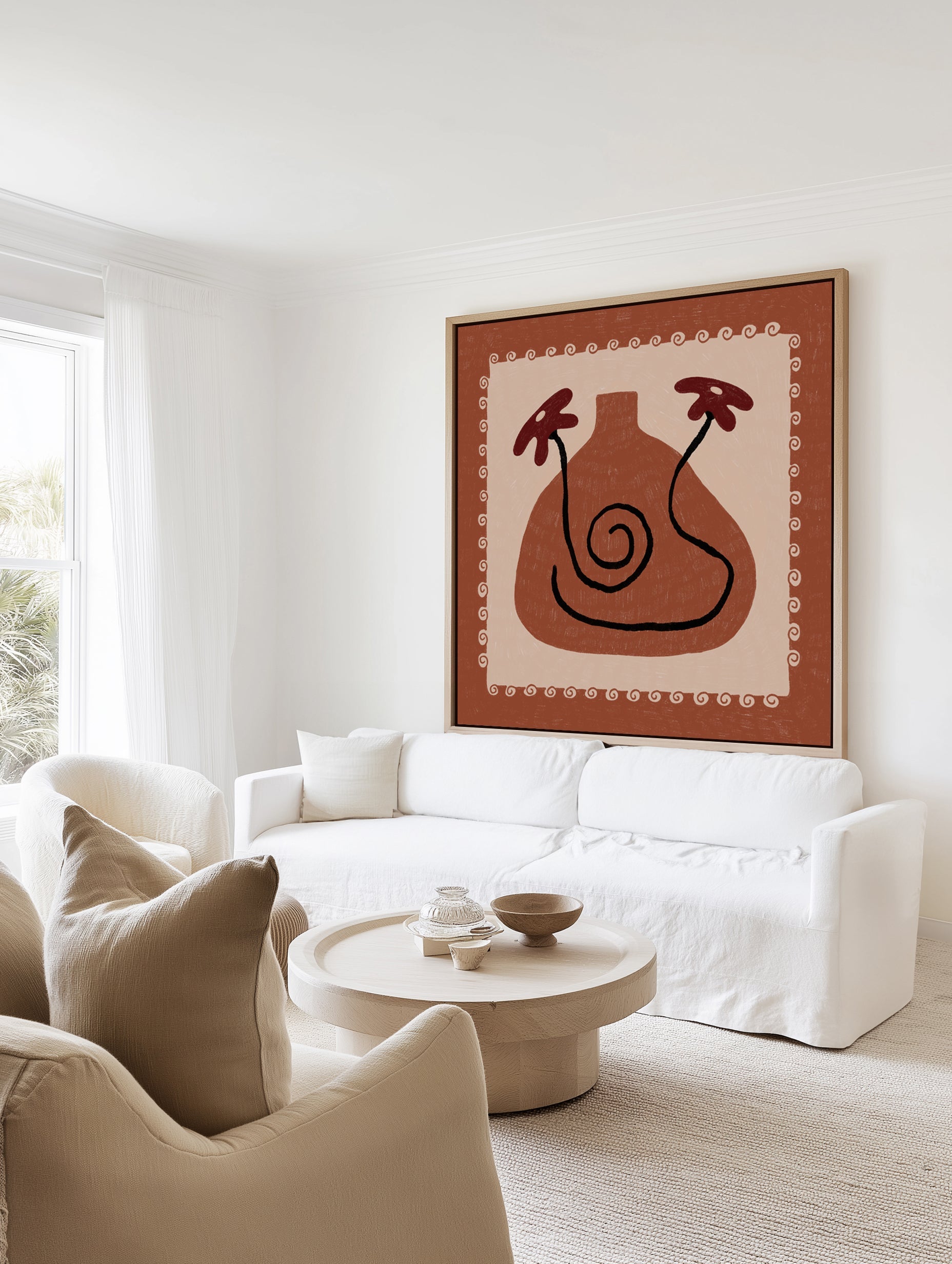

The 9 Types of Abstract Art: A Buyer’s Field Guide
The 9 types of abstract art, decoded: recognise gestural, colour field, geometric and organic styles in seconds and pick the right one for every room.
Learn moreWhy Family Photo Wall Art Beats Flowers Every Mother's Day (A Gift That Lasts Forever)
Every year on the second Sunday in May, Australians spend tens of millions of dollars on Mother's Day flowers. Bouquets get hand-delivered to homes across the country, presented at brunches, set down on kitchen counters with a card. Mum smiles. She says they're lovely. She puts them in water. And then, somewhere between Wednesday and Sunday of the following week, she throws them in the bin. I'm not anti-flower. Flowers are gorgeous. A bunch of peonies on the kitchen island makes the whole house feel different. But every Mother's Day I watch my friends and family panic-buy $80 bouquets because it's the default, and I think: there's a better way to spend that money. A way that lasts longer than a weekend. A way that doesn't end with mum quietly sweeping wilted petals into a dustpan, feeling slightly sad about it. This is a piece for anyone who wants to give mum something meaningful this year — something she'll still be looking at in 2036. Custom family photo wall art is, hands down, the gift mums keep, talk about, and quietly cry over when they unwrap it. Below, I'll walk you through the maths, the emotional case, and how to spend your usual Mother's Day flower budget on something that won't be in the compost by next weekend. If you're already convinced and just want to get on with it, jump straight to our family photo collection. Otherwise, read on — this'll help you make the case to anyone in your group chat still defaulting to roses. The flower problem (let's just say it) A standard Mother's Day bouquet runs $60 to $120 in Australia in 2026. The good ones — proper florists, locally arranged, with eucalyptus and the kind of foliage that costs as much as the blooms — push past $150. You hand it over. Mum is genuinely touched. The bouquet sits on the dining table for three days looking incredible. And then it starts. Petals on the floor. The tulips bend dramatically. The lilies bruise. By day five, half the stems have gone slimy at the bottom of the vase. By day seven, mum is having the awkward conversation with herself: do I throw these out today, or do I give it one more night? She gives it one more night. By day nine, she's binning them, often a bit teary about it because that bouquet was from you. Now do the cost-per-day maths. An $80 bouquet that lasts seven days is $11.40 a day for a memory that's literally rotting on her sideboard. If she's a softie, she keeps a single dried rose in a book somewhere — that's the only fragment that survives. The rest goes in the green bin. It gets worse when you look at the supply chain. Most bouquets sold in Australia for Mother's Day include flowers grown overseas — Kenya, Colombia, Ecuador — that have already spent three to five days in cold storage by the time they reach the florist. They're often picked at half-bloom and shipped in a refrigerated box, which means by the time mum gets them, you're already burning through their best days. A bouquet that arrives "fresh" on Mother's Day morning may have been picked the previous Tuesday. And — this is the part nobody says out loud — mum's reaction is often a little performative. She loves you. She knows you tried. She says "oh, they're lovely!" because what else can she say? But the real story is what happens on day eight, when she's the one cleaning up the dropped petals and quietly mourning that this expensive, thoughtful gesture turned into a chore. That's not a guilt trip. It's just the honest cost-benefit of cut flowers. Once you see it, you can't un-see it. The wall art alternative — let's do the maths An A4 framed art print from our catalogue starts at around $79. A custom framed family photo in A3 sits between $130 and $180 depending on the frame. Compare that to the flower budget you'd spend each year, and the maths gets uncomfortable for the bouquet team very quickly. A $79 framed print, hung properly on her wall, will give her at least 10,000 days of joy — that's roughly 27 years, and most prints last considerably longer than that with proper care. Even on the conservative end, you're looking at less than a cent per day. A flower bouquet runs roughly $11 a day. The print is over a thousand times better value, before we even talk about how it makes her feel. And the value isn't just financial. Wall art is there in the background of her life, doing quiet work. It's there every morning when she has her coffee — the first thing her eyes land on when she's still half-asleep. It's there when her oldest friend pops in for a wine and asks "oh, when did you get that?", and mum tells the story of who gave it to her and why. It's there at Christmas when the kids are over and the house is full. It's there on the days she's flat or sad and needs a visual reminder of what matters most. That's the difference. Flowers give her three good days. Wall art gives her ten thousand. Once you reframe Mother's Day as "what's the highest-leverage thing I can do with this $80?", the answer stops being a bouquet and starts being a frame. Why family photo prints win specifically Generic wall art is good. Custom family photo prints are something else entirely. Here's why. When mum looks at a beach print, she thinks "that's pretty." When she looks at a framed photo of her grandchildren, or her wedding day, or a candid of her own mum from forty years ago — her brain does something different. It releases the same warm dopamine hit she gets when she scrolls to that same photo on her phone, except the print is bigger, more present, and she can't accidentally swipe past it. It's permanent. It's sitting on her wall, claiming space in her daily life. It's also a built-in conversation starter. Every guest who comes over notices a framed family photo. "Oh, when was this?" "That's our Byron trip, the kids were tiny." "How old is he there?" "That's mum's 70th." A framed family print becomes the centrepiece of those conversations — and mum gets to tell the story over and over for years to come. Try doing that with a bouquet. Then there's longevity. Most mums currently look at their favourite family photos on their phone. Phones get replaced every two to three years. Photos get buried under thousands of newer ones. Cloud storage glitches. iCloud asks her to upgrade. The photo she loved most slowly disappears into a digital archive she doesn't really know how to navigate. A framed print, hanging on her wall, is immune to all of that. It's there until she takes it down — which she won't. The other quietly powerful thing about family photo prints: you're saying something specific to her. You're saying "I noticed you love this picture. I had it printed for you. I had it framed in solid timber frame with oak finish because that suits your house. I picked the size, the paper, the matting. I thought about you." That's the gift. The print is just the wrapping for the attention. If you've never ordered one, the process is simpler than you'd expect. You upload the photo to the family photo product page, choose your size, choose your frame, and we handle the rest from our Central Coast studio. We'll do light retouching, colour correction, and dust removal on older scans at no extra charge — so even slightly grainy photos from 1995 can come out looking gallery-quality. What to do with the flower money this year Let's get practical. Here's how the typical Mother's Day flower budget converts directly into wall art she'll actually keep. $50 budget: An A4 unframed family photo print. Mum can pop it in an off-the-shelf frame, or you can take it to her with a $20 frame from somewhere like Officeworks. It's the perfect "I tried but I'm on a budget" gift, and the print itself is exactly the same fine art paper we use on our framed pieces. $80 budget (the standard bouquet swap): An A4 framed family photo print. This is the move. Same money you would've spent on flowers, except mum hangs it on the wall and looks at it every day for the next decade. The frame is real solid timber (oak, white, or black finish), and the print is hand-framed in our Central Coast studio. $150 budget: An A3 framed family photo print, plus a small bunch of fresh flowers from the local florist on the day. This is the absolute sweet spot if she's a flower person — she still gets the bouquet on Sunday morning, but the framed print becomes the permanent part of the gift. Best of both worlds, and you're still spending less than a single fancy bouquet. $250 budget: A2 framed family photo print, OR a matching pair of art prints from our pair and set collection. This is statement-piece territory — the kind of thing that hangs above the couch or the bed and visibly anchors a room. $400+ budget: An A1 framed family photo print, a trio of three matching prints, or a custom-sized canvas piece. This is for the milestone Mother's Day — her 60th, her first as a grandmother, the year you really want to land it. The kind of gift she'll mention in the eulogy fifty years from now (sorry, but it's true). If you want help picking sizes, our art hanging guide covers proportions, hanging heights, and how big a piece needs to be to land properly above a couch, console, or bed. What about mums who genuinely love flowers? Some mums genuinely, deeply love flowers. They have a garden. They identify everything by its Latin name. A bouquet, for them, is genuinely a love language. I'm not here to drag your floral-obsessed mum into a wall art future she didn't ask for. But here's the move: lean into the flower love by giving her flowers that don't wilt. Botanical and floral wall art prints capture exactly the same energy as a bouquet — peonies, roses, foliage, pressed-flower studies — except they last forever. We've got pieces shot from real flower studies and pieces illustrated in soft watercolour, framed pieces and unframed prints, single panels and trios. For a flower-loving mum, a framed botanical above her bed is a love letter that doesn't expire. If she's also a wallpaper-curious mum, our wallpaper collection has full floral feature wall options — Bal Harbour and Palisades in particular turn a powder room or bedroom feature wall into something a magazine would shoot. Order a $4.99 wallpaper sample first (samples are wallpaper-only, so she can check the colour against her walls before committing). The hybrid approach is the best Mother's Day move I know: a small, cheap, fresh bunch of flowers on the morning of, plus a framed botanical print as the permanent gift. She gets the floral hit she loves, and a piece of art that quietly references it on her wall every day for the rest of her life. Total cost: roughly the same as a single big bouquet. Total joy: not even comparable. The emotional case (the bit that really matters) Strip away the maths and the practicality and here's what this is really about. When you give mum flowers, you're giving her something pretty for now. It's a lovely gesture. It says "I thought of you on Mother's Day, here's a bouquet." That's nice. That's enough, in a way. When you give mum framed wall art — and especially a custom family photo print — you're giving her something different. You're giving her: I want you to think of me, or us, or this memory, every single day. I want this to be on your wall. I want you to glance at it when you're making your morning coffee, or watching telly at night, or feeling lonely on a Tuesday. I want you to see it for the next thirty years. Mums know the difference. They feel it. The reaction when she opens a framed print versus a bouquet is genuinely different — there's usually a longer pause, sometimes tears, sometimes that particular kind of speechless hug. We've had hundreds of customers tell us about that exact moment in their reviews on our testimonials page. It's the same story over and over: she opened it, she went quiet, she cried. The other thing: mums remember thoughtful gifts forever. She might forget the flowers you gave her in 2024 (she will). She will not forget the framed photo of her grandchildren you gave her in 2026. She'll point at it for the next twenty years and tell every visitor who gave it to her. That's the gift. The print is the medium. The point is the message — that you actually saw her, paid attention, and made an effort beyond the default. If that sounds like a lot to put on a piece of paper in a frame — well, yeah. That's the whole job of art on a wall. It's not décor. It's a daily reminder of the people, places, and moments that matter. Our whole studio is built around that idea. How to actually pull this off this year If you're reading this with two weeks or more until Mother's Day, you've got plenty of time. Pick the photo (or browse our family photo collection), order it framed, and we'll print it in our Central Coast studio and ship it nationwide in 3-5 business days. Express delivery is available across Australia for closer-to-the-day orders. If you're reading this with less than a week to go, you've still got options. Unframed prints ship faster, and a printed photograph plus a $20 off-the-shelf frame she can pop it into is a perfectly respectable Mother's Day gift. Or grab a piece from our most-popular range — they're our fastest-moving stock, and they ship quickly. We've also written a full Mother's Day gift guide with last-minute picks if you're really cutting it close. And if you want recipient-specific picks — for a grandmother, a new mum, your own mum versus your mother-in-law — we've covered that in detail in our by-recipient gift guide. The deep-dive on family photo prints specifically lives in this companion piece — worth a read if you want help choosing the right photo and crop. One more thing. If you do still want flowers in the mix, do the hybrid: a small fresh bunch from a local florist on the morning of, plus a framed print as the main event. Total spend: about the same as one big bouquet. Total impact: she'll be talking about that print twenty years from now. The flowers just buy you the moment of opening. The print buys you the rest of her life. Frequently asked questions What's the best Mother's Day gift that isn't flowers? A framed custom family photo print, hands down. It costs roughly the same as a mid-range bouquet, lasts forever, and triggers a much stronger emotional reaction. You upload the photo, choose the size and frame finish, and we handle the printing and framing in our Central Coast studio. How much should I spend on a Mother's Day gift that lasts? You can do a meaningful framed gift from around $79 (A4 framed print). $130-$180 gets you a properly-sized A3 framed family photo. $250+ moves you into statement-piece territory with A2 framed prints or matching pairs. The cost-per-day on any of these completely demolishes a flower bouquet — under one cent per day versus around $11 for a bouquet that lasts a week. Why do framed photo prints make a more meaningful gift than flowers? Flowers give mum three to seven good days. A framed photo gives her a daily emotional touchpoint for decades. There's also a specific dopamine hit when she looks at a framed photo of her family — same as scrolling to it on her phone, but bigger, more permanent, and impossible to lose to a phone upgrade or a cloud storage glitch. What if my mum genuinely loves flowers though? Two options. First, lean into a botanical or floral framed print from our flower and botanical wall art collection — same flower love, doesn't wilt. Second, do the hybrid: a small fresh bunch on Sunday morning plus a framed botanical print as the permanent gift. Total cost is similar to one fancy bouquet, but she gets both the moment and the keepsake. How long does it take to get a framed family photo print delivered in Australia? Standard turnaround from order to dispatch is 3-5 business days from our Central Coast studio. Express shipping is available across Australia. So even with two weeks until Mother's Day, you're well inside the window. Closer than that? Unframed prints ship faster, or browse our most-popular framed pieces for fastest turnaround. What size framed print should I buy for above a couch or bed? A general rule: the artwork should fill roughly two-thirds the width of the furniture below it. Above a standard couch (around 220cm wide), an A1 framed print or a matching pair of A2s lands well. Above a queen bed, A2 framed or a pair of A3s work nicely. Our art hanging guide walks through the proportions in more detail. Are your prints actually made in Australia? Yes — every print and frame is made in our Central Coast studio. We print on archival fine art paper, hand-frame in solid timber frame with oak finish, solid timber frame with white finish, or solid timber frame with black finish, and ship Australia-wide. Read more about our studio here. What's the most thoughtful Mother's Day gift for a mum who has everything? A custom framed photograph of something she can't buy: her grandchildren, her wedding day, a candid from a holiday years ago, her own mum at the age she is now. The "she has everything" mum doesn't need another object — she needs something that reflects her life back at her. A framed family photo does exactly that. Start in the family photo collection for ideas. Make this the year Mother's Day on Sunday 10 May 2026 is two and a bit weeks away. You can either spend $80 on a bouquet that's already in cold storage in Kenya, or you can spend the same money on a framed family photo print that mum will look at every morning until you're both old. The second option is genuinely better, and once you've done it once, the bouquet default never feels quite the same again. Start with our custom family photo print page, browse the wider family photo collection, or — if you're still flower-curious — wander through our botanical and floral wall art. And if you want a sense of the full Mother's Day range across every kind of mum and budget, our 2026 Mother's Day gift guide covers 25 picks across every category. One last thing. If she's a flower person, get her flowers anyway — just smaller, cheaper, fresher, on the morning of. Then give her the print as the real gift. The flowers fade by Friday. The print stays on her wall for the rest of her life. That's the whole pitch.
Learn moreMother's Day Wall Art for Grandmothers, Mums-To-Be & New Mums
The wall art that makes a grandmother cry happy tears is almost never the same piece that excites a first-time mum decorating her nursery. And the print a mum-of-teens hangs proudly above her sideboard? It's a different beast again. This is the part of Mother's Day shopping that catches gift-givers out. We grab "something nice for mum" — a generic floral, a coastal scene, a print we'd actually love ourselves — and quietly hope it lands. Sometimes it does. Often it doesn't, because the woman opening it isn't a generic mum. She's your grandma with her watercolour botanicals from the 90s, or your mum-to-be sister with her sage-and-cream nursery vision board, or your stepmum who decorated her whole hallway in coastal blues last summer. Wall art is one of the most personal gifts you can give — it hangs in her home for years and she'll see it every morning. Matching the piece to the person — her stage of motherhood, her decor style, her relationship to you — matters more than the price tag. This guide breaks down what actually works for each kind of mum-figure in your life: grandmothers, mums-to-be, brand-new mums, mums of teens and adult kids, and the mum-figures who aren't technically your mother. For each one, we'll cover what to look for, what to avoid, and a few specific pieces that tend to land well. If you're still figuring out the bigger picture first, our Mother's Day 2026 wall art gift guide covers the full overview. And if a custom family photo print is already on your shortlist, the family photo deep dive is the one to read next. For everything else — let's get into it. Mother's Day wall art for grandmothers (Nan, Grandma, Oma, Yia-Yia, Pop's wife) Grandmothers are, in our experience, the most under-thought recipient on Mother's Day. The grandkids' parents handle the big gifts to mum; nan often gets a card, a hug, and a box of Roses. A piece of wall art — chosen carefully — is the kind of gift that genuinely surprises her. The thing to understand about gifting art to a grandma: she has lived in her home for a long time. Her walls are not a blank canvas waiting for your bold choices. They have a history. A successful gift either honours that history (classic, coastal, botanical, photographic) or makes a deeply personal addition (a custom photo of the grandkids). The grandkids photo print — the gift that actually gets cried over If you take nothing else from this section, take this: a custom photo print of her grandchildren is, by a country mile, the most-loved Mother's Day gift a grandma can receive. It's not close. Custom family photo prints from $89 turn an iPhone snap of the kids — the one she keeps showing her bridge group on her phone — into a framed piece she can put in pride of place on the mantel or above the hallway sideboard. The version that hits hardest is a multi-generational photo: grandma plus her grandchild, or all the grandkids together. If you have a recent shot from Christmas or a birthday, that's your gift sorted. Order it in A4 or A3 (more on sizing in a moment), pick the oak finish, and you're done. Calm, classic styles — coastal, Hamptons, traditional botanical For grandmothers who would prefer "real art" over a personal photo, lean into styles that already feel at home in a traditional Australian home: coastal photography, Hamptons-style prints, and soft botanical artwork. These aren't "exciting" the way a bold modern piece is — and that's the point. They blend into rooms she's spent decades curating, rather than fighting them. A piece like Meelup No. I — soft coastal photography from Western Australia — sits comfortably alongside the watercolours and family photos already on her walls. Amalfi Seas I is another safe, classic choice if she's been to the Mediterranean (or always wanted to). Heritage and cultural connections If your grandmother has a strong cultural identity — a place she came from, a heritage she's proud of — wall art that nods to it can be deeply meaningful. For First Nations grandmothers, the Warlukurlangu Aboriginal art collection features works from the Yuendumu artist community in the Northern Territory, with each piece supporting the artist directly. For Italian, Greek, French or other European-heritage grandmothers, photography from Teigan Geercke's European Summer collection often feels like coming home. The right size for a grandmother's home Here is where most gift-givers go wrong: they buy too big. A1 and A0 prints look incredible in a young couple's open-plan living room. In a grandmother's home — typically with smaller wall sections, more existing artwork, and lower ceilings in older Australian houses — they overwhelm. Stick to A4 or A3 for most situations. They're easier for her to handle, easier for her to hang (or for you to hang for her on Mother's Day morning), and they slot into the gaps on her existing walls without forcing her to rearrange the room. Five specific pieces that work for grandmothers Custom grandkids photo print — A3 oak finish, from $89. The default winner. Meelup No. I or II — soft WA coastal photography, A4 or A3 framed. Calming, classic, easy to live with. Amalfi Seas I — Mediterranean coastal scene, A4 oak finish. For the grandma with European travel stories. Warlukurlangu artist print — A4 framed. For meaningful Aboriginal art with provenance. Botanical pair from our pair sets collection — two A4 prints designed to hang together, perfect for a hallway or above a guest bed. Mother's Day wall art for mums-to-be A mum-to-be is in one of the most particular gift-giving windows of her life. She's exhausted, hormonal, and almost certainly thinking about the nursery she's halfway through pulling together. Mother's Day for her is "first Mother's Day" — even if the baby isn't here yet — and the gift that lands acknowledges her, not just the baby. Nursery wall art she can hang now (without committing to a baby-only space) The smartest nursery wall art is art she'd happily hang in any room of the house. Bunny prints and "Hello little one" typography date fast — by the time her child is two, she's repainting and replacing. Instead, look at nursery wall art with broader appeal: soft botanicals, gentle landscape photography, neutral animal illustrations in oak or white finish frames. Sets and trios are particularly powerful here. A three-piece trio above a cot or change table feels intentional in a way that a single floating print doesn't, and it solves the "what do I hang on the big nursery wall" problem in one purchase. Look for trios in matching frame finishes so the whole arrangement reads as one composition. Soft pastels and gentle palettes Mums-to-be tend to gravitate toward calming palettes — soft sage, dusty pink, oatmeal, pale blue, warm cream. The Bal Harbour light blue and Palisades wallpapers (with $4.99 samples available so she can test before committing) are perfect for an accent wall behind a cot. They're gentle, photograph well, and grow with the room as the baby becomes a toddler. Avoid the "baby-specific" trap If she's expecting her second baby, she may not want another set of "first nursery" pieces. If she's expecting her first, she may not want art that screams "baby" — she may want a softer, more grown-up version of "this is a child's room." The safest path: art she could just as easily hang in a guest bedroom or her own bedroom in five years' time. Five specific pieces that work for mums-to-be Coastal trio set from our trio collection — three matching A4 prints, oak finish. The "fills the wall, looks intentional" choice. Pair set from pairs and gallery walls — two A3 prints designed to hang together above a cot. Bal Harbour light blue wallpaper — peel-and-stick, removable, grows with the room. Botanical print from our floral collection — A3 white finish frame, for the soft-and-feminine nursery. Custom name or date print — once she's settled on the baby's name. Order in advance and hand it over with the original Mother's Day card. Mother's Day wall art for new mums (baby in arms or under 12 months) If there's a perfect time in a woman's life to receive thoughtful wall art, it's the first year of motherhood. She's sleep-deprived, often housebound, and the walls of her home are suddenly the most-looked-at surfaces in her world. A piece of art that brings her quiet joy at 3am — that's a real Mother's Day gift. The first family-of-three photo print If she has a baby in her arms this Mother's Day, this is the gift. A custom photo print of her, her partner, and the baby — even from a phone snap taken in the hospital — turns the most emotional season of her life into something framed and permanent. Above the cot, above the change table, or in her own bedroom: it's the print she'll still have when the baby is twenty. Calm art for sleep-deprived eyes This is where new mums diverge from mums-to-be. A mum-to-be still has bandwidth for "decorating the nursery" as a fun project. A mum with a four-month-old has none. What she wants on her walls is calm: soft coastal photography, neutral botanicals, gentle abstract. Nothing high-contrast, nothing that demands attention. Think art that lets her breathe, not art that adds to the visual noise of toys, swaddles and bottles. Peel-and-stick wallpaper for the nursery she'll change six times A new mum knows something a mum-to-be doesn't yet: the nursery she set up before the baby came is going to evolve. Crib becomes toddler bed; pastels get replaced by primaries the kid picks themselves; the whole room changes around the second birthday. Peel-and-stick wallpaper (samples $4.99, full rolls easy to remove and replace) is a gift she'll quietly thank you for in two years' time when she wants to redo the whole room without paint and primer. Duties paid for international wallpaper orders, so no surprise charges at the door. Self-care art for HER bedroom — a reminder she's still her The most under-rated new-mum gift is wall art that goes in her bedroom, not the baby's. A piece from Teigan Geercke's European Summer collection, or a Poolside at Romeo's Ibiza print — something that says "you're still a person, you still travelled, you still have a self outside of motherhood" — is a quietly powerful Mother's Day gesture. It hangs in her room. She sees it before she sees the baby every morning. Five specific pieces that work for new mums Custom family-of-three photo print — A3 oak finish, from $89. The keystone gift. Meelup No. I and II as a pair — soft WA coastal photography, calming above the cot or in the main bedroom. Peel-and-stick wallpaper sample pack ($4.99 each) so she can test palettes for the nursery refresh. Poolside at Romeo's Ibiza — for HER bedroom. A reminder she's still the woman who travels. Soft botanical pair from our pair sets collection — calming, neutral, easy to live with. Mother's Day wall art for mums of teens and adult kids The mum-of-teens and the empty-nester mum are two of the most overlooked recipients on Mother's Day, and they tend to want very different things from new mums. Their kids are independent, their houses are full of decade-old decor that's overdue for a refresh, and they finally have time, headspace and disposable income to think about their walls again. Throwback family photos — the kids when they were small If she's a mum of teenagers or adult kids, a custom print of a photo from when the kids were toddlers will undo her in the best way. Print it large, frame it in oak finish, hand it over on Mother's Day morning. There's a reason this is such a popular gift in this stage: she misses them being small, and she'd never print and frame the photo herself. Statement art for the empty-nester home Mums of adult kids often have a living room or hallway that's been waiting for a real piece of art. They've been making do with hand-me-downs and "for now" choices for two decades. Mother's Day is a great excuse to give her something with scale: a large aerial photography piece, or a single statement print from our most popular collection. A0 or A1 in this stage of life, not A4. Travel photography from her dream destination This is the demographic that's planning trips. The Italy trip, the Mediterranean cruise, the long-promised holiday. Photography from a place she's dreaming of — Amalfi Forever, Sunday Swim Ibiza, the European Summer collection — is the kind of gift that makes her stop and look every time she walks past it. Mother's Day wall art for mum-figures who aren't your mother Mother's Day isn't only for mums. Mothers-in-law, stepmums, aunts who raised you, friends who've just become mums for the first time — these relationships often involve more careful gift-giving than the one with your own mum, because there's less shared history to fall back on. Mother-in-law: play it safer than you think The rule with a mother-in-law is: more universal than personal, more classic than trend-led. Coastal, botanical, neutral. Coastal photography in white finish frames is almost always a safe bet. Avoid anything ironic, anything edgy, anything that requires her to "get it." She doesn't need to get it; she needs to like it. Stepmum: lean into inclusion For a stepmum, art that visually includes her is meaningful. A custom family photo print of a moment that involves her — a holiday, a Christmas, a recent gathering — quietly tells her she's part of the family. It can't be undone with a bad day or a snippy comment. It's on the wall. The aunt who's basically a second mum For aunts who functioned as a mother figure, treat the gift as you would for your mum — personal, considered, with weight. A custom print of her with you (or with her own kids) makes the relationship explicit in a way she might never have heard out loud. The friend who became a mum this year For a friend in her first year of motherhood — especially one whose own mum isn't around or available — Mother's Day can be quietly hard. A small piece of wall art that acknowledges her new chapter (a soft botanical, a coastal A4, a custom print of her with the baby) lands far harder than a card. How to know what art she'll actually love If you're still not sure, here's the practical short version. You don't need her to tell you what she wants — you can work it out without her noticing. Look at her current decor. Open her Pinterest if it's public, scroll her Instagram, glance around her living room next time you're there. Her existing art tells you 90% of what you need to know. Note her favourite colours. Not "what colour is her favourite jumper" — what colour comes up across her cushions, throws, kitchen, hallway? That's her real palette. Match her existing frame finishes. If her house is full of oak finish frames, get oak. White finish, get white. Black, get black. A timber frame is solid timber regardless of finish — it just needs to match what she already has on the wall. When in doubt, custom family photo print. It's the one gift that works for almost every mum-figure, every stage, every decor style. Our family photo deep dive walks through how to make it land. And if you've left this until the eleventh hour, the last-minute Mother's Day gift guide covers what's still possible to deliver in time. For more general inspiration across the whole shop, browse our most popular pieces or all wall art. The wall art guide and art hanging guide are quietly useful if you're choosing for someone whose home you don't know inside out. Frequently asked questions What's the best Mother's Day wall art gift for a grandmother? For most grandmothers, a custom photo print of her grandchildren is the gift that lands hardest. Custom family photo prints start at $89 and we recommend A4 or A3 in oak finish — easy to handle, easy to hang, easy to slot into an existing wall arrangement. If she'd prefer "real art" over a personal photo, calm coastal or botanical pieces in classic styles tend to work best. What should I buy a mum-to-be for Mother's Day in Australia? Lean toward nursery wall art that won't date — soft pastels, gentle botanicals, neutral animal illustrations, or a three-piece trio she can hang above the cot. Avoid anything overtly "baby-themed" if she might want the room to grow with the child. Removable peel-and-stick wallpaper (with $4.99 samples) is another smart, low-commitment option. What do new mums actually want for Mother's Day? The two gifts that consistently land with new mums are: a custom family-of-three photo print (her, her partner, the baby) for above the cot, and a piece of calm, soft art for HER bedroom — something that reminds her she's still her, not just a mum. Coastal photography and neutral botanicals work especially well because they don't overstimulate sleep-deprived eyes. Is wall art a good Mother's Day gift for a mother-in-law? Yes — but pick safer than you think. Universal styles like coastal, traditional botanical, or Hamptons photography in white or oak finish frames tend to land best. Avoid anything ironic, edgy, or that requires her to "get" the reference. Match her existing decor rather than trying to push her style in a new direction. What size print should I get for a grandmother's home? A4 or A3 in almost every case. Older Australian homes typically have smaller wall sections, more existing artwork, and lower ceilings than open-plan modern builds — A1 and A0 prints can overwhelm rather than enhance. A3 in a solid timber frame with oak finish is the safest bet for most grandparent homes. Can I gift wall art to a stepmum without it feeling awkward? Absolutely — and the trick is to pick something inclusive rather than something neutral. A custom family photo print from a moment she's part of (a holiday, a recent Christmas, a family gathering) quietly tells her she belongs in the family in a way words don't always manage. It hangs on the wall as a permanent reminder. What's the best wall art for a mum of teenagers or adult kids? This is the demographic that finally has time, space and budget to refresh the home. Two strong directions: a custom print of a throwback family photo from when the kids were small (she misses them being little), or a statement-scale piece of aerial photography or European Summer travel photography for the empty-nester home. Go bigger here than you would for a grandma — A1 or A0 in the right room. Will Mother's Day wall art arrive in time if I order this week? For Mother's Day on Sunday 10 May 2026, most ready-made framed prints ordered by the end of the first week of May will arrive in time across metropolitan Australia. Custom family photo prints need a few extra days for production. If you're cutting it fine, see our last-minute Mother's Day gift guide for what's still realistic, including printable digital cards and gift vouchers she can redeem in her own time. Whoever the mum in your life is — grandma, mum-to-be, brand-new mum, mum of grown-up kids, mother-in-law, stepmum, aunt, friend — there's a piece of wall art that fits her exactly. The trick is matching the art to the woman, not to a generic "Mother's Day" idea. Start with her: her stage of motherhood, her decor, her colours, her relationship to you. The right piece almost picks itself. And if it doesn't, a custom family photo print almost always does.
Learn moreLast-Minute Mother's Day Gift Ideas (That Don't Look Last-Minute)
We've all been there. It's Friday afternoon, Mother's Day is on Sunday, and that knot in your stomach has just arrived along with the realisation that you have, in fact, forgotten to organise a gift. Or — equally common — you've been thinking about it for three weeks, but every "good idea" keeps falling through. Either way, you're here now, and you've got somewhere between a few hours and a few days to make this right. Take a breath. You're going to be fine. The good news is that it's 2026, you live in Australia (where the postal service has actually become quite reliable again), and there are genuinely lovely gifts that can arrive on time without screaming "panic-bought at the petrol station". The other piece of good news: most of the best last-minute Mother's Day gifts don't even need to ship at all — they arrive instantly via email, and your mum gets to choose exactly what she wants. This guide is the one we've written for the version of you who left it late. No judgement. We're going to walk through the fastest options first (instant gift cards), then fast-ship art prints that genuinely arrive within the week, custom family photo art that can still make it if you act now, and what to do if you're really up against the clock. We'll also cover what to write in the card while you're waiting for delivery, because that part matters more than you think. If you're new to Olive et Oriel, here's the short version: we're an Australian-owned print and wallpaper studio. Our art prints ship from our local production partner, most orders go out within 3–5 business days, and we offer instant gift cards for the truly last-minute among us. This post covers the fastest paths to a thoughtful gift — start at the top and stop reading the moment you find your match. The fastest option: instant gift cards (zero shipping risk) Let's just say it: if Mother's Day is tomorrow, the gift card is the right answer. Not because it's lazy, but because it solves three problems at once. First, it arrives instantly. The moment you check out, an Olive et Oriel gift card lands in your mum's inbox (or in yours, if you want to forward it with a personal note). No tracking number, no Australia Post anxiety, no "estimated delivery 12–17 May" panic. Second, it removes the guessing. Picking art for someone else is genuinely hard — you have to know their taste in colour, their wall sizes, whether they prefer framed or unframed, and which room they actually want to refresh. A gift card lets your mum choose all of that herself, which is often the kindest version of "I want you to love this". Third, it's still genuinely thoughtful. Pair the gift card with a screenshot of two or three pieces from our most popular collection that you think she'd love, and you've turned a digital voucher into a curated suggestion. ("I picked these three out — but choose whatever speaks to you.") That's a thoughtful gift, full stop. If we don't have a dedicated gift card live for any reason, our most popular collection is the next best thing — order an unframed A4 today, and you'll get a tracking number tomorrow. Fast-ship art prints (under 7 days delivery in Australia) If you've still got a week — or even five working days — a real, physical art print is absolutely back on the table. Here's how the timing actually works. For unframed paper prints in A4 or A3, our production window is 1–3 business days. Australia Post Express adds 1–2 business days to most metro addresses. That means an order placed Monday morning is genuinely arriving by Friday or Saturday in most capital cities, and standard shipping to Sydney, Melbourne, Brisbane and Adelaide isn't far behind. (See our full shipping policy for current cut-offs and regional times — those are the truth, not the marketing version.) The trade-off to be honest about: framed prints take longer. Our solid timber frames (with oak finish, white finish, or black finish) are made-to-order, which means an extra few days of production. If you're already inside seven days from Mother's Day, an unframed print is the safer call. Your mum can frame it later — or treat the unframed print as the "real gift" with a promise of framing as round two. (More on that idea later in the card-writing section.) So which prints actually ship fast? Realistically: anything available in A4 or A3 from these collections. Coastal art prints — our most loved category, and there's a reason. They're calm, recognisably Australian, and look right in almost every home. Aerial photography — sweeping overhead shots of Australian beaches and reefs. Quietly impressive without being loud. European Summer (Teigan's exclusive series) — Amalfi, Capri, Ibiza. If your mum loves to travel, this is the section to send her to. Botanical and floral art — soft, bright, unfussy. Easy to hang in a hallway, kitchen or bedroom. Most popular — if you don't know where to start, start here. An unframed A4 print from any of these collections clears the door fast and arrives looking like it was chosen with care — because it was. Pair it with a card and you've genuinely landed a thoughtful gift inside a tight window. Custom family photos that can still ship in time This one surprises people. If you've still got 7–10 days, a custom family photo print is still on the menu — and honestly, this is the gift that lands hardest with mums and grandmas. Wall art of the people she loves, printed properly, hung where she'll see it every day. It's the gift that gets sent in the family group chat with three crying-face emojis. Here's how the timing works specifically. Custom photo orders have a 5-business-day production window because we're hand-checking each image, doing a colour edit, and producing the print to gallery standard (we don't bulk-batch this product — every photo gets a real human's eyes on it before it prints). Add 1–2 days for Express shipping and you're at roughly 7 working days door-to-door for most metro addresses. So the maths is simple: count back 7 working days from when your mum needs it. If you're inside that window, an unframed A4 or A3 family photo print is realistic. If you're tighter than that — five days or less — order an A4 unframed print of one of our ready-to-ship art collections instead, and put a custom family photo on your list for her birthday. Don't try to force the timeline; a rushed print that arrives Monday after Mother's Day isn't the win we're going for here. One more practical note: when you're ordering a custom family photo print on a tight timeline, send the highest-resolution photo you've got. Phone-camera photos taken in good daylight are usually fine. Photos pulled from Instagram or Facebook have already been compressed twice and tend to print soft — if that's all you have, send it anyway and our studio will let you know if we need a better source. The faster your reply on that, the faster the print ships. If your mum already has a wall earmarked for "the family photo" and you've been meaning to do this for months — this is your push. The dedicated family photo wall art for Mother's Day guide goes deeper on choosing the right photo, sizing, and framing decisions if you've got a few more minutes to read. 6 fast-ship gift ideas under $100 If you want something concrete, here are six gifts that hit the under-$100 mark, ship in time, and don't feel like a last-minute scramble. A4 unframed coastal art. Pick from Pool Club or Poolside at Romeos for that sun-soaked, slightly nostalgic feel. Both are signature pieces that look styled and considered, even on a small wall. A4 botanical print. Quiet, soft and warm — works in a bedroom, a kitchen window wall, or a home office. Browse the full botanical collection for the right palette. A4 aerial photography. Meelup No. II is one of our most loved Australian aerials — gentle blues, sand, and a sense of space that suits almost any room. Quietly impressive, never loud. A4 abstract art. If your mum's style is more modern than coastal, browse the most popular collection for soft abstracts in dusty pinks, ochres and sand tones. Easy to live with for years. A4 European Summer print. Amalfi Forever is the one we recommend for mums who love travel and the Mediterranean. From Teigan's European Summer exclusive series. A4 family photo print. A small unframed family photo from your custom family photo art print is genuinely the most-loved gift on this list. Add a frame later as a follow-up. All six options sit comfortably under $100 in A4 unframed format, all ship inside the fast-ship window, and all of them look like a real, considered choice — not a scramble. Pick the one that matches your mum's taste, not the one that matches your panic. Premium fast-ship gifts ($100–$300) If you've got a bit more to spend and you still need it to ship fast, this is where the gift starts to feel substantial without crossing into "wedding present" territory. The sweet spot here is an A3 print — bigger presence, more wall impact, still safely inside the fast-ship window for unframed orders. A3 framed prints are also possible if you've got 7+ business days; the solid timber frame (with oak finish, white finish, or black finish) adds a real sense of finish and weight to the gift. The other premium move that ships in time: a matching pair. Two A4 or A3 prints designed to hang side by side land much more like a curated gift than a single piece. Browse the pairs and sets collection or the dedicated matching wall art collection for prints that have been styled and tested as a pair. The Meelup No. I and Meelup No. II aerial pair, or the Amalfi Seas I and Amalfi Seas II European Summer pair, are both reliable choices that feel deliberately chosen. For the splurge end of fast-ship: an A3 framed coastal print with a dedication on the back, or an A3 custom family photo print if you've still got a 7-day runway. Both come in well under $300 in their unframed sizes and read as a "real" gift, not a placeholder. Same-day digital download options (if you're really up against the clock) Time for the honest conversation. If Mother's Day is tomorrow, no Australian art studio is shipping you a physical print today — that's just physics. So here's what we'd actually recommend if you're inside 24 hours. Olive et Oriel doesn't sell instant digital downloads. Our prints are physical-only, produced to gallery standard on archival paper, because that's the gift we believe in — something real to hang on a wall, not a JPG to print at home on copy paper. So if you're stuck in the same-day window, the right move is the instant gift card, full stop. Here's the version that lands well: send the gift card by email at the time of your choosing on Sunday morning. Pair it with a screenshot of three or four prints from our most popular collection that you think she'd love. Add a note: "I wanted to choose something for you, but I also wanted it to be exactly right — these three are my picks, but you choose. Can't wait to see what ends up on the wall." That's a thoughtful gift, delivered on time, with no postage drama. Anyone who tells you a hastily-printed JPG is a thoughtful gift is lying to you. The gift card is better. It really is. What to write in the card while you wait for delivery Here's an underrated move: the print is on the way, but you've got a card to fill out today. The card matters more than people give it credit for — it's the part your mum reads twice, keeps in a drawer for a decade, and pulls out the next time she's having a hard week. If your gift is shipping and won't arrive on Mother's Day itself, here's a small idea that's genuinely lovely. Print a small preview image of the art (a screenshot from the product page is fine), pop it inside the card, and write something like: "This is on its way to you. I picked it because [the colour reminded me of the kitchen at the old house / it's the kind of print you'd actually want / it made me think of our trip to the coast]. It'll be here by [date]. Until then — happy Mother's Day. Love you." That little preview-in-the-card move turns "your gift is in the mail" from a stress point into a teaser. She gets to anticipate it. It's the same trick people use with experience gifts ("here's a card; the trip is in October") and it works. For the message itself: keep it specific. Generic Hallmark phrases are forgettable. The line that lands is the one with a real detail in it — a memory, a tiny inside joke, something only you two would write. Two sentences of specific is worth ten of vague. The "I'll get it in time" anxiety guide Once you've placed the order, here's how to stop refreshing the tracking page every twenty minutes. You'll get an order confirmation immediately, then a separate email with a tracking number once your print enters production. From there, Australia Post tracking updates roughly twice a day — once when it's scanned at the production facility, once when it lands in the local depot. If you're seeing radio silence for 48 hours, that's normal. The most useful update comes the day before delivery, when it moves to "out for delivery". Most metro addresses see the print land between 9am and 3pm on the day. If something goes sideways — a delayed scan, a missed delivery, a print that doesn't look right — get in touch with our team. We treat last-minute Mother's Day orders as a priority and we'd rather hear from you on day three than on day seven. Our shipping policy has all the specifics, but the short version is: we want this to land as much as you do. For more on choosing the right size and frame for the wall once your print arrives, our art hanging guide walks you through it. And if you want to keep browsing while you wait, the broader Mother's Day gift guide hub covers the full year's gifting for mums, grandmothers, mums-to-be, and partners. Frequently asked questions What's the latest I can order an art print and still get it in time for Mother's Day in Australia? For unframed A4 or A3 prints to most metro Australian addresses with Express shipping, ordering by the Monday before Mother's Day is the safest cut-off — that gives 1–3 business days for production and 1–2 for delivery. For framed prints, push that earlier: order at least 7–10 business days before. Regional and remote addresses need an extra 2–3 days. Our shipping policy has current cut-offs. Do you offer instant digital gift cards? Yes — our digital gift cards arrive in your inbox seconds after checkout and can be forwarded to your mum at the time of your choosing. They're the right answer when Mother's Day is tomorrow. Can I order a custom family photo print and still get it in time? Yes, if you've got at least 7 business days before Mother's Day. Our custom family photo prints have a 5-business-day production window so a real human can colour-check the image, plus 1–2 days Express shipping. Inside that window, an unframed A4 or A3 photo print is realistic; framed needs more lead time. What's faster — framed or unframed? Unframed, every time. Our solid timber frames (with oak finish, white finish, or black finish) are made-to-order, so framed prints add several extra production days. If you're tight on time, order unframed and add a frame for her birthday — or buy one locally once the print arrives. Can I get same-day delivery on a Mother's Day art print? No Australian art studio offers genuine same-day delivery on quality prints — production and freight don't move that fast. If you're inside 24 hours, the instant gift card is the best option. It arrives by email the moment you check out and lets your mum choose her own piece. What if my Mother's Day gift doesn't arrive on time? First — print a preview of the art and tuck it into the card with a note saying when it'll arrive. That bridges the gap and turns a delay into anticipation. If something's actually gone wrong with shipping, contact our team — we prioritise Mother's Day orders and would much rather hear from you early than late. Are digital downloads available for Olive et Oriel art prints? No — we're a physical print and wallpaper studio, not a digital marketplace. Every print is produced on archival paper to gallery standard. For instant gifting, the gift card is the right path; for fast physical gifting, an unframed A4 or A3 print from our most popular collection is the answer. What's a good last-minute Mother's Day gift under $100? An A4 unframed art print from our coastal collection, botanical collection, or aerial photography collection. All sit under $100, all ship inside the fast-ship window, and all look considered rather than rushed. If you're really last-minute, the gift card is the cleanest move. Final thought Last-minute doesn't have to mean last-resort. A good gift is a good gift, whether you ordered it in February or on the Wednesday before Mother's Day — the only thing that changes is which option is on the table. Use this guide to find the option that's still open to you, write a card with one specific memory in it, and that's it. You're done. If you've got more time than you thought, our 2026 Mother's Day gift guide hub goes wider, the custom family photo gift guide goes deep on the most-loved gift in our studio, and the gift guide for grandmothers, mums-to-be and new mums covers the rest of the women in your life. While you're here, our wall art guide and interior design guide are the pages mums actually keep open in a browser tab. Good luck. She's going to love it.
Learn moreCustom Family Photo Prints — Mother's Day Gift | Olive et Oriel
Ask any mum what she'd save first if the house was on fire — after the kids and the dog — and it's almost always the photos. Not the jewellery, not the good china, not the framed degree on the wall. The photos. The proof that this family existed, that these tiny humans grew up, that there was a wedding day and a hospital day and a holiday everyone still talks about. Which is why a custom family photo print, properly framed and ready to hang, is one of the most quietly powerful Mother's Day gifts you can give. It doesn't try to be clever. It doesn't compete with the bouquet that arrives on Sunday and is in the bin by Wednesday. It just sits on her wall, every day, reminding her of the people she loves most. If you've been scrolling through gift guides looking for something that actually means something this year, this is the deep dive. We'll walk through what makes a great family photo for printing, exactly how the Olive et Oriel custom family photo process works, how to size and frame it for her home, and five photo ideas that tend to make mums (and grandmas) cry in the good way. This is post 2 in our Mother's Day 2026 gift guide cluster — a deep dive on the most personal product we make. If you want the full overview of options (art prints, wallpaper, gift cards, etc.), start with the main hub post. If you want the case for personal over generic, our companion piece on why family photo wall art beats flowers is worth a read. What makes a great family photo for printing? Before you go spelunking through your camera roll, a quick reality check: not every photo deserves to be blown up to A1 and framed in solid timber. Some shots that look fine on a phone screen fall apart at print size — the resolution wasn't there, the composition is off, or mum is holding a glass of wine in front of her face. Picking the right photo is half the gift. Resolution matters more than you think The single biggest reason a family photo print disappoints is low resolution. A photo screen-grabbed from Instagram, pulled from a Facebook post, or zoomed in on with your phone camera might look crisp on a 6-inch screen, but at A2 or A1 the pixels start showing — soft edges, blurry faces, that tell-tale fuzzy look. The fix is simple: use the original file. The actual image straight off your phone's camera roll, or better still, a photo your photographer sent you full-resolution. If you took it on a recent iPhone, Pixel, or Samsung, you're almost always fine up to A1. If it came from a professional shoot, you're fine all the way to A0. If you're not sure whether a photo will hold up, our team does a quality check before printing — more on that in the next section. Composition: candid usually wins The instinct is to pick the most "polished" photo — the formal portrait, the school photo, the wedding shot where everyone is staring at the camera. Those work, and they have their place. But the ones that tend to land hardest emotionally are the candid shots: the one where everyone is laughing, the one where the toddler is mid-leap, the unguarded moment at the beach where the light was perfect and nobody knew the photo was being taken. The reason is simple — formal portraits show what your family looks like. Candid moments show what your family feels like. Mum already knows what you all look like. Show her how it felt. Recent vs. throwback You can't go wrong with either, and the answer often comes down to who the recipient is. For your own mum, a recent family portrait with the grandkids is hard to beat. For grandma, a throwback shot — you and mum when you were small, your mum and her mum at the beach in 1978 — hits different. A black-and-white scan of an old film photo, printed at A2 in a solid timber frame with oak finish, is the kind of gift that makes people cry on the couch. What to avoid Phone-zoomed shots (the digital zoom kills the quality) Group photos where someone is half-cut-off or blinking Anything taken in low light without flash — noisy and grainy at print size Filtered-to-death Instagram exports — the heavy filter often baked weirdness into the file Anything too crowded — single subjects or tight groups print best If you're stuck choosing between a few, message us with the options. We'll tell you honestly which will print best. The Olive et Oriel custom family photo process — step by step We've made the custom family photo product as straightforward as we possibly can, because we know that ordering personalised wall art for a gift can feel high-stakes. Nobody wants to spend three hours wrestling with an upload tool. Here's exactly how it works. 1. Choose your size You'll see size options from A4 (small, intimate, perfect for a bedside or office) all the way up to A0 (statement piece, sofa-scale). Sizing is the most common stumbling block, so we've written a full art hanging guide that walks through which size suits which wall. We'll also cover this below. 2. Choose your frame finish Every frame is a solid timber frame with oak finish, white finish, or black finish. We don't do plastic, we don't do MDF wrapped in fake woodgrain. Timber, in three finishes, designed to suit any home — full breakdown further down this post. 3. Upload your photo Use the upload tool on the product page to drop your file in. Use the original — the actual photo, not a screenshot of it. Files up to a generous size limit are accepted, and the upload is encrypted. 4. We review the file Before anything is printed, our team checks your photo for resolution, colour balance, and any obvious issues. If something's wrong — too low-res to print at the size you've chosen, weird colour cast, dust spots from an old film scan — we'll email you and either suggest a different size or ask if you have a higher-resolution version. Nothing prints until you're happy. 5. We print it properly Here's the bit that matters: we print on premium matte fine art paper using giclée pigment inks. That's the same museum-grade printing process used for limited-edition art prints — archival, sharp, no glossy reflections, designed to last decades without fading. Family photo prints from a chain photo lab on cheap glossy paper start fading within a few years. Ours don't. 6. We frame it by hand Each piece is hand-framed in a solid timber frame with your chosen finish — oak, white, or black. We use proper backing, conservation-grade mounting, and a glazing that protects the print without distorting it. 7. We ship it carefully — Australia-wide Framed prints are packed in protective corner-guards and shipped Australia-wide. Tracking is automatic. If anything arrives less than perfect, we replace it. Full stop. Read what other Australian customers have said on our reviews page — we take this seriously because we know what these prints mean. Lead times around Mother's Day get tight, so the earlier you order, the better. If you're cutting it fine, our last-minute Mother's Day guide covers gift card options too. Sizing your family photo print for the room The most common mistake people make with personal photo prints isn't picking the wrong photo — it's picking the wrong size. Too small, and the print looks lost on the wall. Too big, and it overwhelms a quiet corner. Here's a rough guide based on where the print is going to live. A4 — bedside, desk, small bathroom wall A4 is intimate. It's the right size when the print is going to live close to where mum sits or sleeps — a bedside table, above a desk, on a narrow wall in a powder room. It reads as a personal object rather than a wall statement. Great for childhood throwbacks or single-subject portraits. A3 — above a console, gallery wall anchor, kitchen A3 is the workhorse size. It's big enough to read from across a small room, small enough to slot into a gallery wall or sit above a console without dominating. If you're not sure what size to pick and the wall is "average," start at A3. A2 — above the bed, hallway, dining wall A2 is where prints start to feel like proper wall art. It's the right size above a bed in a master bedroom, on a long hallway wall, or as the focal piece on a dining or kitchen wall. Family portraits and grandkid photos shine at A2. A1 / A0 — above the sofa, mantle, statement wall A1 and A0 are statement sizes. They're for the big walls — above a three-seater sofa, above a fireplace mantle, in a spacious entryway. Resolution becomes critical at these sizes, so use the highest-quality file you have. The pay-off is enormous: a family photo at A0 stops people in their tracks. For a more thorough breakdown of size-to-wall ratios, eye height, and gallery wall layouts, our full art hanging guide covers it all. The general rule of thumb: the artwork should fill roughly two-thirds of the available wall space (or the width of the furniture below it). Anything smaller and it floats. Still unsure? Our wall art guide and interior design guide include real-room examples for context. Frame finish guide for family photos Every Olive et Oriel custom family photo print comes in a solid timber frame with your choice of three finishes: oak, white, or black. There's no wrong answer — it's about what suits her home. Here's how to think about it. Oak finish — warm, coastal, Hamptons, mid-century The oak finish is the most popular pick for a reason. It reads warm without being heavy, and it works in almost every Australian home style: coastal homes, Hamptons interiors, mid-century, even modern farmhouse. If mum's home has any timber or rattan in it — exposed beams, oak floors, a cane chair — the oak finish picks up that warmth and ties the photo into the room. For families with a beach house or a relaxed coastal aesthetic, oak is almost always right. White finish — Scandi, minimalist, contemporary, light-filled The white finish disappears into the wall, which is exactly what you want when the photo is the hero. If mum's home is white-on-white — Scandi-inspired, minimalist, or just a modern apartment with white walls — a white frame keeps the focus on the people in the photo. It's also the right pick for nursery walls and kids' rooms (we have a whole nursery wall art collection if you're shopping for a new mum). Black finish — moody, bold, gallery-style, modern Black is the editor's pick. It frames the photo like a gallery print, draws the eye, and looks particularly good with black-and-white family photos or moody coastal shots. If mum has a darker interior — navy walls, dark timber floors, leather and brass — black finish reads as considered and contemporary. Pair a black-framed family photo with one of our aerial photography prints for a layered, gallery-style wall. Still not sure? When in doubt, oak. It's the safest pick for the widest range of homes and never feels out of place. 5 family photo print ideas mum will love If you're stuck staring at your camera roll, paralysed by choice, here are five photo categories that tend to land hardest. Pick one — or pick a few and order a small set. 1. The recent family portrait — above the mantle The most reliable choice: a recent group portrait of the whole family, ideally taken in the last 12 months. If you've had a professional family shoot done, perfect. If not, the slightly-staged-but-genuine photo from the last big lunch or holiday works just as well. Print at A2 or A1 in a solid timber frame with oak finish and hang above the mantle or in the main living room. This is the "every visitor will see this" pick. 2. A childhood throwback of you with your mum — her bedside This one is for grandma especially. Find a photo of you and her from when you were small — at the beach, on her hip in the kitchen, blowing out candles together. Scan it if it's an old film photo (a quick run through any decent scanning app on your phone, or take a sharp photo of the original print in good light). Print at A4 or A3 in a white finish and gift it for her bedside table. This is the kind of present that gets quietly stared at every morning. 3. The grandkids — for her hallway gallery If grandma already has the family-photos-everywhere setup, slot into her existing gallery wall with a fresh grandkid portrait. Match the frame finish to what she already has on the walls. A3 is usually the sweet spot for hallway gallery walls. If she doesn't have a gallery wall yet, build her one — order three matching prints (one of each grandkid, or three from the same shoot) and hang them in a row. Our matching set guidance works for custom photos too. 4. The wedding photo — for her living room Wedding photos are wildly under-printed. Most couples have a thousand digital wedding photos and exactly zero on the wall. Pick the one shot that captures the day — not necessarily the formal portrait, often the candid one of you laughing on the dance floor — and print it large. A1 in a solid timber frame with black finish reads as gallery-grade wall art rather than "wedding photo." For mum and dad's place, the formal portrait of the two of you works better. 5. The pet portrait — for her office or studio Don't underestimate the family pet. If mum is besotted with the dog (or the cat, or the horse, or the chickens), a high-resolution portrait of the family pet printed at A3 or A2 is a genuinely lovely gift. White finish keeps the focus on the animal. This works equally well for the family pet as for mum's own dog. If you want the pet plus the kids in one frame, even better. Pairing family photo prints with art prints and wallpaper The best-looking walls almost always mix personal photos with proper art. Pure gallery walls of family photos can read as cluttered or "photo-frame shop." Pure art-only walls can feel impersonal. The sweet spot is a layered mix: family photos as the emotional anchor, art prints and texture as the visual rhythm. Gallery wall ideas A simple formula that works: take one statement family photo (A2 or A1) as the anchor, and surround it with two or three smaller art prints from a complementary palette. For coastal homes, pair a family beach portrait with prints from our coastal collection — a Poolside at Romeos or Amalfi Forever in the same oak finish ties the wall together. For Hamptons or warm-neutral homes, mix family photos with botanical prints from our floral wall art collection or one of the timeless pieces from the Hamptons collection. Wallpaper as a backdrop For something properly editorial, hang a framed family photo against patterned wallpaper — we tend to recommend a calm, large-scale pattern like our Bal Harbour Light Blue or Palisades Light Blue as a backdrop. The wallpaper grounds the photo and turns a quiet hallway into a feature wall. (Quick reminder — we offer wallpaper samples for $4.99 if you want to test the colour before committing.) Pair sets and trios If you're feeling ambitious, order a custom family photo plus a matched pair set or trio from the broader art print collection in the same frame finish. The custom photo becomes the personal heart of the wall; the pair or trio gives it structure. Why custom family photo prints beat photo books and digital frames The two main alternatives to a framed family photo print are photo books and digital frames. Both have their place. Neither does what a properly framed photo on the wall does. Photo books get put away Photo books are gorgeous in the moment — mum opens it, flicks through, gets emotional, says thank you, gives you a hug. Three days later, the book is on the coffee table. A month later, it's on the bookshelf. A year later, she'll dust it off when someone visits and say "look at this, I forgot we had this made." It's a one-off experience. Digital frames feel impersonal Digital frames are a clever idea on paper — hundreds of photos cycling on a screen. In practice they read as electronics. They have a power cable, a glowing screen, sometimes a slow loading transition between photos. They feel like a tech gadget rather than a meaningful object. The screen quality on most of them is also genuinely bad — your photos end up looking worse than they do on her phone. Wall art is daily presence A framed family photo on the wall does what neither of those does: it lives in her line of sight, every day, without effort. Walking past it on the way to the kitchen. Catching her eye while she's on the phone. Sitting in her peripheral vision while she's reading on the couch. It becomes part of the architecture of her home. It's not a "moment" gift — it's a presence gift. That's why mums love them. For the full case on why this beats fresh flowers as a Mother's Day gift, our companion piece on why family photo wall art beats flowers goes deeper. Caring for your framed family photo print A properly made family photo print should outlast the wall it's hanging on. A few simple habits will keep it looking museum-fresh for decades. Keep it out of direct sun Even archival pigment inks fade if you hang the print in a window that gets six hours of full Australian sun a day. Hang it on an interior wall, or a wall that gets indirect light only. North-facing rooms in Australia are the most ruthless — east and west walls, with afternoon shade, are usually safer. Dust gently A soft microfibre cloth, dry, once a month is all you need. No sprays, no Windex, no kitchen wipes — anything wet can wick under the frame edge and damage the matting. If you must use a glass cleaner, spray onto the cloth first, never directly onto the glass. Watch the humidity Bathrooms and laundries are tougher environments for any framed print. If mum wants the photo in the bathroom, fine — just hang it well away from the shower and check the back of the frame every six months for any moisture build-up. Re-hang if you renovate Solid timber frames are heavy. If she repaints the room or moves house, use proper picture hooks rated for the weight (our larger A1 and A0 prints in solid timber want a 10kg-rated hook). Cheap adhesive strips are not your friend at this size. Frequently asked questions How long does a custom family photo print take to arrive in Australia? Standard production is around 5-8 business days, plus shipping time depending on where in Australia she lives. For Mother's Day, we strongly recommend ordering at least 10-14 days before 10 May 2026 to be safe. Cutting it closer? Check our last-minute Mother's Day guide for gift card options. What resolution does my photo need to be? For A4 and A3, almost any recent phone photo works fine. For A2, you want the original (not a screenshot or social media export). For A1 and A0, you'll want a high-resolution file — straight off the camera or from your photographer. We check every file before printing and will let you know if there's a problem. Can I print an old film photo or scanned photograph? Yes — black-and-white throwbacks are some of the most emotionally powerful family prints we make. Scan the original at the highest resolution your scanner allows, or take a clear, well-lit photo of the print on a flat surface. Send us the file and we'll tell you what size it'll print well at. Do you offer matting around the photo? The standard product is the photo printed full-bleed inside the timber frame. If you'd like a white mat border around the photo (gallery-style), get in touch before ordering and we'll quote it. What's the difference between your custom family photo prints and a chain photo lab? Two things: paper and frame. We print on premium matte fine art paper using giclée pigment inks (archival, no glare, designed to last decades) rather than glossy photo paper. And every frame is a solid timber frame with oak, white, or black finish — not plastic or MDF. The print is built to function as wall art, not a fridge magnet. Can I order more than one print of the same photo? Absolutely. Lots of people order one for mum, one for grandma, and one for themselves. Add to cart in multiples on the product page and they'll all be produced together. Do you ship custom family photo prints internationally? Our custom family photo prints are produced and framed in Australia and we focus on Australia-wide shipping for these. If mum lives overseas, please get in touch before ordering and we'll talk through the options. What if the print arrives damaged? We pack every framed print with corner-guards and protective wrapping, and we ship via tracked carriers. If anything arrives less than perfect, send us a photo within 7 days and we'll replace it. No drama. Can I use the same photo for a wedding or anniversary gift later? Yes — your uploaded file stays on file with your order, so reordering the same photo at a different size or frame finish later is straightforward. Just reach out. Is a custom family photo print a good gift for a new mum? One of the best. A framed photo of her holding the baby, printed at A3 in a white finish for the nursery, is a quietly perfect gift. Pair with something from our nursery wall art or kids art prints collections to round out the room. Ready to make her cry in the good way? Pick the photo. Pick the size. Pick the finish. We'll do the rest. Start your custom family photo print now, or browse the full family photos collection for more inspiration. If you want to see what other Australian families are doing with their photo prints, our customer reviews page is full of real homes. Want to keep reading? Head back to the main Mother's Day 2026 hub guide, the case for family photos over flowers, or learn more about Olive et Oriel and how everything we make is designed and printed in Australia.
Learn moreMother's Day Gift Guide 2026 — 25 Wall Art & Photo Print Ideas Mum Will Treasure
Mother's Day in Australia lands on Sunday 10 May this year, and if you're reading this you've probably already opened — and closed — a dozen browser tabs. Candles. Robes. Another scented diffuser. A bouquet that'll be brown by Wednesday. Picking the right gift for mum is genuinely hard, especially when you want it to mean something this year. Here's the thing we keep hearing from customers: the gifts mums actually keep, the ones that get pointed at when guests come over, are almost always wall art or framed family photos. They don't get used up. They don't go in a drawer. They sit on the wall and quietly remind her every single day that someone she loves chose this for her. So we've put together 25 Mother's Day gift ideas spanning every budget, every kind of mum, and every level of "oh no I left it late again." Whether you're shopping for a new mum, a grandmother, a coastal-loving mother-in-law, or your own mum who has very particular taste — there's something here that'll land. And because we're an Australian small business with our own studio on the Central Coast, NSW, every print, frame, and canvas is made locally and shipped Australia-wide. If you want to skip ahead: custom family photo prints are our most-gifted Mother's Day item, hands down. But keep reading — we've got plenty more ideas across our full wall art range. Why wall art makes the best Mother's Day gift Flowers wilt. Chocolates get eaten. A diffuser gets shoved to the back of the bathroom shelf by July. Wall art does something different — it becomes part of her home. Every morning when she walks into the kitchen, every evening when she's pouring a glass of wine on the couch, the gift is right there. It's a slow-burn kind of present. The kind that earns its keep over years, not minutes. There's also something quietly emotional about choosing art for someone. You're saying: I noticed what you love. I paid attention. Whether it's a coastal print because she grew up by the beach, a botanical because her garden is her happy place, or a custom photo of the grandkids she misses — the gift is half the art and half the act of seeing her properly. That's why we keep coming back to wall art as the Mother's Day default. 1. Custom family photo prints (the gift mums cry over) If you read nothing else in this guide, read this. Our custom family photo prints are the single most-gifted item we sell at Mother's Day, and the reviews are honestly difficult to read without getting a little teary. Mums opening them on the morning of Mother's Day, finding a photo of their grandchildren or their wedding day or a candid from a trip ten years ago — printed properly, framed properly, ready to hang. Here's how it works. You upload the photo (we'll touch it up if it needs a bit of help — colour correction, light retouching, dust removal on older scans, all included). You choose the size, the paper, and whether you want it framed in solid timber frame with oak finish, solid timber frame with white finish, or solid timber frame with black finish. We print it in our Central Coast studio on archival fine art paper, frame it by hand, and ship it Australia-wide. The whole family photos collection includes options for single prints, matching pairs (great for two grandkids), and trios for bigger family galleries. We've also got a deep-dive guide on how to turn family photos into wall art mum will actually love if you want help choosing the right photo and crop. What surprises people most: the lead time is shorter than they think. Print-and-frame turnaround from order to dispatch is typically 3-5 business days, with express delivery available across Australia. So even if you're reading this two weeks out from Mother's Day, you've got time. Closer to the day? Skip down to our last-minute gift section. 2-5. Gift ideas for new mums If your mum is a new mum — or you're shopping for the new mum in your life on her first Mother's Day — the brief is a little different. Sleep-deprived, surrounded by tiny socks, possibly still in pyjamas at 3pm. The gift she'll actually use is something for the nursery or the baby's first room. A bit of softness, a bit of beauty, something that makes the most-photographed room in the house feel intentional. Our nursery wall art collection is built exactly for this. Soft palettes, hand-illustrated animals, gentle botanicals, and pastel abstracts that don't feel babyish — they grow up with the kid. Pair sets work especially well above a cot or a change table, and we sell a lot of matching pairs for exactly this moment. Gift idea #2: A pair of small framed nursery prints (A4 or A3) — under $200 framed, ships flat. #3: A custom photo print of the baby's newborn shoot, framed and ready to hang above the cot. #4: A trio set from our three-piece art sets, perfect over a low dresser. #5: A wallpaper sample pack (just $4.99 each — wallpaper samples only, not art prints) so she can plan a feature wall whenever she's got a free five minutes. Bonus tip: if you're not sure of her style, lean neutral. Sage greens, soft blues, warm whites. New mum interiors tend to want calm. Our kids art prints have plenty of options that work in nurseries without feeling like a theme park. 6-9. Gift ideas for grandmothers Grandmothers are the easiest mums to shop for and the hardest. Easiest because they want one thing — photos of the grandkids. Hardest because they probably already have a fridge covered in printouts and a phone full of screenshots, and you want this gift to feel like more than that. This is where custom family photo prints earn their reputation. A framed, printed, properly-presented photograph of her grandchildren is the kind of gift she'll show every single visitor for the next ten years. We've had grandmothers ring our studio in tears. It's a lot. Gift idea #6: A single framed photo of her grandchildren — A3 framed in solid timber frame with oak finish. #7: A pair: one photo of each grandchild, hung side by side. #8: A trio: three photos across different years, telling a little story of how they've grown. #9: A multi-generational piece — a photograph of her, her daughter, and her grandkid together, printed large. For grandmothers who lean traditional, our Hamptons wall art prints sit nicely alongside framed family photos — coastal florals, sailboats, soft blues. If she's more eclectic, we've got our most-loved prints covering everything from contemporary photography to fine art landscapes. If you're shopping for a grandmother specifically, we've also written a dedicated guide for grandmothers, mums-to-be, and new mums with more recipient-specific picks. 10-13. For the art-loving mum If your mum has Opinions about art — the kind of mum who has a favourite gallery, who notices framing, who'll absolutely know if you got her something generic — this section's for you. Skip the mass-market and head straight for fine art photography or considered abstract pieces. Our Teigan Geercke European Summer collection is a personal favourite for this kind of mum. Teigan's photography is shot across Italy, Spain, France — capri lemons, Amalfi swims, Mediterranean light. They're paintings as much as photographs. A pair of these framed in solid timber frame with black finish over her dining table or in the entry, and her house just got 30% more interesting. Gift idea #10: A single Teigan Geercke piece, framed large. #11: A matching pair from the matching wall art set collection. #12: A piece from our wider fine art print catalogue — choose by colour palette to match her existing space. #13: A statement canvas print for a feature wall — bigger impact, no glass, no glare. If she's into design generally, throw in a wallpaper sample of Bal Harbour or Palisades and a copy of our interior design guide — the kind of mum who'll appreciate the gesture and immediately start planning a feature wall. 14-16. For the coastal or beach-loving mum If she's the kind of mum who'd live at the beach if she could — bare feet, salty hair, pretends to like cold water — coastal art is a no-brainer. Our coastal and beach wall art collection is one of our most-shopped categories at Mother's Day, and our aerial photography drops jaws. Gift idea #14: The Meelup I and Meelup II aerial pair — Western Australia's clearest water shot from above, looks like a watercolour painting. Framed pair, ready to hang. #15: A Bondi piece — Surf & Swim Bondi or Bondi Splits — for the Sydney mum or anyone who's spent a summer there. #16: A Mediterranean coastal piece — Poolside at Romeo's, Pool Club, or any of our Amalfi works for a more European-coastal feel. Coastal art photographs especially well when she has a lot of natural light or a neutral palette already going. Our art hanging guide has the size and placement maths sorted if you're trying to hit the right scale above her couch or bed. 17-19. For the plant or botanical mum You know the mum I mean. The one whose phone camera roll is 80% close-ups of leaves. Who can identify a plant from a single blurry photo. Whose Bunnings trips are religious experiences. Botanical art is genuinely her love language. Gift idea #17: A piece from our floral and botanical wall art collection — works as a single, but really sings as a pair or trio. #18: A botanical wallpaper feature wall — Bal Harbour in light blue or our Palisades in soft pinks turn a powder room into something a magazine would shoot. Unsure of her palette? Order the artwork in its smallest size first — an A5 or A4 print (from $9.95) is made on the same 230gsm archival paper as the full-size piece, a true sample of colour and detail for your wall. #19: A trio set of pressed-flower-style botanical prints from our trio collection — gorgeous above a hallway console. If she's the kind of mum who already has a lot of green going on in her house, lean into deeper, moodier botanicals — dark backgrounds, rich foliage. If her aesthetic is whiter and brighter, the lighter floral pieces will sit far more naturally. We've covered this in detail in our 2026 wallpaper trends post if you want to read where botanicals are heading this year. 20-22. For the cultural or storytelling mum Some mums collect stories. They want art that came from somewhere, that means something, that she can talk about when guests ask. For her, three directions land especially well. Gift idea #20: A piece from our Warlukurlangu Artists collection — Aboriginal art from a community-owned art centre in the Tanami Desert, with proceeds returning directly to the artists. Every piece comes with the artist's story. #21: A travel photography piece from somewhere meaningful — the country she honeymooned in, the city you grew up in together, a place she's always wanted to go. #22: A vintage-style poster reproduction — old travel posters, mid-century prints, anything with a sense of history. The cultural mum gift is half about the art, half about the story you tell when you give it. Take a minute to write a card explaining why this specific piece, by this artist, from this place. That's the gift. 23. Gift ideas under $100 Tight budget? Wall art still works at this price point — you just shop a little smarter. Unframed A4 and A3 prints from our full print catalogue sit comfortably under $100, and the prints themselves are exactly the same quality as the framed versions. She can frame it herself, or you can pop it in an off-the-shelf frame from somewhere like Officeworks for a quick assist. A few specific ideas under $100: a single A4 framed print from our most popular collection; a wallpaper sample bundle (4-6 samples at $4.99 each — only wallpaper samples, art prints aren't sampled this way) so she can plan a future feature wall; a small kids print from our kids art collection for a grandkid's room she'll see every visit. Also worth knowing: we run free Australia-wide shipping over a threshold and ship flat-packed for unframed prints, so the under-$100 budget genuinely lands her door without surprises. 24. Gift ideas $100-300 This is the sweet spot. Most of our framed A3 single prints sit comfortably in this range, and any of our matching pairs at small-to-medium sizes land here too. Grab a framed A3 from any of our collections — coastal, botanical, fine art photography — and you've got a gift that arrives ready to hang. Pairs are the secret weapon at this budget. Two A4 framed prints feel like more thought than one A3, and they hang really nicely above a bed, a couch, or a hallway console. Our pair sets and gallery walls collection makes the pairing decision for you — pre-curated combinations that we know look right together. 25. Premium gifts $300+ Going big? You can't really go wrong with a large framed canvas, a trio set, or a custom wallpaper feature for her bedroom. A large canvas print over the bed reads like a hotel suite. A three-piece trio over the dining table is a dinner-party flex. And custom wallpaper from our wallpaper collection in her bedroom or powder room is the kind of gift she'll talk about for a year. For the absolute premium move: a custom family photo printed to A1 or A0 in a solid timber frame with oak finish, over her main living room wall. People genuinely cry. We've seen it. Running out of time? Last-minute Mother's Day gifts It's the week before Mother's Day. We see you. Plenty of options still on the table — instant download digital prints she can print herself, gift cards (immediate, lets her choose, never the wrong size), and our express-ship framed prints which dispatch from our Central Coast studio in 1-2 business days with express delivery Australia-wide. For a full breakdown of what's still possible from a week out down to the night before, head to our last-minute Mother's Day gift ideas guide — it has the actual cut-off dates and the smartest fast-ship picks. Frequently asked questions What's the best Mother's Day gift for a mum who has everything? A custom family photo print, framed properly. She can't already own a printed, framed photograph of her own grandchildren or her own family — and that's exactly what makes it land. Our custom family photo print service is designed for exactly this gift. How long does it take to get a custom family photo print delivered in Australia? Print-and-frame turnaround from order to dispatch is typically 3-5 business days from our Central Coast studio. Express delivery is available across Australia, so most orders land within 7-10 business days total. Closer to the day, instant downloads or gift cards are the safer call. Can I order a Mother's Day gift if I'm shopping with two weeks to go? Yes — two weeks is comfortable for any framed print, custom photo work, pair set, or trio. We'd suggest ordering by the start of the week before Mother's Day to give yourself buffer for express shipping. What size print should I buy for above a couch or bed? For above a couch or bed, you generally want the art to span around two-thirds of the furniture's width. For a standard three-seater, that's typically an A1 single piece or a pair of A2s side by side. We've got the full sizing maths in our art hanging guide. What frame finish suits most Australian homes? Our solid timber frame with oak finish is our best-seller — it works in coastal, Hamptons, modern, and traditional interiors and warms up white walls. Solid timber frame with black finish is our top pick for contemporary or moodier spaces, and solid timber frame with white finish sits cleanly in lighter, breezier homes. What's the best Mother's Day gift under $100? An unframed A4 or A3 print from our most popular collection. The print itself is the same quality as the framed version — she just adds her own frame. It's the best value-for-impact gift in this price range. Are your prints made in Australia? Yes — every print, frame, and canvas is made in our Central Coast studio. We print on archival fine art paper, hand-frame in solid timber, and ship Australia-wide. Can I get help choosing the right piece for my mum? Absolutely — our team takes interior design questions over email and DM and we'll genuinely help you pick. If you'd rather DIY it, our wall art guide and interior design guide walk you through choosing pieces that suit her existing palette and style. Still deciding? Take five minutes, look at the wall in her house you see most often when you visit, and think about what's already there. That tells you everything — the palette she's drawn to, the scale she's comfortable with, the kind of mum she is. Match that and you'll land the gift. If you want help, we're a small Australian team and we read every email — drop us a line and we'll genuinely point you to the right piece. Otherwise dive into family photos, browse the rest of our journal for inspiration, or read our customer reviews to see how other Australian gift-givers have done this. You've got this. Mum's going to love it.
Learn more
How to Fix Wall Mural Seams (And Common Problems)
Fix wall mural seams, bubbles, peeling, and pattern misalignment with this professional troubleshooting guide. Every common mural problem solved.
Learn more
How to Order a Wall Mural Sample in Australia
Learn how to order a $4.99 wall mural sample in Australia. Our 48-hour test ritual, trade samples, custom mural proofs and shipping explained.
Learn more
Where to Buy Wall Murals in Australia: A Buyer's Guide
An honest buyer's guide to wall murals in Australia: the five seller categories, what to look for, red flags, samples, shipping, and install.
Learn more