

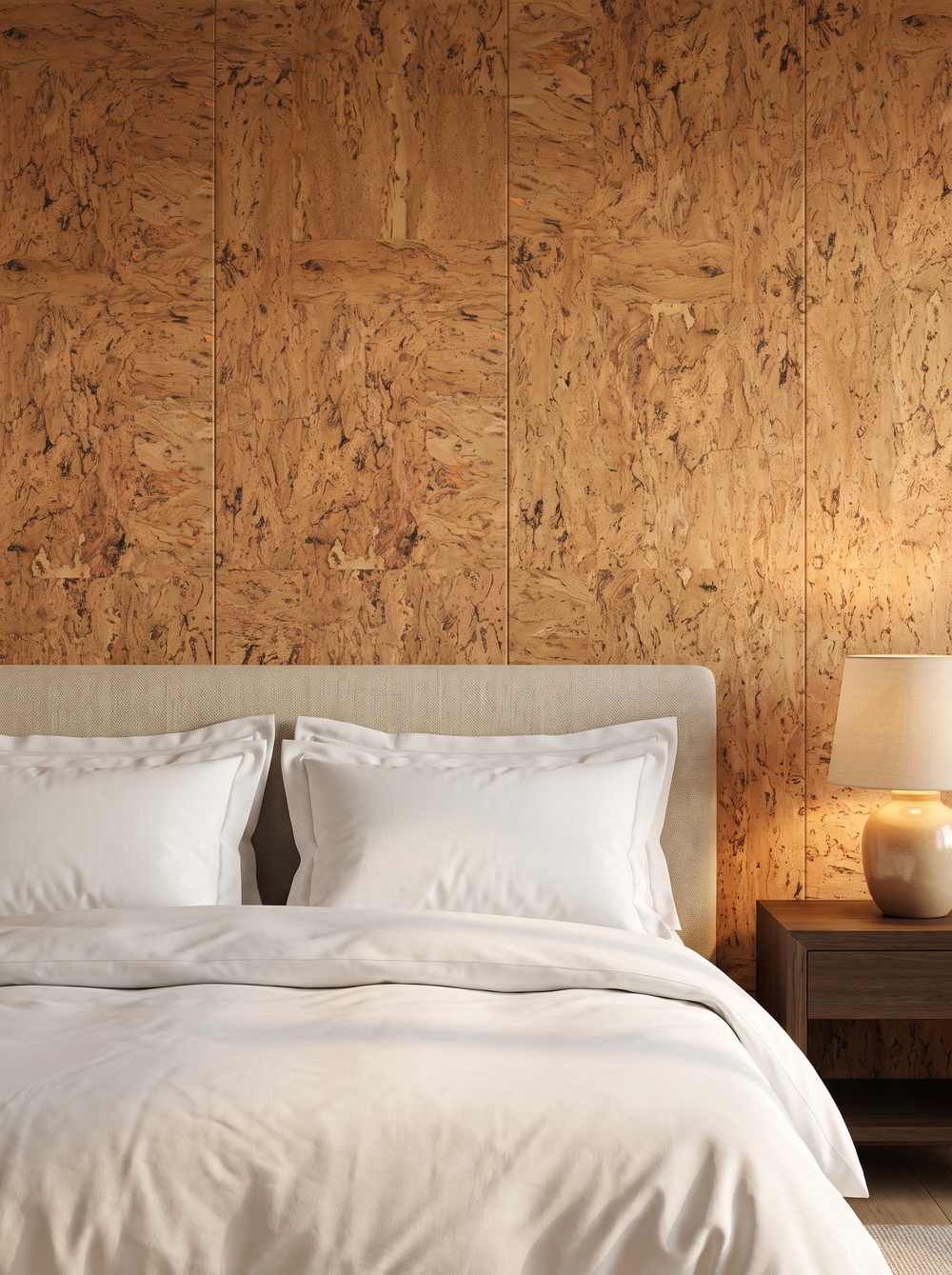
There is a moment that happens with every cork wall we have ever seen installed. Someone walks into the room, stops mid sentence, and reaches out to touch it. Paint never gets touched. Printed wallpaper rarely does. Real cork invites your hand before your brain has caught up, and that small human moment is the whole argument for natural wallcoverings in one gesture.
If you have been circling the idea of a textured feature wall and wondering whether cork is the one, you are in the right place. This guide covers what real cork wallcovering actually is, how it is harvested, which colourways suit which rooms, and how to order it with confidence. We make and supply wall finishes from our Central Coast manufacturing facilities in Australia, and our cork wallpaper collection spans 36 colourways of genuine harvested bark.


Natural Cork Wallpaper · Natural Sand Cork Wallpaper · Coconut White Cork Wallpaper
What real cork wallcovering actually is
Cork wallpaper starts its life as the bark of the cork oak tree. The bark is stripped by hand, seasoned, then shaved into fine veneers and pressed over a toned paper backing. What ends up on your wall is the actual material, pores, grain, natural markings and all. No print run can reproduce it, because there is nothing to reproduce: every roll is its own one-off arrangement of bark.
That is the fundamental difference between cork and the cork-look papers you may have seen. A printed texture repeats. Real cork never does. Stand a metre from a genuine cork wall and the surface shifts as you move, catching light at a hundred tiny angles. It is the same reason designers love grasscloth in real homes: the material is the pattern.
Many of our colourways add one more layer to this story. Beneath the bark sits a toned or metallic backing, so colourways like Taupe & Gold or Pearl & Gold Fleck glint softly through the bark's natural openings. The shimmer sits inside the material rather than on top of it, which is why it reads as depth rather than sparkle.
The tree is never felled. The bark is stripped by hand, regrows completely, and the same tree keeps giving for over a century.
The most renewable wall finish you can choose
Here is the part of the cork story we find genuinely satisfying to tell. Harvesting cork does not harm the tree. The bark is removed by hand in sheets, the trunk is left to regenerate, and Portuguese law requires a minimum of nine years between harvests. A cork oak gives its first harvest at around 25 years of age and continues producing for well over a hundred years. Those facts come from APCOR, the Portuguese cork industry association, and the UN Food and Agriculture Organisation, and they make cork one of the most defensible sustainable choices in interiors.
If eco credentials matter to your project, cork belongs on the shortlist next to the options in our eco-friendly wallpaper guide. Unlike many finishes that claim green virtue through recycling schemes, cork's virtue is built into how it grows.


Alabaster White Cork Wallpaper · Blonde Linear Cork Wallpaper
Choosing your natural: the light colourways
The naturals are where most cork journeys begin, and for good reason. These are the colourways that give you all of cork's texture while keeping the room light and open.
- Natural Cork: the honest, honey-toned classic. If you want the wall everyone recognises as cork at its best, this is it. It warms white interiors instantly and pairs with every timber we can think of.
- Natural Sand: a softer, sandier read that sits happily in coastal and relaxed contemporary homes. Lovely behind a linen bedhead.
- Coconut White: the brightest of the range. All the texture, almost none of the colour commitment. A quiet hero for small rooms and hallways.
- Alabaster White: cooler and more gallery-like than Coconut, suited to minimalist schemes where the texture should whisper.
- Blonde Linear: a pale cork with a gentle linear grain, a natural fit for Scandinavian and Japandi rooms.
A styling note from our team: light cork loves low, warm lamps. Overhead lighting flattens any natural texture, but a table lamp washing across a cork wall at night brings the whole surface alive. If your room leans dramatic rather than light, we have written a separate guide to the deep end of the range, from espresso to ink black, in our dark cork wallcoverings guide.
The gilded middle: naturals with a glint
Between the pale naturals and the deep moody colourways sits the part of the range our designers reach for most: naturals carried over metallic backings. Stone & Gold Fleck, Caramel & Gold and Sage & Gold Fleck keep the calm of a natural wall while adding a quiet warmth that reveals itself as the day darkens. In the morning these walls read as pure texture; by dinner, with lamps on, the metallic layer glints through the bark's openings like late sun on water. If this is the direction pulling at you, our dedicated guide to gilded and gold fleck cork walks through every metallic colourway in detail.
Where natural cork works hardest
Cork is a dry-area wallcovering, and within that boundary it is remarkably versatile. The rooms where we see it loved most:
- Bedrooms: this is cork's home ground. The material softens sound and feels warm, which is exactly the sensory brief of a bedroom. One wall behind the bed is all you need.
- Studies and home offices: calmer acoustics and a surface that looks considered on every video call.
- Dining rooms: cork takes the echo out of hard-floored dining spaces and glows under evening lighting.
- Entries and hallways: a corridor in Alabaster White cork turns a pass-through space into a moment.
- Commercial spaces: receptions, consulting rooms and boutique hotel suites, where the material's story is part of the welcome. Specifiers can read more in our commercial spaces wallpaper guide.


Taupe & Gold Cork Wallpaper · Porcelain Damask Cork Wallpaper
Meet the paper before you commit
Here is how we recommend buying cork, and it is the same advice we give trade clients spending five figures: sample first, always. Every colourway in the collection is available as a $4.99 sample. Order two or three contenders, hold them against your wall in morning light and again under your evening lamps, and the right one will announce itself. Cork tones shift subtly with light, and the metallic-backed colourways especially deserve to be seen in your room rather than on a screen.
Once you have met the material, confirming quantity is simple. Rolls are 91cm wide by 7.32 metres long. Measure your wall, check it against our measuring guide, or send your dimensions to our team at help@oliveetoriel.com and we will confirm the count for you. One thing we insist on: order your full quantity in one go. Cork is a natural material and tone varies subtly between production batches, so a wall should always come from a single batch. We cover why in detail on every product page.
Installation, simply
Cork hangs as vertical panels, butted edge to edge, using a paste-the-wall method. It is a premium natural material, so we recommend an installer who has hung naturals before; our installer directory can connect you with one near you. Seams on a well-hung cork wall read as fine hairlines inside the texture, far less visible than on printed papers. Care afterwards is nothing more than a dust with a soft dry cloth.
If you are weighing cork against other textural routes, our guides to textured wallpaper and timber-look wallpaper cover the printed alternatives honestly, including where they beat naturals and where they cannot compete.
One project, one dye lot: the rule that protects your wall
Because cork is harvested bark rather than printed pigment, tone varies gently from one production batch to the next. Two rolls from the same batch are siblings; two rolls from different batches are cousins. On a single wall you want siblings only, which is why we ask you to order your full quantity in one go rather than topping up later. If a project grows after the first order, tell us; we will check batch availability before you commit, and if the batch has moved on we will say so plainly and send a fresh sample of the current one so you can compare with your own eyes.
This is not a quirk to work around. It is the signature of a real material, the same reason a timber floor is laid from one milling run and a stone benchtop is cut from one slab. Once the wall is up, that batch is yours alone: no other wall in the world carries the same arrangement of bark. Customers tell us this is the detail that makes a cork wall feel like a commission rather than a purchase.
How cork compares with grasscloth and sisal
The three naturals get shortlisted together constantly, so here is the honest comparison we give over email every week. Grasscloth is woven plant fibre, linear and soft, with visible weft lines that give a wall gentle horizontal rhythm. Sisal is the more robust weave, tighter and more tailored, a favourite in studies and commercial fit-outs. Cork is the only one of the three that is a solid surface rather than a weave: no threads, no weave lines, just continuous bark figuring. That makes cork read calmer from across the room and slightly more contemporary up close.
Acoustically, all three soften a room, with cork ahead on touch: it is measurably warm under the hand because of those sealed air cells. On care they are equals, a soft dry dust and nothing more. On sustainability cork has the strongest single story in interiors, the harvested-bark cycle covered above. Plenty of our customers end up using two of the three across a home, cork in the bedroom, grasscloth in the living room, and the pairing works because the materials share a palette family while playing different textures.
From our facilities to your wall, duties paid
Every cork order is managed by our own Australian team, and we ship to more than 40 countries with all international import duties paid on wallpaper orders. That means the price you see is the price you pay, whether the wall is in Sydney, Auckland, London or New York. Designers and architects can also order through our trade design program with coded SKUs for schedules and specifications.
Frequently Asked Questions
What is natural cork wallpaper made of?
Real cork wallpaper is shaved from the harvested bark of the cork oak tree, pressed onto a toned paper backing. The texture you see and feel on the wall is the material itself, not a printed pattern.
Is cork wallpaper environmentally friendly?
Yes. The bark is stripped by hand and regrows fully, with Portuguese law requiring at least nine years between harvests. The tree is never felled and keeps producing bark for more than a century, according to APCOR and the UN Food and Agriculture Organisation.
How is cork wallpaper sold?
Our cork wallcovering comes in single rolls, 91cm wide by 7.32 metres long, at $449.95 per roll across all 36 colourways. Each roll covers about 6.6 square metres.
Can I see cork before I buy a full roll?
Yes, every colourway is available as a $4.99 sample. We recommend viewing it in your room in the morning and again at night, because cork changes character with the light.
What rooms suit natural cork walls?
Dry interior walls: bedrooms, living rooms, studies, dining rooms, hallways and entries. We do not recommend cork for wet areas.
Does cork wallpaper help with noise?
Cork is filled with millions of sealed air cells, so it naturally softens sound in a room. Bedrooms and studies feel noticeably calmer with a cork wall.
How do I know how many rolls I need?
Measure your wall width and height, then use our measuring guide or send the dimensions to our team and we will confirm the roll count for you. Order the full quantity in one go so every roll comes from the same batch.
Does Olive et Oriel ship cork wallpaper internationally?
Yes, we ship to 40+ countries from our Central Coast facilities, and we pay all international import duties on wallpaper orders so there are no surprise fees.
Ready to meet the material? Browse the full cork wallpaper and wallcoverings collection, start with a $4.99 sample of your shortlist, or explore our woven grasscloth wallpaper collection for cork's softer cousin. And if you would like a second opinion on a colourway, our team genuinely loves this material; write to help@oliveetoriel.com and tell us about your room.


