

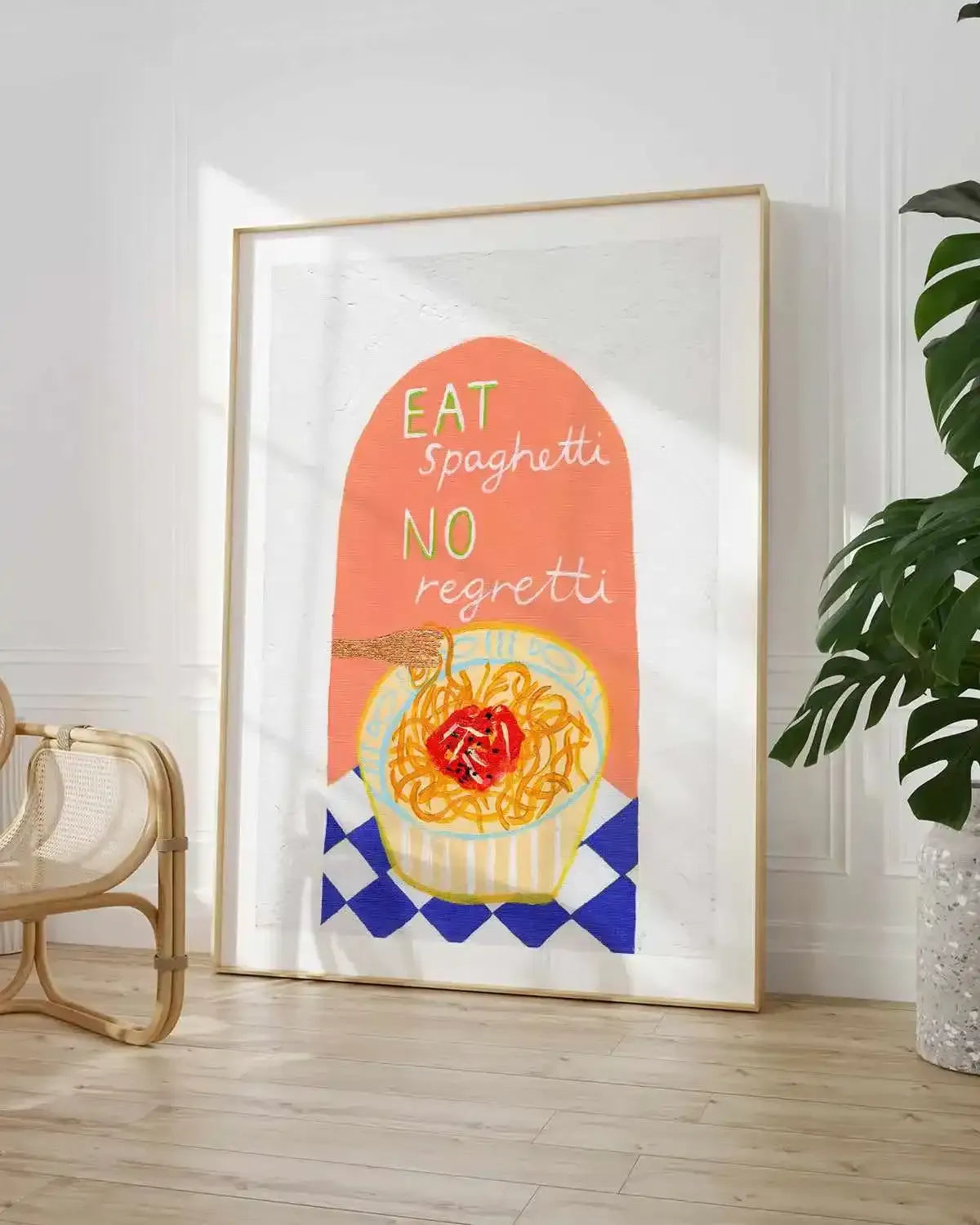
Large wall art is the fastest transformation in decorating: one confident oversized piece does what a dozen small frames, a repaint and new cushions cannot. It is also the purchase people hesitate over longest, because scale feels risky until you know the sizing rules. This guide removes the hesitation: how large is large, where big art belongs, formats, budgets and the sizing method that makes oversized feel inevitable rather than brave.
We print, stretch and frame large-format art daily at our West Gosford facilities, up to genuine statement scale, made to order and to measure. The extra large wall art collection is the starting point; this is the method that goes with it.


Spaghetti by Britney Turner Art Print · Flower Market Mykonos Art Print · Sea Grass II Art Print
What Counts as Large (and Why It Works)
In Australian rooms, large begins around a metre wide and extra large from about 1.4m. The reason big art works is proportion psychology: walls in modern homes are wide and tall, and small art on a big wall reads as apology. One work at proper scale calms the whole room, fewer edges, fewer decisions for the eye, one clear voice. This is why designers reach for scale first and colour second; the room's confidence lives in the ratio, not the palette (though our extra large abstract guide covers the palette half in depth).
Nobody has ever stood in a finished room and wished the art were smaller.
Where Large Art Belongs
- Above the sofa: the classic. Sixty to 75 percent of sofa width, one piece or a pair combined, per our framed art sizing rules.
- Above the bed: large and calm, canvas for safety and softness, sized per our king bed sizing guide.
- Dining walls: the room built for one confident gesture, a single oversized work outperforms any arrangement, see the dining room collection.
- Entries and stair voids: double-height walls are wasted on small frames; this is portrait-format large art's home ground.
- Open-plan zones: one large work per zone defines space without a wall, the method in our open-plan guide applied to art.


Long Road Home · Bronte Rocks I
Format at Scale
Canvas wall art dominates large formats: light enough to hang safely, matte enough to kill glare across big surfaces, no glass to shatter or reflect. Framed fine art prints hold their own to about 1.2m where detail and formality lead. For the truly wide wall, panoramic works (70x140cm in our range) and horizontal-format canvas solve the letterbox wall above sideboards and bedheads. Subject-wise, scale flatters atmosphere: abstract art, landscape photography and tonal fields from the neutrals collection all grow more commanding as they grow.
Buying Large, Practically
- Measure the wall, not the feeling: painter's tape at the candidate dimensions for 24 hours converts nerves into certainty, the tape always ends up bigger than the first guess.
- Made to order beats stock: our large works print to the size the wall wants, in days, rather than the three sizes a warehouse holds.
- Hang it properly: two fixings minimum, wall-appropriate anchors, centre at 145cm (slightly lower over low furniture), full method in the hanging guide.
- Delivery matters at scale: ours ships Australia-wide, packed for the size it is, with international shipping available.
- Trade pricing: stylists, designers and fitouts buy large-format at trade through the trade program.
The Psychology of Scale: Why Big Art Changes a Room's Behaviour
Something measurable happens when art crosses the one-metre threshold: it stops decorating the wall and starts governing the room. Visitors orient toward it; furniture arrangements resolve around it; the eye finally has somewhere to rest in open-plan spaces that otherwise feel like airports. Interior designers call it the anchor problem, and it is the single most common reason big Australian living areas feel unfinished, the build gave the room volume, but nobody gave the volume a centre. One properly scaled piece from the extra large collection does what four small pieces scattered around the room never will, because four small pieces are four apologies and one large piece is a decision.
Scale also does quiet work on proportion. High ceilings that dwarf standard furniture stop feeling cavernous when a tall portrait-format work claims the vertical; long blank hallway runs stop feeling institutional when a panoramic sits at their vanishing point. This is why we resist the "fill the wall with a gallery" reflex for large spaces: gallery walls are for storytelling in intimate rooms, but volume wants mass, and mass at scale is what large-format art is for.
Ceiling Heights, Voids and the Australian Open Plan
The rooms that need large art most, double-height voids, open-plan living-dining runs, entry galleries in new builds, are also the rooms where sizing intuition fails hardest, because every reference object is oversized too. Working numbers from a decade of these walls: in a standard 2.4m-ceiling room, 100x130cm framed is a confident maximum; under a 2.7m ceiling, 120x150 sits properly; in a true double-height void, nothing under 120x150 even registers, and a portrait-orientation work uses the vertical far better than landscape. For stair voids, hang the centre of the piece at eye level from the half-landing rather than from either floor, it is the one spot both flights actually see it from.
Open-plan spaces add a sightline question: the big wall is usually viewed from six or eight metres away across a kitchen bench, not from two metres like a hallway print. At that distance, detail dissolves and palette and gesture are everything, which is why bold abstracts and atmospheric landscapes dominate our living room canvas sales at scale while intricate work stays in the close-viewing formats. Stand where you will actually see the piece from, daily, at the distance you will see it, before choosing it; the artwork that wins from across the room is rarely the one that wins on a phone screen at thirty centimetres.
Delivery, Walls and the Practicalities Nobody Mentions
Large art has logistics, and knowing them upfront removes the last excuse for the too-small purchase. Our biggest formats ship in purpose-built cartons with corner armour, and canvas at scale stays remarkably light, a 120x150 framed canvas is a comfortable two-person lift and a one-person hang. Check the path before ordering the largest sizes: door frames, lift dimensions and tight stair turns defeat more oversized deliveries than couriers ever do, and thirty seconds with a tape measure at the narrowest point saves the re-delivery dance entirely. On the wall itself, plasterboard with the right anchors carries any piece we make without finding a stud, though for the largest works over seating we still recommend two fixing points, not for weight but so the piece never drifts off level.
Rental walls are not disqualified either. Modern removable hooks rated honestly, two of them, load-shared, will carry surprisingly large canvas works without a mark at bond inspection, and the hanging guide walks through the wall-type decision tree, brick, plasterboard, concrete, rental-safe, one by one, with the hardware named for each. If the wall gets full afternoon sun, choose the position across from the window rather than beside it; archival pigment inks hold colour for decades, but the piece will also simply look better lit obliquely than backlit into silhouette.
Pairs, Triptychs and Panoramics: Scale Without the Single Slab
A single monumental work is not the only route to scale, and on some walls it is not even the best one. A matched pair from the pairs and sets collection, hung with a tight 5 to 8cm gap and treated as one composition, spans sofa-width walls with more rhythm than a single slab, and it ships, carries and hangs more easily at every step. Triptychs push the same idea further for the widest walls, three verticals reading as one horizontal gesture. The rule that keeps these arrangements looking intentional rather than assembled: same series, same format, same frame, tight spacing. The moment the gap grows past a hand-width, one artwork becomes three small ones and the scale advantage evaporates.
Panoramic formats solve a different wall: the long, low run, above a sideboard, a bedhead, a media unit, where standard ratios leave awkward air. A 70x140 panoramic fills that band the way the wall wants, one uninterrupted horizon line instead of a compromise. Between pairs, triptychs and panoramics, almost every difficult large wall in a home has a native answer; the mistake is defaulting to one medium-sized rectangle and hoping. Match the format to the wall's actual shape and the room stops arguing with itself.
Budgeting for Scale Honestly
Large art is an investment, so treat the spend like one. The mathematics favour scale more than most buyers expect: one 120x150 statement piece typically costs less than the four medium works, four frames and four sets of hardware people buy while avoiding the big decision, and it produces a room the four-piece version never achieves. If the budget needs staging, buy the anchor wall first at full scale and leave the secondary walls literally empty for a season; an empty wall reads as intentional restraint, while an under-scaled anchor reads as a miss every single day. Print-only options also stretch the budget at the top end, ordering the largest works unframed and framing locally, or choosing canvas over glazed framing at scale, keeps the size ambition intact when the total needs trimming.
The last honest note is about nerve. Nobody has ever written to us regretting the metre-and-a-half artwork; the regret mail is uniformly about the piece that was one size too timid, bought in caution, hung in hope, and resented quietly for years afterwards. If the tape outline on the wall looks slightly too big on day one, it is right, that is what every gallery hanger and every interior designer we work with will tell you, and after ten years and many thousands of large-format walls, it is the closest thing this category has to a law. Trust the tape, not the nerves; the wall already knows what it needs, and the tape is simply letting it say so before the money moves.
Frequently Asked Questions
What size is considered large wall art?
Roughly a metre wide and up, with extra large from about 1.4m. In practice though, large is relative: art spanning 60 to 75 percent of the furniture below it, whatever that measures on your wall.
Is large wall art worth the cost?
Per square centimetre of transformation, it is the cheapest intervention in decorating, one purchase, one hanging, whole-room effect. The regretted purchases are almost always the too-small ones bought twice.
Canvas or framed for big walls?
Canvas from about 1.2m up, for weight, glare and safety reasons; framed prints below that where crispness and formality lead. Both are made to order at our facilities in solid timber framing.
How do I hang heavy large artwork?
Two fixings rated for the wall type (stud, masonry or quality hollow-wall anchors), never a single picture hook. Our large works arrive with hardware fitted and hang in under twenty minutes with a level and a friend.
What art looks best oversized?
Atmosphere over detail: abstraction, landscapes, tonal fields and soft photography. Busy detailed compositions can overwhelm at scale; calm ones become architecture.
Can I get art larger than the listed sizes?
Ask us, made-to-order printing means custom dimensions are routine, and we advise honestly on each artwork's maximum before quality compromises.
One large piece or a gallery wall?
Different rooms, different answers: one large piece for calm and modern registers, a gallery wall for collected warmth, per our gallery wall method. When a room hosts both, let them live on different walls.
Browse extra large wall art, canvas wall art and abstract art, printed and framed at our West Gosford facilities and delivered to more than 40 countries. Send us the wall photo and its measurements if you want the sizing called by people who scale walls every day; it is the five-minute conversation that prevents the one regret this category has.


