

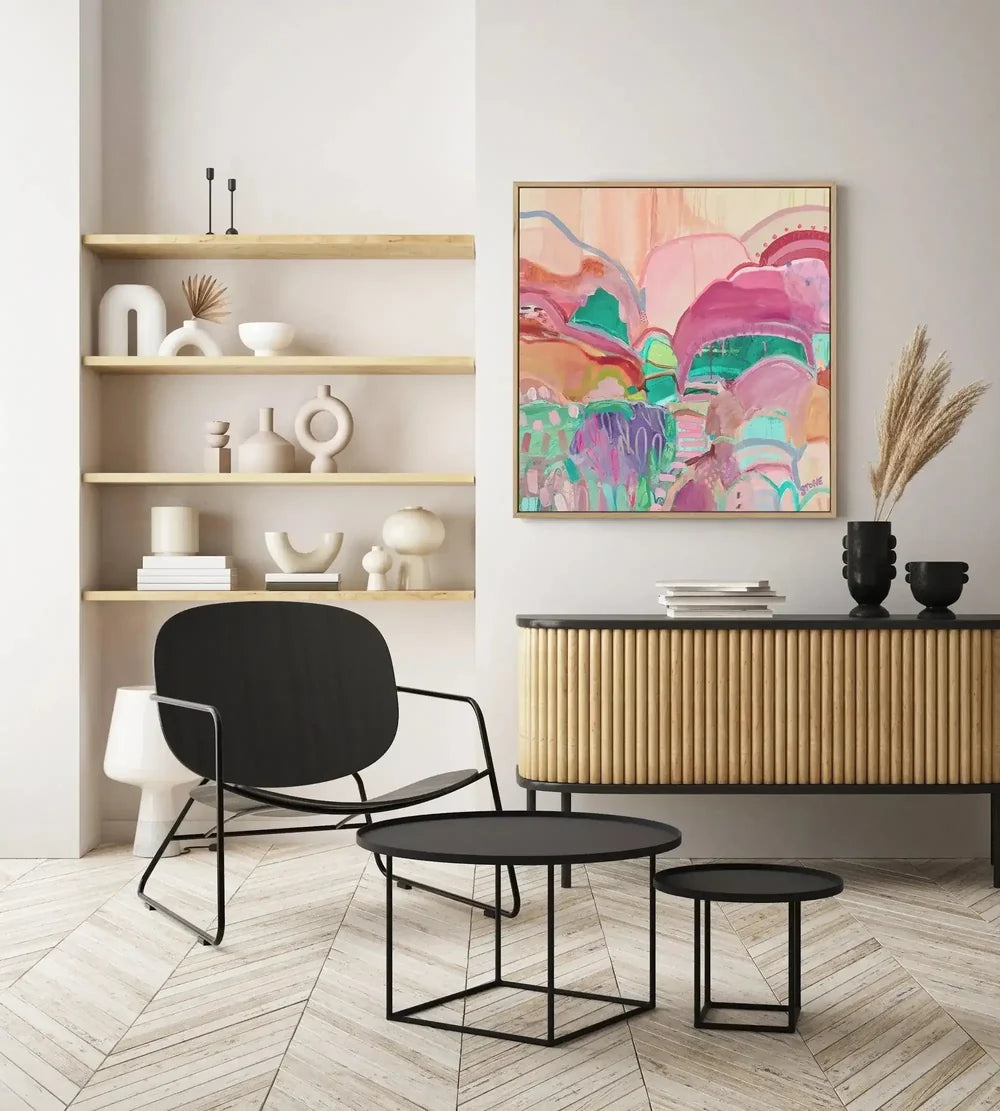
"Gallery-quality canvas" is one of those phrases the internet has worn smooth. Almost every stretched print online claims it, and almost none can tell you what it actually means. We can, because we build the thing ourselves: solid timber frames, gallery-wrapped canvas, pigment-ink printing, all assembled to order at our two West Gosford production facilities on the NSW Central Coast. In this guide we'll walk you through what gallery-quality really means, part by part, so you know exactly what separates a canvas that still looks beautiful in 2036 from one that sags by Christmas. By the end you'll be able to judge any seller, us included, against a simple checklist.
Here's why it matters in practical terms: canvas tends to be bought large. Above the sofa, above the bed, at 100 x 130 cm and beyond, which means every little quality difference that hides at poster size is on full show at statement scale. A slightly saggy corner, a whisper of a colour cast, a stretcher bar that bows: at 150 centimetres wide, everything shows. Materials really are the whole story here, and stories about materials are best told by the people who handle them every single day. So let's start with the anatomy, then work outwards to how you actually choose, buy and live with a canvas built to last.


Tulum Sunset by Belinda Stone | Framed Canvas Wall Art · Noosa Palm by Belinda Stone | Framed Canvas Wall Art · Springtime in the Yarra by Belinda Stone | Framed Canvas Wall Art
What's Actually Inside a Gallery-Quality Canvas
- The canvas itself: a proper artist-grade poly-cotton with a visible weave, heavy enough to stretch drum-tight and stay that way. Cheap canvas fails one way and one way only, it sags. Thin material over thin bars loosens through humidity swings, and Australian summers swing hard.
- The print: pigment inks, not dye. Pigment stays lightfast for decades where dye fades in a few years, and on day one you honestly can't tell the difference, which is exactly how the cheaper version gets away with it. Our printing is colour-managed on calibrated equipment, so the canvas that lands on your doorstep is the canvas you approved on screen.
- The stretcher bars: solid timber, dimensioned properly for the span, with real corner joinery that holds square. At 120 x 150 cm, bar quality effectively is canvas quality. Undersized bars bow inward under tension and the whole face goes soft.
- The float frame: our framed canvases sit in solid oak, black or white timber float frames, that beautiful shadow-line gap between the canvas edge and the frame that gives the format its gallery look. The frame is doing structural work too, keeping the stretcher squared up and protected for the long haul.
- The finish: gallery wrap (with the image or a colour carried around the edge), fitted hanging hardware, and a face that needs no glass in front of it. That's canvas's practical superpower, no glass means no glare, no reflections, and a lot less weight at large sizes.
At statement scale, the materials are the artwork. Everything that hides at poster size is on permanent display at 150 centimetres.
Canvas or Framed Print: the Honest Comparison
We make both, so this comparison isn't tilted in either direction. Framed fine art prints, printed on 230gsm archival paper behind crisp glass, are the winner for detail-forward work: photography, botanical studies, line art, anything where sharpness is the point. They also carry a certain formality that suits considered, gallery-style rooms beautifully. Framed canvas, on the other hand, wins for scale, softness and light. No glare on bright walls, less weight at large dimensions, and that lovely surface texture that flatters abstracts, painterly pieces and big atmospheric compositions. After ten years of orders, a few honest patterns have shown up: bright rooms and west-facing light love canvas, corridor detail is happier on framed prints, above sofas and beds at statement scale canvas takes most of the orders, and when the decision genuinely won't settle, our free mockup renders both formats on your actual wall photo, which usually decides it in one look. If you want the full side-by-side, our canvas versus framed prints guide lays it all out.
Where Canvas Really Earns Its Wall
- Above the sofa: the heartland of canvas. Pieces at 100 x 130 cm and 120 x 150 cm from the framed canvas collection, sized by the classic 60 to 75 percent of your sofa rule, with no glare bouncing across your longest sightlines.
- Above the bed: lighter than glass at the same size, which your wall anchors will thank you for, and softer in the calmest room in the house. Our bedroom range leans canvas for exactly this reason.
- Bright and coastal rooms: full-height windows and beach light will punish anything behind glass. Canvas just quietly ignores glare. Every beach house order we send out teaches the same lesson.
- Abstracts and painterly work: the weave finishes what the image starts. Our abstract canvas range exists because the format and this genre were made for each other.
- Open-plan expanses: big walls, long viewing distances, and a format that scales up without the weight penalty. Our extra large collection leans canvas-heavy for structural reasons as much as style ones.


Release it To The Sea by Amanda Skye | Framed Canvas Wall Art · Life Is Sweet by Jackie Green | Framed Canvas Wall Art
Five Questions That Sort a Good Canvas From a Cheap One
There are five little questions that sort the whole market, and most sellers can't answer even one of them properly. First, what are the stretcher bars made of, and how thick? (Solid timber, dimensioned for the span, in our case.) Second, pigment or dye inks? (Pigment, or the colour is temporary.) Third, what's the canvas weight and blend? (Artist-grade poly-cotton with a real weave, thin polyester is the sag machine.) Fourth, where is it made, and who do you speak to if something's not right? (West Gosford, NSW, and you speak to the people who built it.) Fifth, is the frame solid timber or plastic wrap? (Solid oak, black or white timber, doing real structural work.) A seller who answers all five plainly is selling you a canvas. A seller who can't answer any of them is selling you a photo of one. We publish our answers because we're the manufacturer, and the checklist costs us nothing while it costs the drop-shippers everything.
Buying a Statement Canvas With Total Confidence
A big canvas is a proper purchase, so it deserves the full sequence. Start by shortlisting from the collection and zooming into each product page at print resolution. Canvas rewards inspecting both the image detail and imagining the weave through it. Next, send us a photo of your wall along with your measurements and we'll put together a free mockup, your shortlist rendered at true scale on your actual wall, with frames compared side by side if you like, usually back to you within a business day. If you'd like to verify the material in your hands first, our A5 and A4 art prints from $9.95 use the same pigment inks on archival paper, so they're a faithful colour reference for the canvas version. Then when you're ready, place your order. Every canvas is stretched, framed and quality-checked to order at West Gosford, standard sizes dispatch within 24 hours, delivery runs Australia-wide with international shipping to over 40 countries, and there's a 30-day exchange policy on standard sizes backing your scale decision. Custom dimensions handle the wall between sizes too, because a gallery-quality canvas really ought to fit the wall it was always meant for.


Love Is All Around by Jackie Green | Framed Canvas Wall Art · Your Destiny Is Golden by Jackie Green | Framed Canvas Wall Art · Mermaid by Britney Turner | Framed Canvas Wall Art
Why "Gallery-Quality" Really Means Buying From the Builder
The phrase only means something when the seller genuinely controls every layer: the canvas, the inks, the bars, the frame, the wrap, the hardware, and the hands that put it all together. We control all seven at two large production facilities on the NSW Central Coast, and we've been doing it for over ten years now, across more than 350,000 homes. The marketplace alternative outsources every layer to the cheapest bidder and borrows the vocabulary. At poster size that difference is just a disappointment. At 120 x 150 cm above your sofa, it's the entire purchase. Buy your canvas from the people who can tell you what the stretcher bars are made of without checking, because they cut them this morning.
If you'd like more help sizing, our complete sizing guide has all the formulas, our panoramic guide solves the extra-wide walls, and the hanging guide walks you through the mechanics for heavier pieces.
Looking After a Canvas That's Built to Last
A properly built canvas asks almost nothing of you in return for its decades on your wall. Dust the face gently with a dry, soft brush or microfibre cloth, moving lightly with the weave. Never wet-clean a canvas surface, and never spray anything toward it. Cleaning products don't belong anywhere near pigment on fabric. Hang it away from direct heat sources and out of relentless direct sun, the same courtesy you'd give any artwork, and let the no-glass construction do its quiet work: no trapped humidity, no glare, and nothing to shatter in transit or during an enthusiastic game of indoor cricket. If a corner ever loosens years down the track, solid timber stretchers happily accept a re-tension, which is a ten-minute job for a framer rather than a full replacement. That's one more benefit of construction that was built to be serviced rather than thrown away. The frame itself wants nothing more than an occasional dust along the top edge, since solid oak and black and white timber finishes are sealed for exactly this low-maintenance life.
Composing a Wall With Canvas
Canvas plays differently in multiples than framed prints do. Its softer presence means canvas pairs and triptychs tend to read as one atmospheric field rather than a sequence of separate objects, which suits wide walls that want a sense of calm. Think two 60 x 90 cm canvases with a 6 cm gap above a king bed, or one of the composed three-piece sets from our trio collection stretched across an open-plan wall. The discipline is tonal: multiple canvases want to share one palette family and one subject temperature, and the float frames should match exactly, one finish right across the set, which ordering from one production run guarantees and buying piecemeal from a marketplace really can't. Mixing formats works beautifully too when it's done with intent. A large canvas anchor with two framed print satellites gives a wall both softness and crispness at once, and it's the combination our stylists reach for on long living room walls, usually drawing the framed satellites from our gallery-quality framed range. Send us your wall photo and shortlist, and we'll compose the arrangement for you at true scale, with the format mix recommended for your light. The thinking is completely free, and it gets the wall right the very first time.
Frequently Asked Questions
So what does gallery-quality canvas actually mean?
Five things you can verify. Artist-grade poly-cotton canvas stretched drum-tight, pigment (not dye) inks, solid timber stretcher bars dimensioned for the span, a solid timber float frame, and gallery-wrapped edges with fitted hardware. Any seller using the phrase should be able to tell you all five without hesitating. We build all five at our West Gosford facilities.
Canvas or framed print, which should I go for?
Canvas for scale, bright rooms and painterly work, since there's no glare, less weight and that warm texture. Framed prints for detail-forward images and more formal presentations. Above sofas and beds at statement size canvas takes most orders, and in bright or coastal rooms it's very close to mandatory. Our free mockup will render both formats on your wall photo if you'd like to see them compared before deciding.
Why do cheap canvases end up sagging?
Thin canvas stretched over undersized bars. Humidity cycles gradually loosen the stretch, the face goes soft, and it usually happens within the first Australian summer. Solid timber bars dimensioned properly for the span, paired with artist-grade canvas, hold drum-tight for decades. That's the whole structural difference the price gap actually buys you.
Do canvas prints fade over time?
Dye-ink canvases can fade visibly within a few years. Pigment-ink printing, which is what we use, stays lightfast for decades in normal room light. The two look identical on delivery day, which is exactly why asking the ink question before you buy matters far more than any product photo can show you.
What size canvas should I actually buy?
The standard rules work beautifully: 60 to 75 percent of your furniture width, 50 to 65 percent of an open wall, and when you're torn between two sizes, go the larger. Canvas doubly rewards that rule because the format scales up without adding glass weight. Our mockup will show you the exact size on your exact wall before you commit.
Are your canvases really made in Australia?
Yes, every one of them. Printed, stretched, framed and quality-checked to order at our two production facilities in West Gosford on the NSW Central Coast, as they have been for over ten years now. You can ask the team what the stretcher bars are made of, and the person answering can walk over and touch them for you.
How quickly does a framed canvas arrive?
Standard sizes dispatch within 24 hours of ordering, built to order, delivered Australia-wide with international shipping to over 40 countries. Custom dimensions run on a short production schedule. Statement walls don't have to mean statement lead times.
What if the canvas doesn't suit the room once it arrives?
Standard sizes are covered by our 30-day exchange policy: exchange or store credit, with return shipping at the customer's cost. Honestly though, it's rare. The mockup-first approach means customers who've seen the piece on their own wall photo before ordering almost never send it back.
Judge us against the checklist in the framed canvas collection, scale up in our extra large art range, and send us a photo of your wall. The mockup will show you exactly what gallery-quality looks like in your room, before a single dollar moves.


