
A child's room is a small world. Four walls, a rug, a bed, a shelf of favourite things — and, increasingly, one wall that opens onto somewhere else entirely. A misty forest. A gilded horizon. A calm blue sea. Australian parents are quietly moving away from the pink-and-blue accent-wall era and choosing wall murals for kids rooms instead: panoramic, story-filled, room-as-world scenes that grow with a child from cot to school age.
This guide is for the parent standing in front of an empty nursery wall at 10pm, phone in hand, wondering whether to paint, wallpaper, or mural. We'll walk through mood choices by age, gender-neutral palettes, peel-and-stick for rentals and commitment-shy homes, safety credentials that actually matter for babies, sizing for a typical Australian kids room, and the handful of scenarios where a mural isn't the right call. Every mural pictured is made in our Central Coast NSW studio, sized to your exact wall, printed on PVC-free substrate with water-based inks, and shipped globally with all import duties paid.


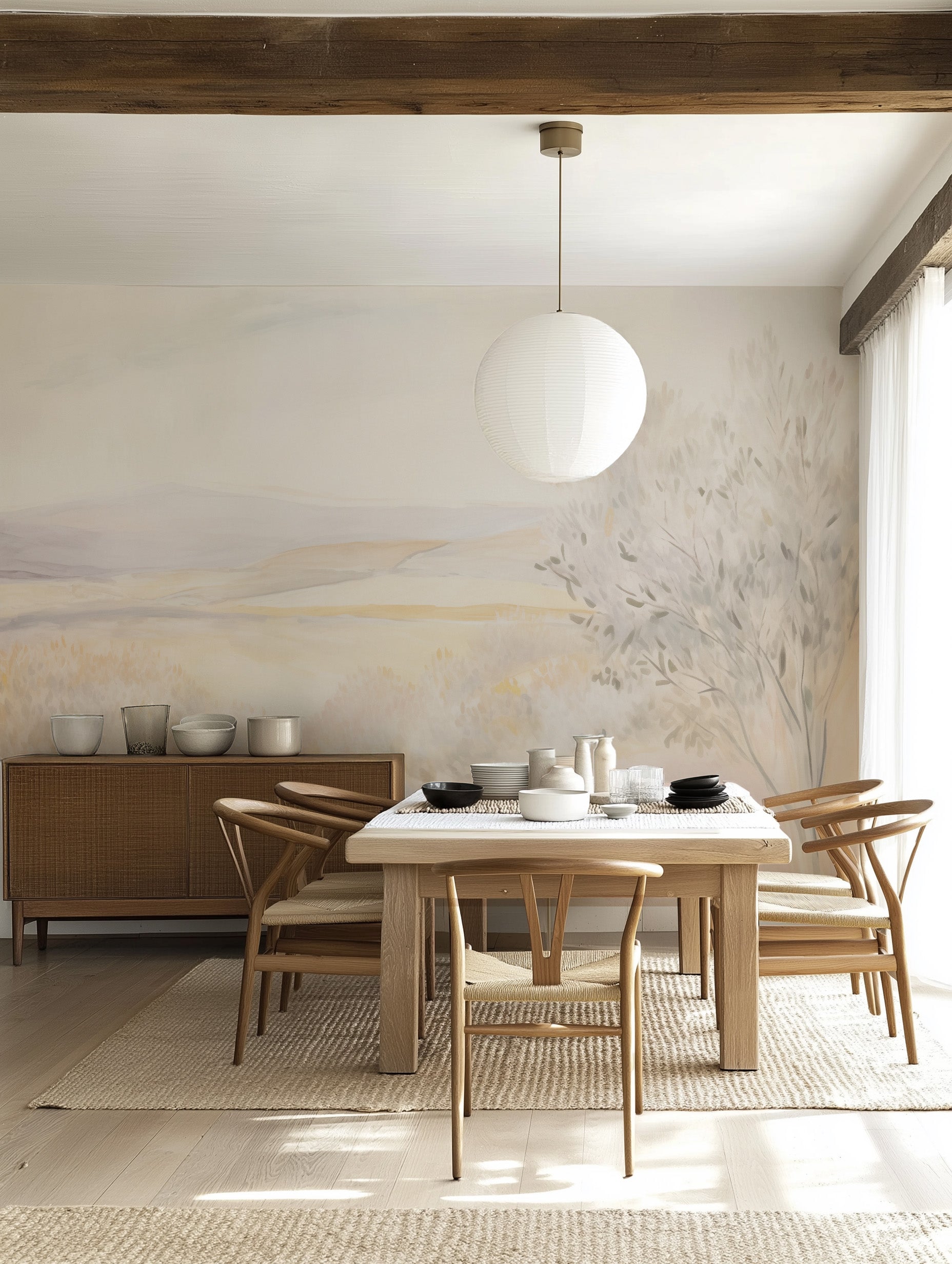
Soft Golden Horizon Mural Wallpaper · Japandi Garden Panoramic Mural in Navy & White · Painted Province Mural Wallpaper
Why parents are choosing murals over painted walls
Paint asks a child to imagine. A mural does the imagining with them. Open a tin of dusty sage, roll it on a feature wall, and you have… a green wall. Hang a hand-painted forest panorama across the same four metres and your child has a place to be. A canopy to fall asleep under. A horizon to stare into during a tantrum. A room that feels like a small, self-contained world rather than a box that happens to be their size.
The design reasoning behind this shift is what interior stylists call cocooning — the post-2020 move toward interiors that hold you rather than perform for you. Kids rooms are where cocooning has taken hold fastest, because a child's bedroom has one job: to feel safe, contained, and legibly theirs. A mural delivers that in a way paint genuinely cannot. It gives the room an identity before any toy hits the floor.
The second reason is longevity. A pink nursery is a pink nursery until your three-year-old loudly informs you she hates pink. A panoramic forest, a celestial meadow, or a soft golden horizon carries from newborn through to tween without renovation. Murals chosen well are one of the few decor decisions in a child's room that don't need to be redone at every stage, which matters for household budgets and for the quiet dignity of a child who doesn't want their room to feel babyish once they've outgrown that phase.
The third reason is Instagram-neutral: murals photograph in a way that painted walls don't. Parents shoot a lot of photos in their children's rooms — milestone cards, birthday mornings, first-day-of-school shots. A mural behaves like a backdrop that lifts every image without looking like you styled the room for the camera. It simply reads as intentional.
Nursery vs toddler vs big kid: what changes with age
The biggest mistake parents make when choosing a mural is treating "kids room" as a single category. What calms a six-month-old actively bores a six-year-old, and what excites a six-year-old can overstimulate a newborn. The mural lives on the wall for years — choose for the stretch of years, not the current month.
Nursery (0–2): muted, low-contrast, soundless
Babies see best at short distance and in soft contrast. High-contrast monochrome prints are great for tummy-time cards, not for the whole wall. For a nursery, we consistently recommend muted scenics — soft horizons, misty valleys, pale golden fields, gentle botanical canopies. The palette sits in the cream-to-sage-to-warm-grey range, which means the mural won't compete with a baby's visual system during night feeds (a surprisingly real concern in the first 8 weeks). For more on how to approach the whole room, our calming nursery guide walks through palette, decor pairings, and the emotional logic behind each choice.
Toddler (2–5): animals, soft landscapes, gentle storytelling
Toddlers want characters. Not cartoon characters — characters in a landscape sense. A tree is a character. A bird perched on a branch is a character. A distant mountain is a character. Murals in this age band lean into soft storytelling: botanical canopies with hidden birds, storybook landscapes that suggest a path through, painted tree scenes that invite a child to narrate their own small journeys through the room. The palette widens a little into sage, warm beige, soft blue, muted terracotta.
Big kid (5–11): adventure, atmosphere, specific mood
Big kids want their room to mean something. They're aware of trends (unfortunately), they have opinions, and they want the mural to signal who they are. This is where celestial scenes, dramatic forests, coastal palm panoramas and moodier colourways come in. The mural becomes aesthetic identity, not just decor. Involve them in the choice at this stage — offer three shortlisted scenes and let them pick one.

Six mural mood zones for kids rooms (with scenes that work)
Think of the mural first, then the rest of the room. Once you know the mood zone, furniture and textiles fall into place. Below are the six zones we see most often in Australian kids rooms, each mapped to a scene type and a real product from our wall mural collection.
Zone 1 — Soft scenic (best for nurseries)
Low contrast, wide panorama, horizon in the middle third. Soft Golden Horizon and Whispering Valleys above are both in this family — warm, hazy, almost cinematic without being loud. Pair with cream bedding, oat linen curtains and solid timber furniture in oak finish. The mural does the emotional work; the rest of the room stays near-neutral.
Zone 2 — Tranquil botanical and forest
Canopies, gum trees, layered foliage, painterly leaves. Calming without being sleepy, which suits rooms that also need to function as play spaces. Ideal for toddlers through early school age. Styled well, a forest mural reads as natural, grounding, and gender-neutral by default. If your child is going through a "everything must be a dinosaur" phase, a soft botanical canopy is the adult-proof way to lean into that without committing to a T-Rex bed frame.


Ethereal Woodland Wallpaper Mural · Dreamscape Canopy Wallpaper
Zone 3 — Storybook landscape
Rolling fields, distant villages, winding paths, painterly pastures. This is the "tell me a story" mood zone — scenes that invite narration. Strong for toddlers who are beginning to invent their own play, and for children who resist abstract art. The storybook scene gives them a world to place toys into, which is a quietly underrated reason these murals get kept through several redecorations.

Pasture Valley Wallpaper Mural
Zone 4 — Animals and nature (gentle, not literal)
We get asked for "animal murals" constantly, and our answer is usually: choose a landscape where animals can live, not a landscape with animals painted in. A woodland panorama is a better home for a child's soft toys than a mural that already decides who lives there. For parents who want a suggestion of wildlife without literal illustration, tree-heavy murals like the one below do the job — the child supplies the creatures.

Oak Tree Vista Wallpaper Mural
Zone 5 — Celestial and cosmic
Soft skies, star-scattered atmospheres, moonlit meadows. Strong for bedtime-anxious children (a sky overhead can genuinely help) and for big kids who want something specific without going cartoon. Celestial scenes are also one of the most gender-neutral options in the catalogue — the sky is the sky.


Celestial Dreamscapes Wallpaper Mural · Celestial Meadows Wallpaper
Zone 6 — Coastal, palm and under-the-sea
For Australian beach-side homes and kids who are functionally aquatic from November to April. Coastal murals — palms, blue horizons, dappled tropical scenes — bring summer indoors without veering into literal sea-creature wallpaper. A palm panorama in muted blue works for a two-year-old and still works for the same child at ten, which is more than you can say for a shark motif.

Palisade Blue Palms Wallpaper Mural
Japandi wall murals for kids rooms: the quiet favourite
Japandi — the marriage of Japanese minimalism and Scandinavian warmth — has become a sleeper favourite for children's rooms across Australia, the UK and the US. The reasoning is practical: Japandi palettes (warm whites, oat, soft black, muted green-blue) don't clash with anything a child drags home from kindy, and Japandi mural scenes (bird-and-branch, soft blossom, ink-wash forest) are serene without being saccharine. For the full design philosophy, our Japandi interior design guide is the long-form version; for the wallpaper side specifically, see Japandi Wallpaper: A Designer's Textural Guide.
Japandi murals work especially well as the single decor choice in a small Australian kids room. The palette is restful enough for a cot-age child, interesting enough for a seven-year-old, and reads as considered rather than themed. If you're debating between a busy "children's" wallpaper and something that feels more grown-up without being cold, Japandi sits exactly in the middle.

Japandi Garden Panoramic Mural Midnight Blue Mural Wallpaper
Mural vs repeat-pattern wallpaper: which suits a kids room?
Both work. They solve different problems. A mural gives you one continuous scene across a wall — a forest, a sky, a horizon. A repeat-pattern wallpaper tiles a single motif over the whole wall, like stripes, florals, or small stars. The question isn't which is better, it's which fits the room you actually have.
A mural wins when: the feature wall is mostly uninterrupted (no more than a cot or a low bed in front of it), you want the room to feel "somewhere" rather than decorated, and you want one design decision to carry the room rather than layering patterns. Murals also photograph far better than repeats, which matters more than parents expect.
A repeat wins when: the room is small and packed with furniture against the feature wall (a tallboy, a change table, a bookshelf), when you want all four walls wallpapered rather than just one, or when you want a motif that can be echoed in bedding and curtains. For this route, see our kids room wallpaper guide, which goes deeper on pattern choice and scale.
Peel-and-stick murals: the low-commitment path for kids rooms
If there's one installation type made for children's rooms, it's peel-and-stick. Kids move between bedrooms. Families move between houses. Parents change their minds. Tastes evolve. A peel-and-stick mural can be installed in an afternoon and removed without damage — which is exactly the commitment level a kids room needs. Every mural in our collection is available in both traditional paste-the-wall and peel-and-stick formats, so you choose the install type based on how long you think the mural should stay.
For renters, peel-and-stick is non-negotiable. Australian tenancy agreements generally allow removable wallpaper; traditional paste-the-wall is usually a no. Our renters guide to peel-and-stick wallpaper in Australia walks through which clauses to check in your lease and what to say to property managers.
For homeowners, peel-and-stick is still often the right choice in a kids room specifically because the mural may need to come down in five years when your nine-year-old declares forests are "for babies" (they aren't, but they will). Installation is genuinely solo-friendly — our peel-and-stick install guide and intro to peel-and-stick cover the full process.
Sizing a mural for an Australian kids room
Most Australian kids rooms measure between 3.0m and 4.0m on the feature wall, with ceiling heights between 2.4m and 2.7m. Our murals are custom-sized to your exact wall dimensions, so you don't need to buy a fixed-size panel and hope it fits. Measure the wall width and height at three points (left, centre, right for width; and three points across for height), take the largest measurement in each direction, and add a 5cm overbleed allowance on each edge. That final number is what you order.
Scale matters. A panoramic scene on a 3m wall reads quieter than the same scene on a 5m wall — the figures, trees and horizon lines get smaller, and the room feels calmer. For nurseries, we lean toward the quieter end. For a big kid's room, a larger scale with visible brushwork or stronger detail can work. If you're unsure, our measuring guide walks through it step by step and our team reviews every order before printing.
Safe and sustainable: what actually matters for a kids room
This is the section parents read most carefully, so we'll be specific. Our wall murals are:
- PVC-free substrate. No phthalates, no off-gassing plasticisers. This matters in any sealed room but particularly in a nursery where a baby sleeps within metres of the wall for 16 hours a day.
- Water-based inks, low-VOC. Solvent printing releases volatile organic compounds into enclosed rooms for weeks after installation. Our inks are water-based and classified low-VOC, which means no lingering chemical smell and no exposure concern for infants.
- FSC-equivalent responsibly sourced paper. The non-woven substrate is manufactured from pulp certified against responsible forestry standards.
- Washable finish. Spills, sticky hands, crayon attempts — all wipe clean with a damp microfibre cloth. (Crayon takes a bit more work; see the FAQ.)
- Printed on the Central Coast NSW. Made locally with over ten years of manufacturing history, shipped globally with all import duties covered so there are no surprise fees for international customers.
For parents who want to go further, custom murals can be printed on request with matte finishes that reduce glare from nightlights and overhead globes — small detail, meaningful for light sleepers.
A gender-neutral palette beats pink-or-blue every time
We stopped pushing gendered colour defaults a long time ago, and every year more parents ask us directly for gender-neutral options. Two reasons: siblings of different genders often share rooms, and parents increasingly don't want to tell a three-year-old what colours they should prefer. The murals that perform best across both genders and across the 0–11 age range sit in a tight palette — muted sage, warm oat, soft blue-grey, cream, terracotta, and earth browns. None of those are pink or primary blue, and all of them read as considered rather than assigned.
Colour psychology backs this up. Muted earth tones lower the arousal register of a room, which matters before sleep and during transitions (bath, pyjamas, wind-down). Saturated primary colours do the opposite. This is part of why so many paediatric sleep consultants quietly recommend replacing bright decor with calmer palettes by age two.
Let the mural be the decor
A mural does not need a gallery wall next to it. It does not need a feature rug. It does not need coordinating framed prints. One of the quiet gifts of choosing a mural is that the styling decisions afterward become almost boring — simple furniture, neutral bedding, a few books, one lamp, done. Parents who treat the mural as just another element in a busy room tend to dilute its effect; parents who let the mural be the whole visual event in the room end up with something that photographs and lives better.
If you do want to add wall art, restrict it to the non-mural walls — and keep it small and personal (a child's own painting, a framed name print, a single botanical). Our hanging guide covers placement heights for kids spaces (lower than the adult standard — art should sit where the child can actually see it).
When a mural isn't the right call
There are a handful of rooms where we talk customers out of a mural. Worth naming them honestly:
- Too many windows on the feature wall. A panoramic scene needs continuous wall to breathe. If the wall is 40% window, the mural gets chopped into visual fragments and the scene doesn't read. Choose a different feature wall, or go with a repeat-pattern wallpaper that tolerates interruption.
- Heavy furniture stacked against the mural wall. If a tall bookshelf, wardrobe or robe occupies more than a third of the mural wall, you're paying for mural you'll never see. Move the furniture, or choose a different wall.
- Shared rooms with strongly different taste. A six-year-old who wants celestial and a four-year-old who wants pink florals will not agree on a single panorama. In that case, consider giving each child their own feature wall with a different design, or choose a near-neutral scene (soft horizon, ink-wash canopy) that neither child loves but neither refuses.
- High-humidity rooms without ventilation. Non-woven murals handle normal bedroom humidity fine, but a poorly ventilated ensuite-attached nursery in tropical Queensland can be a stretch. Ventilate the room, or go with our marine-finish options for wet zones.
Installation in real Australian homes (between nap times)
Most parents install their child's mural themselves, usually across two nap windows. This is genuinely achievable. The mural arrives in numbered drops (vertical strips), each around 50–60cm wide, with a 2cm overlap planned in. Paste-the-wall is faster than old-school paste-the-paper; peel-and-stick is faster still and fully repositionable during install.
Two tips that save most of the pain: (1) use a chalk line or laser level to mark a plumb vertical on the wall before hanging the first drop — everything else aligns off that first line; (2) have a second person on call for the top edges even if you install the bulk solo. A partner, a friend, or a Zoom call with someone who can say "left a bit" is enough.
Our full wall mural installation guide covers the process in detail, and if you'd rather hand it to a professional, our wallpaper installer directory lists vetted installers across every Australian state and most major cities. For peel-and-stick specifically, our wall prep guide is the step most DIYers skip — and the main reason peel-and-stick installs occasionally go wrong.
Removing the mural when they outgrow it
Peel-and-stick comes off cleanly — start from a corner, pull slowly at a 180° angle back on itself, and the panel releases without lifting paint. Traditional paste-the-wall is more involved but still manageable with warm water, a spray bottle and time. Our wallpaper removal guide walks through both methods, and our honest review of the vinegar removal method will save you a trip to the shops for ingredients that don't help much.
Plan for this up front. Choose peel-and-stick if you suspect the mural will come down within five years. Choose paste-the-wall if you want it to live there for a decade. The adhesive decision is quietly the most important one parents under-think.
Custom murals: a scene made for your child specifically
Some of the most meaningful mural commissions we print are custom. A grandmother's oil painting of a garden, scanned and printed at wall scale for her grandchild's nursery. A favourite book illustration licensed and re-drawn at mural proportions. A family photograph from a holiday reimagined as a painted panorama. A sibling pair's initials woven into a botanical scene. None of these exist in a standard catalogue, and all of them become the emotional centre of the room.
Our custom wallpaper service handles the full pipeline — from initial brief to mock-up to colour-matched print — and works particularly well for kids rooms where the personal meaning outlasts the trend cycle. The investment isn't dramatically higher than a standard mural, and the result is something no other child in the world has on their wall.
Related reading for your kids room project
Browse our wall mural collection for over 120 panoramic scenes, or explore the broader peel-and-stick wallpaper collection if you're set on removable. For trend context, see Wall Murals: The Statement Wall Trend Dominating 2026 and our 2026 Interior Trend Report. If you're styling calmer rooms across the house, The Most Relaxing Bedroom Colours pairs naturally with every mural in the soft-scenic family. For the adjacent nursery wallpaper collection, repeat-pattern designs live there.
Frequently Asked Questions
Is a wall mural safe for a baby's nursery?
Yes, provided the mural is printed on a PVC-free substrate with low-VOC water-based inks — which all of ours are. Avoid vinyl-faced wallpapers and solvent-printed murals for a nursery; both can off-gas for weeks after installation. Ventilate the room for 24 hours after installing any wallpaper, baby or not, as a sensible general precaution.
How long does a kids room mural actually last on the wall?
A paste-the-wall mural in a normally used kids room lasts 10–15 years in good condition. A peel-and-stick mural lasts 5–8 years while remaining fully removable. The ink and substrate outlast both of those windows — the practical limit is usually the child outgrowing the scene, not the mural wearing out.
Can I install a mural directly over a painted wall?
Yes, over fully cured paint that isn't peeling, chalky or glossy. Matt or eggshell finishes are ideal. If the wall was painted in the last 30 days, wait the full cure window or the adhesive (both paste and peel-and-stick) can lift the paint when the mural is eventually removed. Wash the wall lightly and let it dry fully before hanging.
How much mural do I actually need for a typical Australian kids room?
Measure the feature wall's width and height at multiple points, take the largest value, and add 5cm overbleed per edge. Most Australian kids rooms need a mural sized roughly 3m–4m wide by 2.4m–2.7m high. Our team reviews every order against your measurements before printing, so if something looks off we'll email you before the job goes to press.
Can I use peel-and-stick in a kids room?
Peel-and-stick is often the best choice in a kids room specifically because children move, families move, and tastes change. Install takes an afternoon, removal is damage-free if done correctly, and every mural in our collection is available in peel-and-stick format. Wall prep matters more than most people realise — see our wall-prep guide linked earlier.
What happens when my child spills or draws on it?
Food and drink spills wipe off with a damp microfibre cloth. Crayon and texta need a bit more effort — a small amount of gentle dish soap on the cloth usually lifts them. For stubborn marks, isopropyl alcohol on a cotton pad is safe on our substrate. Do not use abrasive sponges; they'll scuff the matt finish.
Won't my child outgrow the mural quickly?
This is why mood zone matters more than motif. A cartoon character mural gets outgrown at age five. A panoramic forest, a celestial sky, or a soft horizon doesn't — it simply becomes a slightly more mature version of itself as the child ages. Choose for the scene, not for the age-six trend.
How much does a custom children's mural cost?
Custom murals price per square metre, similar to our standard range, with a one-off design fee depending on complexity. For a typical 3.5m × 2.5m nursery feature wall, custom sits within 15–25% of the equivalent off-the-shelf mural price. Start with our custom wallpaper enquiry form — briefing is free, and we quote before any commitment.
Browse the full wall mural collection, order a $4.99 wallpaper sample (48cm × 40cm / 19in × 16in) to test colours against your child's bedroom light, or start a custom mural brief for something only your child will have on their wall. We ship to 40+ countries with all import duties covered, so parents from Sydney to Seattle to Southampton see the same honest landed price at checkout.


