

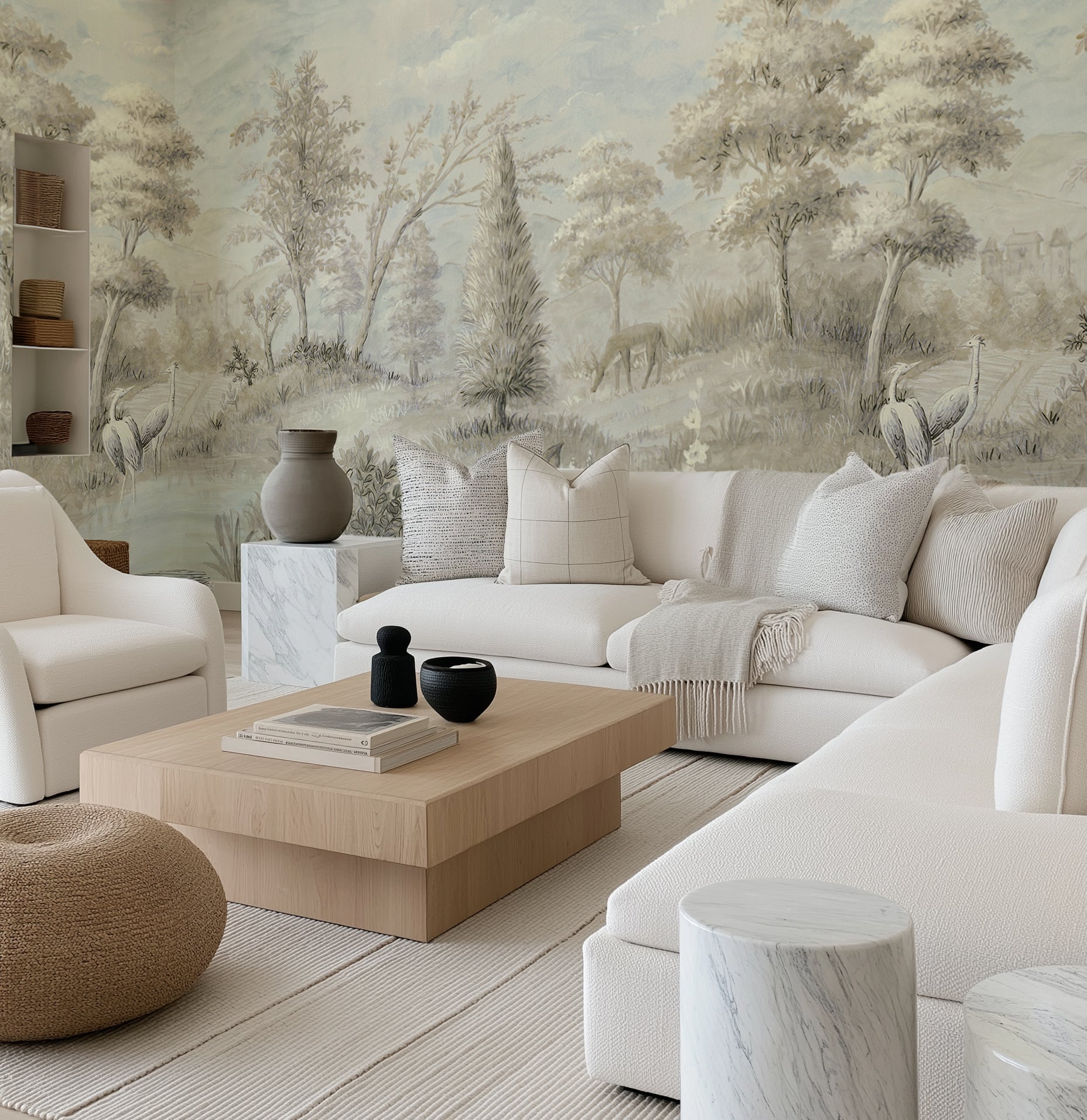
Choosing a wall mural isn't really about choosing a wall mural. It's about answering eleven quiet questions that nobody asks you out loud — and getting most of them right before you press "order." Most "how to choose a mural" guides online skip eight of them and leave you with a polished sales pitch instead of an honest framework.
This is the framework our design team walks customers through when they ring us unsure. It's the same sequence whether you're in a Sydney terrace, a London flat, a Portland craftsman, or a Melbourne apartment — because the decision-making is universal even when the products and walls are not. We've shipped murals into more than forty countries over ten years on the Central Coast of NSW, and the projects that succeed almost always answer these eleven questions in roughly this order.
Work through them once, in sequence, and you'll know — with genuine confidence — whether the mural you're eyeing will live happily on your wall for the next decade, or whether it needs to go back on the shortlist.


Heron Lake Scenic Mural · Mineral Fade in Sage Green · Chinoiserie Garden in Navy
Question 1 — Which room is the mural actually going in?
This sounds obvious. It isn't. The room dictates scale, light conditions, moisture tolerance, traffic wear, cleaning regime, and — most importantly — the emotional register the mural needs to hit. A mural that electrifies an entry will exhaust you in a bedroom. A mural that soothes in a nursery will read flat in a kitchen.
We've written a dedicated playbook for every room where murals commonly go. Read the one that matches your project before you read anything else on this page:
- Living room: see our wall mural statement-wall trend guide for feature-wall composition in open-plan lounges.
- Kids' bedroom or nursery: murals do extraordinary work in children's spaces; see the room-specific guide for scale, safety, and longevity considerations.
- Bathroom: moisture, ventilation, and material choice matter more than pattern — see the bathroom guide.
- Home office: focal-wall placement vs Zoom-backdrop placement changes everything.
- Kitchen: splash zones and heat exclusions define the safe installation area.
- Entry or hallway: the "first impression" wall is the most forgiving canvas in the house.
- Bedroom: behind the bed, opposite the bed, or on the ceiling — three very different outcomes.
- Dining room: murals here need to flatter candle-light and incandescent bulbs, not daylight.
The room isn't a constraint. It's the brief. A mural that ignores its room is a mural that stops delighting you within six months.
Question 2 — Panoramic or repeating pattern?
This is the foundational mural distinction that product photography almost never explains clearly, and it changes the price, the install, and the final look more than any other decision you'll make.
Panoramic murals (sometimes called "scenic" or "continuous") are a single giant image stretched across the wall — think a forest scene, a lake view, a painterly gradient. The composition matters, because what sits at eye level in the middle of the wall is fixed. You can't shift it. Panoramic murals are custom-sized to your wall so the image fits the dimensions you order.
Repeating pattern murals are technically still "murals" in the way we use the word at OEO — they're printed on mural-scale material and installed like a mural — but the design tiles, which means the pattern loops seamlessly and you can run the wallpaper around an entire room if you want. Florals, chinoiserie, and abstract textures often come this way.
Panoramic suits a feature wall. Repeating pattern suits full-room immersion or any wall where you don't want the "landscape view" effect.


Vintage Woodland Trees · Misty Blue Forest
Question 3 — What scale of mural are you actually committing to?
There are four distinct scales, and they ask completely different things of you as a homeowner. Pick the smallest one that still delivers the effect you want — you can always go bigger next time.
- Single-panel feature (one wall, typically 3-4m wide by 2.4-3m tall): the most common mural install. Behind a bed, behind a sofa, in an entry. Lowest commitment, highest impact per dollar.
- Multi-panel feature (two adjoining walls, or a wall-plus-ceiling corner): dramatic, but the design needs to be chosen with the fold in mind. Panoramic murals rarely wrap a corner gracefully — repeating patterns do.
- Ceiling moment (a single mural on a ceiling, often over a dining table or bed): the most forgotten application. Light handling changes on a ceiling and so does gravity on the adhesive — but the payoff is extraordinary.
- Full-room wrap (four walls, sometimes ceiling too): only works with repeating patterns, and only in rooms with minimal architectural noise. A small powder room is the classic full-wrap candidate; a busy family room almost never is.
Use our how-to-measure guide before you commit. Murals are custom-sized, which means accurate wall measurements protect you from waste and from panels that don't quite reach.
Question 4 — Which pattern category actually suits your home?
We group murals into eight families because the category decision usually matters more than the specific design. If you've chosen the wrong family, no amount of picking the "perfect" mural inside it will rescue the outcome.
- Coastal: ocean, horizon, watercolour blues, pale sands. Flatters weatherboard homes, beach shacks, and any room that already has coastal cues. Avoid in dense inner-city apartments — reads disconnected.
- Forest & woodland: trees, misty glades, vertical repetition. Cools down a room, adds depth, extends a small room visually. Works brilliantly in bedrooms and home offices.
- Botanical: florals, foliage, garden scenes. The most forgiving family — works across Federation, mid-century, modern, and cottage interiors.
- Heritage & chinoiserie: hand-painted garden scenes with birds, blossoms, and classical composition. The mural equivalent of a Persian rug — anchors a room with history.
- Abstract & painterly: gradients, brushwork, no figurative elements. The safest choice when you're unsure — and often the most sophisticated.
- Architectural: arched colonnades, trompe-l'œil doorways, painted panelling. Use carefully; the wrong one looks like a theatre backdrop.
- Landscape: mountains, deserts, lakes, skies. Close cousin of coastal. Picks up on the painterly tradition of European dining rooms.
- Cityscape: skylines, street scenes, urban texture. Niche, but unforgettable when the room supports it.


Aspen Sky · Vintage Garden · Painted Pathways in Brown
Question 5 — Peel-and-stick or paste-the-wall?
The adhesive decision is where rental status, commitment level, and installation confidence converge. Most mural-buyers overthink the pattern for weeks and then decide the material in ten seconds — the opposite of what we'd recommend.
Peel-and-stick is pre-pasted, repositionable, and removable without damage when installed on well-prepared walls. It's the right answer for renters, for people who redecorate frequently, for kids' rooms where you expect to change the scheme as they grow, and for anyone installing their first mural without professional help. See our peel-and-stick wall preparation guide for the wall-prep specifics.
Paste-the-wall (non-woven traditional wallpaper) is the professional-grade option — applied with paste, dimensionally stable, easier for a professional installer to hang without bubbling, and typically the longest-lasting choice for forever-home installations. See our paste-the-wall installation guide.
Both options from OEO are printed on the same high-resolution fabric-feel substrate — the difference is the adhesive mechanism, not the image quality. Rental status is the deciding factor for most people. If you're planning to move within three years, choose peel-and-stick.
Question 6 — Can your wall actually handle a mural?
This is the question customers wish they'd asked before ordering. Murals magnify wall imperfections. A small dent that was invisible under paint becomes a visible shadow under mural. Here's what to check before you order:
- Plaster vs plasterboard: both are fine. Old lath-and-plaster walls in heritage homes can be lumpy — check for level with a long straightedge before committing.
- Old paint condition: if the existing paint is flaking, chalking, or peeling, the mural will come off with the paint. Prime and repaint before installing.
- Recently painted walls: let fresh paint cure for a minimum of three to four weeks before applying any wallpaper or mural. Uncured paint outgasses and affects adhesion.
- Textured walls: orange peel, knockdown, or heavy render will show through. Skim-coat smooth before proceeding.
- Damp or rising moisture: non-negotiable. Fix the source, let the wall dry completely, then install. A mural over damp walls fails within months.
- Old wallpaper underneath: remove it properly first — see our complete wallpaper removal guide.
Question 7 — What's the light in this room actually doing?
Every mural colour is calibrated for a neutral print environment. Your room is not a neutral environment. North-facing Australian rooms (south-facing in the northern hemisphere) get cool blue-grey light that pushes warm murals towards muddiness. South-facing rooms get warm honey light that can oversaturate already-warm murals.
Artificial light is worse. A warm 2700K bulb over a blue mural can make it read grey. A cool 5000K bulb over a green mural can make it read clinical. If the room has heavy west-facing afternoon sun, expect UV fading to shift colour temperature across the first two years regardless of ink technology.
Practical rule: order a sample and tape it to the wall at the intended position. Live with it for at least seven days. Look at it at 7am, noon, 6pm, and 10pm with your normal lights on. If you still love it through all four daily light conditions, you have your mural.
Question 8 — Will it clash with everything already in the room?
Mural regret almost always comes from people choosing the mural first and ignoring the furniture, rug, and art that already live in the room. Work the other way: lay the mural's three dominant colours next to the existing rug, sofa, bedding, and largest artwork. If any of them fight, the mural loses.
The safer approach: let the mural replace a single large artwork rather than compete with one. A mural behind a bed usually means no art above the bed. A mural behind a sofa usually means the gallery wall moves elsewhere. Murals are the hero; they don't share billing.


Vintage Tapestry Botanica · Mineral Fade in Pink Clay
Question 9 — Who else lives in this house?
Partner alignment is the most predictive factor in long-term mural satisfaction. A mural that one person loves and the other tolerates becomes a quiet source of resentment within months. If your partner, housemate, or family member can't name three things they like about the mural within ten seconds, don't install it.
Kids count too. If a child is sharing the room, involve them — but hold veto on anything the adults will have to live with for longer than the child stays in the room. Flatmates should get consent rights on any shared-space mural; rental bonds depend on it.
Question 10 — What's your timeline and commitment?
Your timeline determines material choice. It also determines design choice.
- Two-year renter: peel-and-stick, design you love now. You're not designing for the next twenty years. Go bolder than you would in a forever home.
- Five-to-ten-year owner-occupier: you can go a touch bolder, knowing you may redecorate when the children change rooms. Still peel-and-stick unless you have a professional installer.
- Twenty-year forever home: paste-the-wall is the right substrate. Choose a design that reads "classic" rather than "trending now" — your taste in 2036 is not your taste in 2026, and a mural that's twenty years on the wall needs to age gracefully.
- Investment property: neutral abstracts and soft landscapes. Tenants rotate; polarising murals shorten leases.
Question 11 — Custom or off-the-shelf?
Every OEO mural is already custom-sized to your exact wall dimensions when you order. What "custom" means beyond that is full bespoke design — a mural created from scratch to your brief, colour palette, and room. If you can't find a ready-to-order mural that feels right after a week of browsing, custom is often the answer rather than settling.
See custom wallpaper made just for you for the bespoke commission process. Custom typically adds two to three weeks to lead time and a design fee, but for a feature wall you'll live with for a decade, the economics nearly always make sense.
The designer's order of priority — what actually matters most
If you had to rank the eleven questions by importance, most would-be mural buyers get the order wrong. Here's how our design team ranks them:
- Room (Q1) — if you get this wrong, nothing else rescues it.
- Wall condition (Q6) — if the wall can't hold the mural, the mural doesn't exist.
- Commitment level + material (Q5 + Q10) — these two together decide durability.
- Pattern category (Q4) — the family matters more than the specific design.
- Panoramic vs repeating (Q2) — decides whether you're making a feature or an environment.
- Clash-check with existing room (Q8) — the failure mode most people ignore.
- Light (Q7) — matters, but sampling solves it.
- Scale (Q3) — mostly solved by measuring honestly.
- Household alignment (Q9) — a tie-breaker, but decisive when it comes up.
- Custom vs off-the-shelf (Q11) — the last decision, not the first.
Five rules for pairing murals with the rest of the room
- Rug rule: the mural's second colour should appear in the rug, or the rug's dominant colour should appear in the mural. One shared tone is enough to link them.
- Furniture rule: solid timber frames in oak finish, white finish, or black finish all pair with most murals. Avoid matching wood tones exactly to the mural — contrast reads more intentional.
- Art rule: a mural replaces art on that wall. It doesn't hang alongside it. If you need art, hang it on the opposite wall.
- Textile rule: let one textile in the room pick up the mural's quietest colour — a cushion, a throw, a lampshade. Quiet echoes work harder than loud matches.
- Lighting rule: warm bulbs (2700K-3000K) flatter almost every mural; daylight bulbs (4000K+) flatter none. Change the bulbs before you blame the mural.
Browse the full painted wall murals collection, explore our peel-and-stick wallpaper for renter-friendly options, and read more on On the Wall.


Florals Trees in Bloom · Delicate Daisy
Frequently Asked Questions
How do I order a wallpaper sample before committing to a mural?
Every mural pattern is available as a $4.99 sample (48cm x 40cm / 19in x 16in) printed on our production substrate with the actual inks and finish you'll receive. Add the sample to your cart from any mural product page. We recommend sampling every mural on your shortlist before ordering — tape the sample to the wall for a week and view it at multiple times of day.
How long does a wall mural take to arrive in Australia?
Full-price orders print in four business days at our Central Coast facility and ship express across Australia, typically arriving within seven to ten business days from order. International shipping to the United States, United Kingdom, New Zealand, and forty-plus other countries takes ten to fourteen business days. All import duties are paid by OEO on every international order — there are no surprise fees on delivery.
What does a wall mural actually cost?
Murals are priced per square metre because every order is custom-sized to your wall. A typical single-wall feature mural (around 3m wide x 2.5m tall) lands in the mid-hundreds of dollars. Full-room wraps or ceiling applications scale from there. See our complete wallpaper pricing guide for full breakdowns. Use our how much wallpaper do I need calculator guide to size your order accurately.
How difficult is mural installation?
A single-wall peel-and-stick mural is a confident-DIY weekend job for most people — expect three to five hours for a 3m x 2.5m wall. Paste-the-wall is trickier because the paste needs the right consistency and the panels need to book (rest) before hanging. See our complete mural hanging guide for the full step-by-step.
Should I hire a professional installer or DIY?
DIY for single-wall peel-and-stick murals on smooth, clean walls. Professional installer for paste-the-wall, for full-room wraps, for ceiling applications, or for any wall with significant architectural detail around doors, windows, or built-ins. Find an approved installer in your area via our wallpaper installer directory.
How do I know if a mural will actually look good in my room?
Three tests. First: order the sample and tape it at the planned position for a full week. Second: photograph the wall with the sample taped up and view the photos on your phone — the camera flattens scale and reveals clashes the eye overlooks. Third: ask your household — if everyone agrees within thirty seconds, you have your answer. If the conversation stretches past three minutes, it's the wrong mural.
What if I hate the mural after installing it?
Peel-and-stick murals remove without damaging most modern paint finishes, so the downside is the cost of the mural plus your install time — not a damaged wall. Paste-the-wall murals are more committed; they can be removed but require more effort. This is exactly why sampling before ordering is non-negotiable on any mural purchase.
When should I update or replace a mural?
On commitment alone, not on trend. The room tells you when it's time — when you stop noticing the mural, when the colours fight new furniture you've added, or when the space needs to serve a new function (nursery to big-kid room, home office to guest room). Good murals outlast trends by a decade; the right time to replace is the day you stop loving it.


