

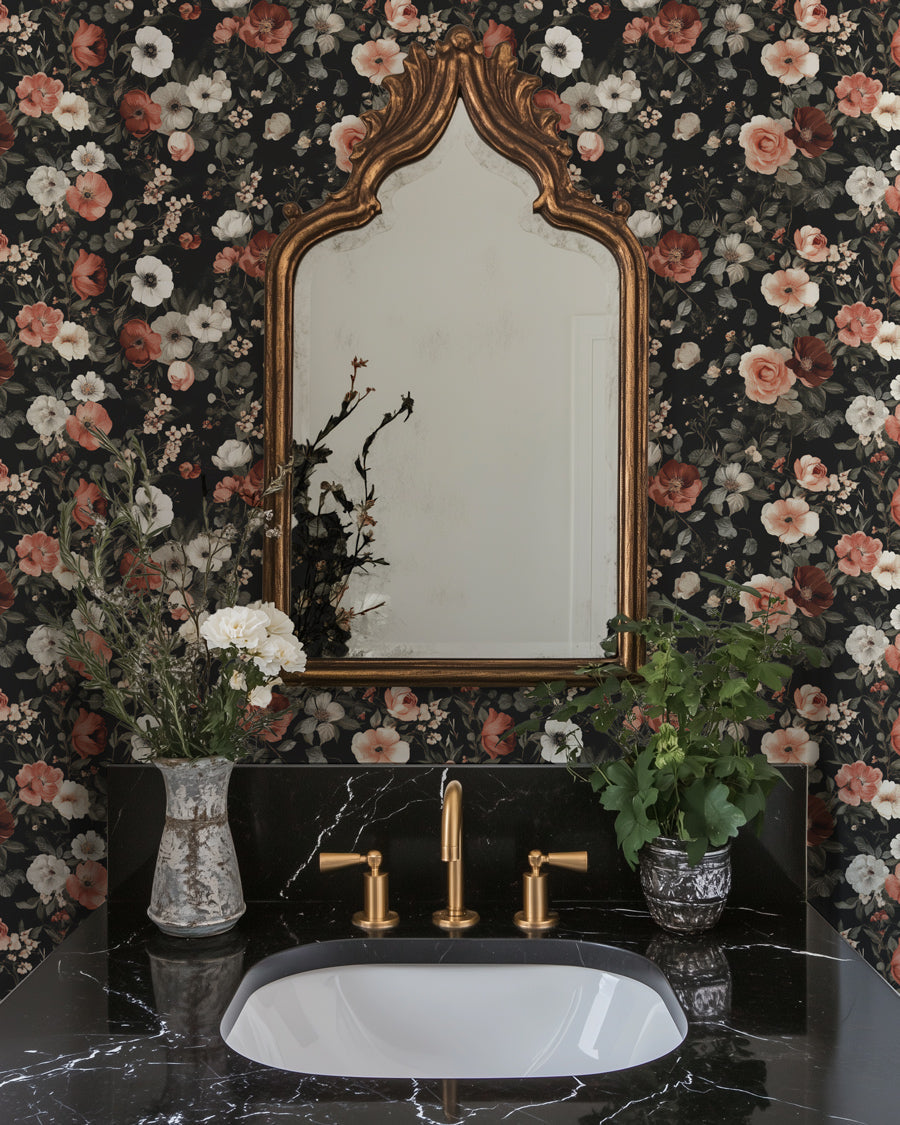
The belief that small rooms should be kept white to maximise the sense of space is one of the most persistent and most limiting axioms in interior design. It is not wrong, exactly — white does reflect light, and light makes spaces feel larger. But it ignores the more sophisticated truth that perceived space is determined by visual organisation as much as by literal dimension. A white room with cluttered, visually competing elements feels smaller than a dark room where everything has been considered and resolved. Wallpaper, used intelligently, is one of the most powerful tools for making a small room feel larger, more resolved, and more deliberately designed — precisely because it addresses the visual organisation of the space at the level of the wall itself.
We manufacture wallpaper for small rooms across Australia and internationally from our Central Coast of New South Wales facility. The techniques below are drawn from more than a decade of specifying wallpaper for compact apartments, narrow hallways, small bedrooms, and the powder rooms and bathrooms where wallpaper has its greatest per-square-metre impact.


Chinoiserie Garden Panoramic Painted Mural in Soft Blue Wallpaper · Amber Cascade Wallpaper Mural · Chinoiserie Garden Panoramic Painted Mural in Sage Green Wallpaper
Technique 1: Vertical Lines Create Height
Vertical stripe wallpaper is the most reliable technique for visually raising a low ceiling. The eye follows vertical lines upward; where those lines terminate at the ceiling, the perceived ceiling height is the point where the eye arrives rather than where the ceiling actually is.
For maximum effect, the stripe should be relatively narrow (5–10cm) and the colour contrast between stripe and background should be moderate rather than extreme. High-contrast wide stripes (white and navy, for example) create a bold graphic effect but can make the room feel like a container. Tonal, narrower stripes — cream on off-white, pale grey on white — create the upward movement without the graphic intensity that can feel oppressive in a small room.
Technique 2: Large-Scale Pattern Creates Depth
Counter-intuitively, large-scale patterns make small rooms feel larger rather than smaller. The mechanism is psychological: a large pattern fills the visual field with fewer discrete elements, which the brain interprets as a generous amount of space. A small, tight repeating pattern in a small room creates visual busyness — many individual elements competing for attention — which the brain interprets as compression and crowding.
The large botanical print, the oversized geometric, the panoramic mural — these are the patterns that make small rooms feel like deliberate spaces rather than accidentally compressed ones. The scale that looks overwhelming in a product photograph usually looks exactly right when installed floor-to-ceiling in the actual room.
Technique 3: Panoramic Murals Create Visual Horizon
A panoramic mural on the wall facing the entry point of a small room creates a visual horizon — a sense that the room extends beyond its physical boundary into the landscape, cityscape, or interior depicted in the mural. This is the most dramatic technique for expanding apparent space, and it works best in rooms with a clear primary axis — a narrow hallway, a small bedroom where the mural faces the door, a compact dining room where the mural is viewed from the table.
Browse our panoramic wall mural collection for large-format options suited to this technique.
Technique 4: Tonal Treatment Dissolves Boundaries
When a small room's wallpaper closely matches the ceiling paint colour and the skirting board colour, the eye loses the boundary lines between surfaces. The room appears larger because the conventional signals of "this is where the wall ends and the ceiling begins" are absent. This tonal treatment — sometimes called colour drenching — is most effective in rooms with limited natural light where the white ceiling/dark wall contrast creates a boxed, compressed feeling.


Les Jardin Panoramic Painted Mural Wallpaper · Coastal Palms Trees in Palisade Blue Wallpaper Mural
Materials
- Mirror: A large mirror on the wall opposite the window reflects the natural light source and the depth of the room. The reflection doubles the apparent depth. A mirrored surface adjacent to a wallpapered wall reflects the wallpaper pattern and creates the impression of a larger patterned space.
- Furniture legs: Furniture with visible legs (raised off the floor) allows the eye to travel under the piece and read the floor as continuous. Furniture that sits on the floor creates a visual block that stops the eye and makes the room feel compartmentalised.
- Lighting: Wall sconces positioned near the corners of a small room push light into the space's extremities, making the room feel wider. Ceiling lights positioned at the room's centre emphasise the room's central point rather than its extent.
Room by Room
- Powder room / WC: The ideal space for bold wallpaper. Small enough to wallpaper completely for a relatively modest cost, intimate enough that a strong pattern feels enveloping rather than overwhelming.
- Narrow hallway: Vertical stripe or panoramic mural on the long wall. Light-coloured paint on the ceiling and skirting boards. A long, narrow mirror on one wall to double the apparent width.
- Small bedroom: Full-room tonal treatment or a single large-scale botanical on the headboard wall. Furniture with legs, raised off the floor. Curtains hung above the window frame and extending to the ceiling to add apparent height.
- Small study or home office: A single feature wall in a confident pattern creates the sense of a designed room rather than an afterthought. The wallpapered wall should be the wall facing the desk — seen constantly during working hours.
Designer Tips
- Order the $4.99 sample (48cm x 40cm / 19in x 16in) and hold it against the wall at standing distance, then at the furthest point of the room. In a small room, both distances matter — you will see the wallpaper from close range and from across the room simultaneously.
- Custom sizing is particularly important in small rooms where wall dimensions are often non-standard. Our panels are manufactured to your exact measurements at our Central Coast NSW facility. 4 business days production. All duties paid globally on wallpaper orders.
- The single most impactful change in any small room: remove as many items from the floor as possible and hang equivalent items on the wall. Wall-mounted shelving, art, and accessories keep the floor visible, which makes the room read as larger.
Browse our full wallpaper collection, explore our panoramic murals for the most dramatic space-expansion technique, or read our guide to how wallpaper makes small rooms look larger.


