
Choosing abstract art feels harder than choosing any other kind, because there is no subject to hide behind. Nobody worries about picking the wrong photograph of Paris; everybody worries the abstract work they love in a browser will feel wrong on the wall. The anxiety is misplaced. Choosing abstraction well is a short sequence of decisions, and every one of them can be made before you spend a dollar.
This is the exact method we walk customers through every week, five decisions, in order, plus the mistakes that cause almost every return. It comes from more than a decade of designing, printing and framing art at our two West Gosford production facilities on the Central Coast of NSW, and from watching which choices people still love years later.


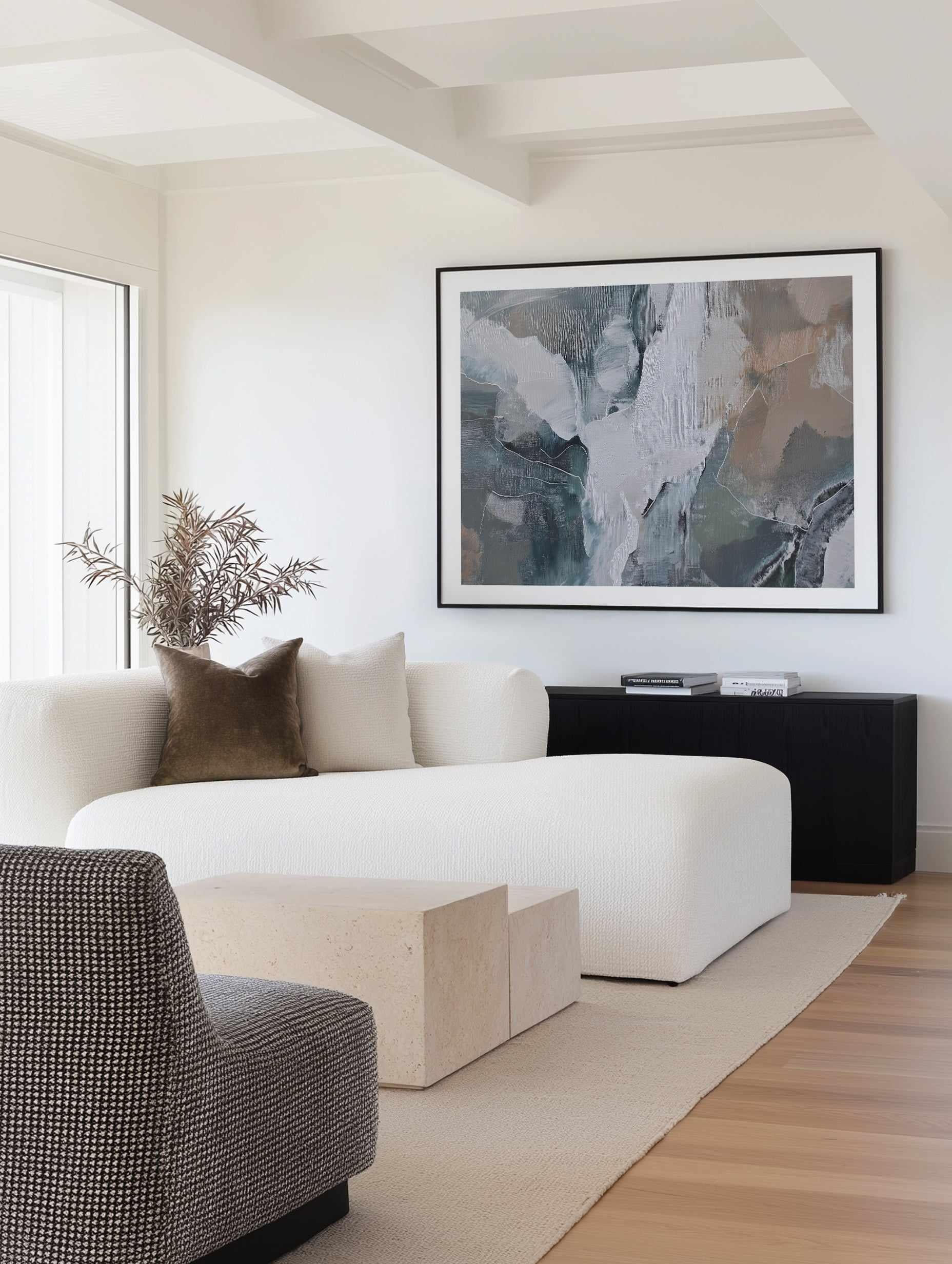
Slate Veil III · Soft Limestone I · Soft Limestone II
Decision One: the Feeling, Not the Fit
Start with response, not decor. Scroll a broad collection quickly and note which works stop you, before you think about the sofa. Decisions about art are made emotionally and justified practically, roughly 95 percent of purchasing decision-making is unconscious, and abstraction in particular is bought with the gut. A work that merely matches will decorate the room; a work you responded to will finish it.
Practical version: shortlist three to five stop-the-scroll works from the abstract wall art collection without filtering by colour. The room enters at Decision Three, not here.
Match the artwork to yourself first and the room second. You are the one who lives with it.
Decision Two: the Job
Every wall hires art for a role, and naming the role eliminates half your shortlist painlessly:
- Anchor: the room's focal point, large, confident, singular. Usually gestural, landscape-derived or one saturated colour field.
- Atmosphere: sets temperature without demanding attention, tonal, organic, low contrast. The bedroom and reading-corner brief.
- Bridge: ties existing elements together, an artwork holding two or three of the room's tones resolves schemes that will not click.
- Punctuation: small, sharp works for hallways, powder rooms and shelves, line work and minimal pieces excel.
If you cannot name the job, the wall probably wants an anchor; under-committed walls are far more common than overworked ones.
Decision Three: Palette Strategy
Two strategies work; halfway between them fails. Echo: the artwork repeats two or three tones the room owns, cohesive, calm, the safe default. Counterpoint: the room stays quiet and the artwork owns its only saturated colour, higher reward, still low risk if you repeat the artwork's key tone once elsewhere. Choose deliberately. The classic failure is art that half-matches, close enough to look accidental, far enough to look wrong.
Test cheaply: view the work at room scale against a photo of your wall, every listing shows each piece styled in an interior, and check it under evening light as well as daylight.


Soft Limestone III · Abstract 1 by Doris Schmitz
Decision Four: Scale and Format
Undersizing is the single most common art mistake in Australian homes. The working numbers:
- Above furniture: art spans 60 to 75 percent of the furniture's width.
- Open wall: 60 to 75 percent of the wall's width, centre at 145cm (57in) from the floor.
- Between two sizes: take the larger. Scale is the cheapest luxury in decorating.
Format follows the wall: framed canvas for large statements and rooms with window reflections (no glass), framed fine art prints for pairs, trios and gallery walls. For long open-plan walls start at extra large wall art; for multi-piece walls read the pairs guide and trio guide first.
Decision Five: the Making
Two works can look similar on screen and live entirely different lives on a wall. Ask what the piece is printed with (archival pigment inks or fugitive dyes), on what (heavyweight fine art paper and proper canvas, or poster stock), and how it is finished. Ours are printed with archival pigment inks, hand trimmed, and framed in solid timber, oak, white or black finish, cut and joined on Italian machinery by our own artisans here in Australia. There is an art surrounding the art: the frame's craft is part of what you buy, and made-to-order means a couple of business days, not weeks.


Abstract 2 by Doris Schmitz · Euphoria - Brown and White by Alma
The Five Mistakes Behind Almost Every Regret
- Buying too small. The postage-stamp print on the four-metre wall. Measure first; tape the outline on the wall and live with it for a day.
- Matching too hard. Art picked purely to repeat the cushions disappears into them. The work needs one note the room does not already own.
- Ignoring the room's energy. High-voltage gestural work in a bedroom, or whisper-quiet minimalism in a busy family room, both fight the room's purpose.
- Hanging too high. Centre at 145cm; the reflex to hang at standing eye-line puts art in dead air. Full method in the hanging guide.
- Deciding from daylight only. Rooms live twice; a work must earn its wall at 7pm under lamps as well as noon.
Designer Tips
- Photograph the wall, then view shortlisted works against it on screen at rough scale, the gap the room needs is usually obvious in seconds.
- Pairs and sets solve indecision: two related works, like Euphoria - White and Brown by Alma and Almara I, give rhythm one hero cannot.
- If wallpaper shares the room, choose the art first and the paper's texture second; the $4.99 wallpaper sample (48cm x 40cm / 19in x 16in) lets you audition both together.
- Keep one frame finish per wall, mixing oak, white and black finishes across one grouping is the fastest way to make considered art look accidental.
- We ship to more than 40 countries with all import duties paid, the checkout price is the delivered price, Sydney or Stockholm.
Frequently Asked Questions
How do I know if abstract art is good quality?
On screen: a resolved composition (crop any edge mentally, if it improves, the composition is weak), a deliberate palette, and honest information about the maker and process. In hand: archival pigment printing, heavyweight paper or true canvas, hand finishing, and solid timber framing with clean joinery. Quality is most visible in what a work does not need, no gloss, no gimmick, no apology.
Should abstract art match my decor?
It should converse with your decor, not repeat it. Echo two or three room tones for cohesion, or keep the room neutral and let the artwork carry the only saturated colour. Exact matching makes art invisible; total disconnection makes it look borrowed. One shared tone plus one new note is the working formula.
What size abstract art should I buy?
Sixty to seventy-five percent of the width of whatever sits beneath it, or of the wall itself if open. For a standard 2.2m sofa, that means roughly 1.4 to 1.6m of art. When torn between sizes, larger wins, undersized art is the most common regret we see, oversized almost never.
Is expensive abstract art worth it?
Price follows making: archival inks, fine art paper, hand trimming and solid timber framing cost more than poster stock in a plastic extrusion, and the difference is visible across a room and durable across decades. Interestingly, the research on perceived value suggests we also experience well-made pieces as more pleasurable partly because we know the care behind them, the making is part of the feeling.
Can I buy abstract art online with confidence?
Yes, with three checks: room-scale styled photography (not just the artwork flat), clear production and framing detail, and honest shipping terms. Every work of ours is shown styled in an interior, made to order at our own facilities, and delivered worldwide with duties paid, what you approve on screen is what arrives.
How many abstract artworks can one room take?
One anchor plus one or two supporting works is the usual ceiling for a living room; more than that needs gallery-wall discipline, one palette thread, one frame finish, planned spacing. Rooms fail from competing anchors far more often than from bare walls.
What if I stop liking the artwork in a few years?
Choose from feeling and it rarely happens, the works people tire of are the ones bought to match a scheme that changed. Abstraction ages better than any figurative genre precisely because it carries no dateable subject; rotate it to another room before retiring it, tonal works especially re-home well.
Start the shortlist in the abstract wall art collection, or go straight to a register: blue abstracts, green abstracts, black and white. Made in Australia, delivered to more than 40 countries, duties paid.


