

Your hallway art works the longest hours in the whole house. Every hello, every goodbye, every trip between the kitchen and the bedroom passes right by it, which quietly makes your hallway the most-viewed gallery you'll ever own, and usually the least considered. After ten years of framing art at our West Gosford facilities, we can tell you that customers who finally dress the hallway all describe the same lovely moment: the whole home suddenly feels finished, because the bits that link the rooms together finally match the rooms themselves. So this is your guide to stairwells, entries and corridors, the walls that introduce every other wall you own.
Here's the thing about hallways: they reward art in a different way from rooms. You're viewing from a metre away, often less, so detail matters far more than sheer scale. You're always moving through, so a sequence or a run works harder than one big statement. And the light is usually the trickiest in the house, which changes the material you choose. All three of those quirks favour a little planning, and all three are covered below, so by the end of this guide you'll know exactly how to approach yours.


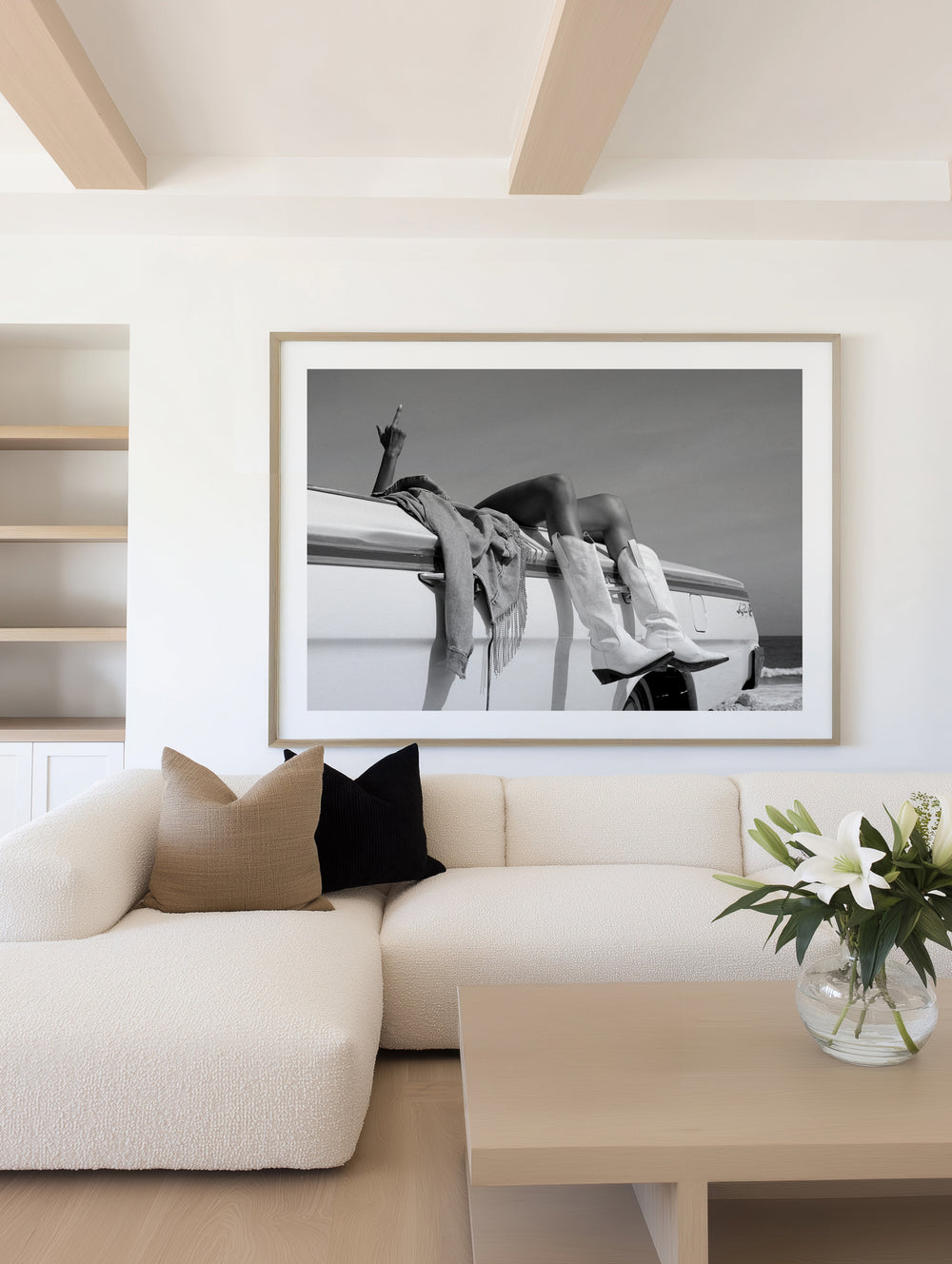
Cali Days II B&W by Amy Hallam | Art Print · Salty Swims by Mario Stefanelli Art Print · Queen of Hearts I by Amy Hallam Art Print
The Entry: Three Metres That Introduce Your Home
The wall you see first, whether it faces the front door or sits just beside it, sets the tone for everything behind it, and it truly deserves your most intentional piece. Think one confident artwork, hung at the standard 145 to 152 cm centre, sized to your wall's width using the 50 to 65 percent rule. In most entries that lands you at a 50 x 70 cm or 60 x 90 cm piece, in portrait orientation for the typical narrow entry wall. Subjects with immediate warmth work hardest here: coastal aerials from the coastal collection, gentle botanical studies, or an abstract in the palette that anchors the rest of your home. Your entry is also the one hallway wall where a mirror-and-art pairing really earns its keep: you get light, a sense of depth and a last check on the way out, and the art stops the whole arrangement from feeling purely practical. What tends to fall flat in entries? Little clusters, because clutter at the threshold reads as chaos, and anything too soft or subtle to survive the two-second glance that's really all an entry ever gets.
Your hallway is the most-viewed gallery in the house and the least considered. Fixing that quiet imbalance is what finishes the whole home.
The Corridor Run: Rhythm Beats Statement
Long hallways want a sequence, not a soloist. The classic run is three to five same-size prints, identical frames, a consistent 6 to 8 cm gap between them, and centres at 150 cm. Do that, and your corridor becomes the little gallery it was always shaped to be. A few rules keep runs looking composed rather than casual: stick to one frame finish the whole way through (oak for warmth, black for a more graphic feel, but not both together in a run), stay within one palette family or one subject family across the set, and please, no size drift. Rooms forgive slightly mismatched frames; corridors don't, because you're viewing everything from so close. Subject-wise, corridors are where beautifully detailed work finally gets the close look it deserves: botanical studies from the eucalyptus range, black and white photography from the monochrome collection, line art and figure studies. Our trio sets are pre-composed for exactly this format, with the palette flow already resolved across the three frames, and ordering the run together means it all arrives at once and hangs level in a single afternoon.
The Stairwell: Your Home's Only Diagonal Gallery
Stairwells feel intimidating because you assume the rules change, but really only one does: your hang line follows the stairs. Run each artwork's centre along an imaginary line parallel to the handrail, with each piece's centre roughly 150 cm vertically above the tread beneath it, and your stepped arrangement will read as considered as any flat corridor run. Two to four pieces usually suit a single flight. The landing wall, which is usually the biggest plane in the stairwell, is the spot for your statement piece, and a portrait-format piece from the large format range can beautifully fill the double-height wall a stair void offers. A quick word on practicalities: stairwell hanging is stepladder work over a fall zone, so please use proper hangers rated well above the frame weight (all our framed pieces ship with fitted hardware). If your void wall is genuinely tall, our custom sizing is there for the dimensions no stock print can quite anticipate. Our hanging guide walks you through the diagonal method with measurements.


The Icon by Amy Hallam Art Print · Icey by Amy Hallam Art Print
Light, Glare and Choosing the Right Material
Hallways get the most uneven light in the house: a bright entry, a dim middle, a window at one end throwing glare all the way down the run. Happily, the material question is a simple one. Glass-front framed prints are lovely in even, moderate hallway light and give detailed work its crispest presentation, which makes them the default for corridor runs. Framed canvas ignores glare altogether, so it's your friend in the hallway with a sunny window at one end or downlights sitting directly above the frames. And in a genuinely dark hallway, go for art with strong tonal contrast rather than trying to fight the gloom with pale pieces: a deep-toned artwork with plenty of internal contrast reads beautifully where a soft pastel just disappears. If any of this feels hard to judge from inside the space, take a photo of your hallway from both ends and send both shots along with your measurements. The free mockup will show your shortlist right there on your walls, usually within a business day, and the team will flag the glare wall for you without needing to be asked, because they render hallways every week and they know exactly where the tricky spots hide.
The Hallway Buying Sequence
Hallway art tends to be a multi-piece purchase, which makes a verify-first approach even more valuable than usual. Start with a proper measure of the run: total wall length, and jot down where the doors, switches and meter box interrupt it. Shortlist your set, whether that's a run of three, a stairwell trio or the entry statement, and send the photos, measurements and shortlist across for your free mockup. You'll get composition, spacing and sizes back on your actual walls, usually within one business day. Confirm the material against your light using the notes above. Then order the set together: standard framed sizes dispatch within 24 hours from our Central Coast studios, everything arrives as one delivery, and a corridor run hangs level in a single afternoon. Our 30-day exchange policy on standard sizes backs the whole arrangement, and the A5 and A4 sample prints from $9.95, printed on the same archival paper with the same inks, are there for anyone who wants the paper in hand before committing to a five-piece run.


Green Room II by Amy Hallam Art Print · Love Struck by Mario Stefanelli Art Print · Morning Checklist II by Mario Stefanelli Art Print
Why Hallway Art Really Should Come From the Maker
Because hallway schemes are sets, and sets punish inconsistency. Five frames ordered from a marketplace tend to arrive as five slightly different oaks, five slightly different whites and five print tones that almost, but don't quite, match. Your corridor exposes every one of those discrepancies at a metre's viewing distance. Ours all come off one production floor, using identical solid timber frames, one colour-managed print run on the same 230gsm archival stock, compositions confirmed by mockup before printing, all dispatched together within 24 hours on standard sizes, delivered Australia-wide and to over 40 countries. Custom sizes cover the stair void and that odd little pier between two doorways. Over 350,000 homes since 2015, and hallways are consistently the before-and-after photos our customers are proudest to share, because nobody expects the connective tissue to be the biggest transformation. It nearly always is.
The sizing maths for every format lives in our complete sizing guide, our thinking on monochrome walls sits with the black and white collection, and if you're working with a smaller footprint, the apartment art guide picks up where this one leaves off.
The Gallery Wall Hallway: When More Really Is More
There's one hallway format that breaks the same-size rule on purpose: the family gallery wall, with mixed sizes and mixed subjects composed around a common centre line, so the corridor becomes a kind of memoir. It works beautifully on three conditions. Your frames need to stay disciplined, so choose one finish, or at most oak and black alternating, and let the variety live in the images rather than the hardware. The composition needs to hold one horizontal datum: whether that's centres or top edges, one level line should run through the whole arrangement, and everything else can dance around it. And the personal pieces need to earn their place beside the professional ones. Family photography benefits enormously from sitting among printed artworks, because the artworks quietly set a standard that the snapshots rise to meet. Compose the whole thing on the floor first, take a photo of your layout, then transfer it up onto the wall one piece at a time. Or send that floor photo across with your measurements and let our styling team refine the spacing before a single hook goes into the plaster. The result is the hallway guests actually stop and look at, which no same-size run, however elegant, quite manages. For the printed-art half of the mix, our boho collection and Australiana range bring the warmth and memory that family galleries thrive on, and the A5 and A4 sizes from $9.95 make the supporting pieces genuinely affordable to layer in.
Doors, Switches and the Interrupted Wall
Real corridors are obstacle courses, aren't they? Doorframes, light switches, thermostats, the meter box. The composition rule is to treat every interruption as a natural section break: each uninterrupted stretch of wall becomes its own small gallery, composed to its own width using the standard percentages, rather than one arrangement limping across all the gaps. A pier between two doorways takes one portrait piece; the long stretch past the linen press takes your run of three; the switch plate cluster simply wins its patch of wall, and the art concedes it gracefully. If your wall is interrupted at chest height by half-height panelling or a dado rail, just move the hang line up: centre the art in the clear field above the rail rather than forcing the 150 cm rule through the woodwork. None of this takes talent so much as a tape measure and the honesty to let the wall be what it is. The mockup service handles interrupted walls every day and will happily compose around every switch plate in your photo.
Frequently Asked Questions
What kind of art suits a hallway?
Detailed work you can view up close: botanical studies, black and white photography, line art. Entries take one confident statement piece, corridors take runs of three to five same-size pieces, and stairwells take a stepped arrangement that follows the handrail line. Rhythm beats scale everywhere except the entry.
How do I hang art up a stairwell?
Follow the diagonal: run each artwork's centre parallel to the handrail, with each centre roughly 150 cm above the tread beneath it. Two to four pieces suit most flights, the landing takes the statement, and rated hangers matter doubly when you're working over a fall zone. Our hanging guide walks you through the method with diagrams.
What size art should I choose for a narrow hallway?
Portrait orientations in the 50 x 70 cm range suit most corridor walls, hung at 150 cm centres. The real constraint isn't the wall size but the viewing depth: art across a 90 cm corridor is being looked at from arm's length, which rewards fine detail over big dimensions.
How many pieces should a hallway run have?
Three to five, same size, same frames, spaced 6 to 8 cm apart. Odd numbers tend to compose more naturally than even ones. Order the run as a set so the frames and print tones come off one production run: corridors expose near-matches without mercy.
Should my hallway frames match the rooms they connect?
Your hallway can absolutely hold its own scheme, but one repeated element, usually the frame timber or one shared palette tone, will tie the whole house together. Most of our customers run the same frame finish through hallway and living areas and let the subjects vary, which reads collected rather than uniform.
What about dark hallways?
Choose strong tonal contrast over pale subjects: deep-toned art with lots of internal contrast stays legible where pastels vanish. Canvas beats glass where downlights or end-windows throw glare. Send photos from both ends of the run and the mockup team will flag the light traps for you before you order.
Can I see a hallway arrangement before I buy?
Yes, and honestly, please do. Photograph the run, send your measurements and your shortlist, and the free mockup will come back with the full arrangement, sizes, spacing and composition on your actual walls, usually within one business day. For multi-piece hallway sets, it's the difference between hoping and knowing.
How quickly does a hallway set arrive?
Standard framed sizes dispatch within 24 hours from our NSW Central Coast facilities and ship as one delivery Australia-wide, with international shipping to over 40 countries. A corridor's whole transformation, ordered on a Monday, is typically hung and photographed by the weekend.
Compose your run from the gallery-quality framed range, anchor the entry from the art prints collection, and send your corridor photos across whenever you're ready. The most-viewed gallery in your home really does deserve the mockup treatment.


