

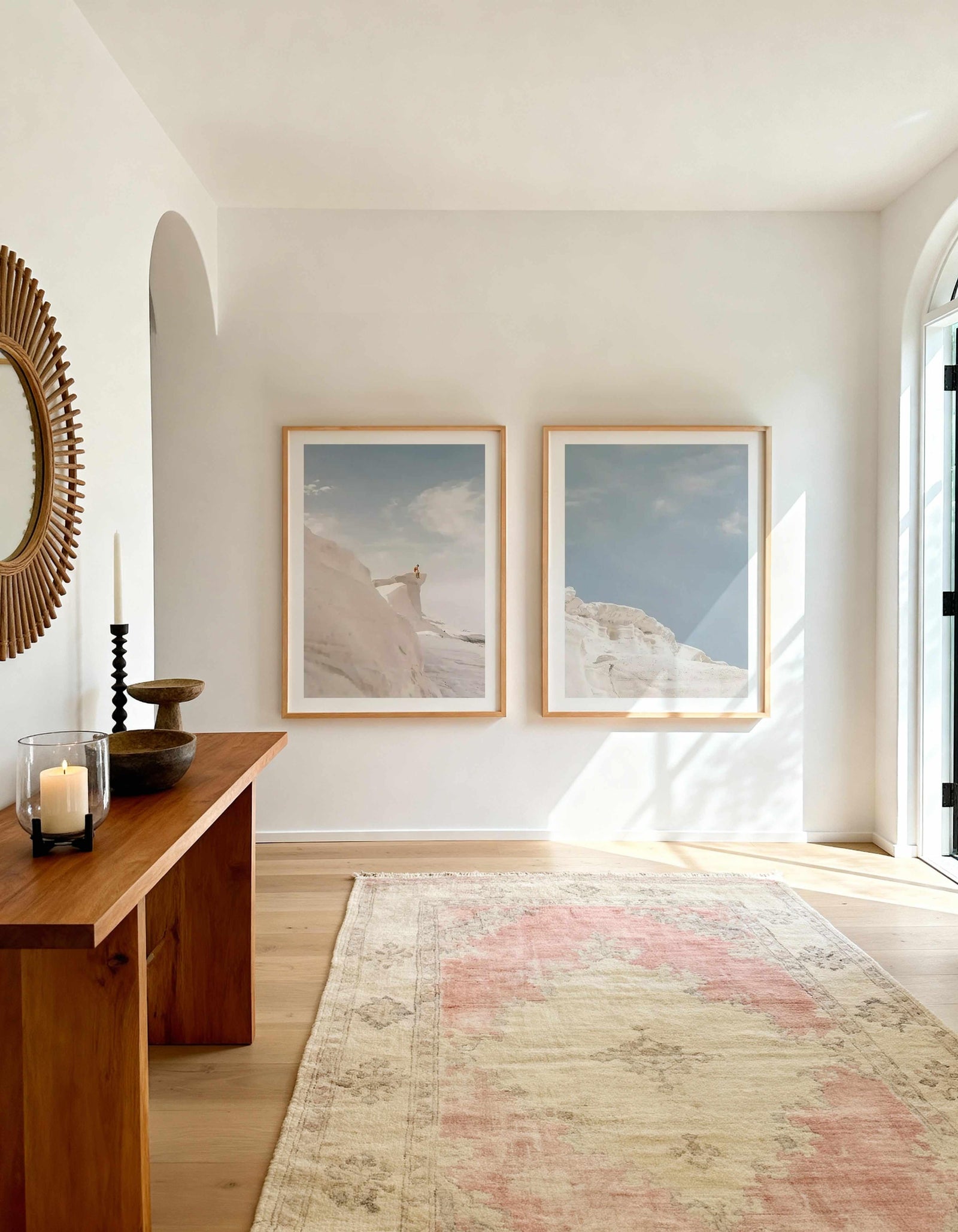
Framed wall art is the finished sentence of decorating, the artwork chosen, sized, bordered and ready to change a room the day it arrives. But "framed" covers everything from a plastic moulding around a poster to solid timber joined by hand around archival fine art, and the price differences make sense only when you know what you are paying for. This is the complete buying guide: frame construction, glazing, sizing, styling and where the money actually goes.
We make every frame we sell, solid timber, cut and joined on Italian machinery by our own team at our two West Gosford production facilities, around fine art prints made in-house on archival papers. That is the standard this guide measures everything against, browse the result in our gallery quality framed art collection.


Milos Island Greece I & II by Jovani Demetrie Art Print Set of 2 · Queen of Hearts I B&W by Amy Hallam · Cali Days II B&W by Amy Hallam
What Separates Real Framing From a Border
- Solid timber vs composite: real timber (ours: oak, white and black finishes) holds its joins square for decades and carries weight safely; MDF composite mouldings sag, chip at corners and telegraph budget instantly at close range.
- The print inside: a frame cannot rescue a thin print. Fine art papers (ours run 230gsm) with archival pigment inks hold colour for generations; poster stock yellows within a few years of Australian light.
- Fitment and finishing: hand-trimming, clean mounting and sealed backs are the invisible half of framed art, visible only when they are missing.
- Ready to hang: proper framed art arrives with hanging hardware fitted, hang it per our hanging guide and the job is done in minutes.
The frame is jewellery for the artwork. Nobody sets a diamond in plastic.
Choosing the Frame Colour
- Oak: the warm default, completes earth tones, coastal palettes and the whole neutrals register; reads relaxed-premium everywhere Australians actually live.
- Black: the formal choice, sharpens black and white art and photography, contains busy compositions, suits moody and modern schemes.
- White: the quiet float, lets pale and pastel works breathe on pale walls, the gallery look, and the safest frame for dense gallery walls.
- One rule above all: one frame finish per wall. Mixing finishes on a single wall is the most common framing mistake in Australian homes; the room reads coherent the moment it stops.


Born Free by Mario Stefanelli · Basilica Italy by Mario Stefanelli Art Print
Sizing: Where Framed Art Succeeds or Fails
Undersizing is the national decorating error. The rule that fixes it: artwork (framed, total width) should span 60 to 75 percent of the furniture beneath it, a 2.4m sofa wants roughly 1.5 to 1.8m of framed art, one large piece or a pair or trio combined. Eye-level centre sits at about 145cm from the floor (our height guide covers the exceptions), and for oversized statements the extra large guide takes over. Because we print and frame to order, every artwork in the range comes in the size your wall actually needs, including custom dimensions, rather than the three sizes a warehouse happens to hold.
Framed vs Canvas: the Honest Split
Framed prints behind glazing carry fine detail, delicate tonal work and photography with the crispness those media deserve, and the glass adds a layer of formality. Canvas goes matte and glass-free, warmer and more relaxed, better over beds, in glare-prone rooms, and wherever reflections would fight a window or a video call. Most well-decorated homes run both; the full decision method is in our format guide.


Queen of Hearts I by Amy Hallam Art Print · Queen of Hearts II by Amy Hallam Art Print
Designer Tips
- Buy the pair when in doubt about scale, two related framed works fill a wide wall with rhythm a single mid-size piece cannot, per the pairs guide.
- On gallery walls, keep frames identical and let the art vary, the method in our gallery wall guide.
- Hang framed art on two fixings, always; single-nail art drifts crooked within a month.
- In coastal and humid homes, sealed backs and quality mounting prevent the foxing that ruins cheap framing within two summers.
- Trade buyers: designers, stylists and commercial projects access the whole framed range at trade pricing through the Designer Trade & Commercial Program.
Inside the Frame: What You Are Actually Paying For
Framing is where the art industry hides its shortcuts, so here is what the inside of an honest frame looks like, from the people who assemble them daily. The moulding should be solid timber, ours is oak, finished in oak, white or black, not MDF wrapped in printed foil, which swells at the corners within a couple of humid summers. The glazing should sit clear of the print face; art pressed hard against acrylic can stick to it over time, a fault you only discover when it is too late to fix. Behind the print, the backing needs real rigidity, foam-core backing at the correct depth, so the artwork stays flat instead of developing the gentle warp you see in cheap frames after their first winter.
The print inside matters as much as the box around it. We print on 230gsm matte fine art paper with archival pigment inks, which is the difference between artwork that holds its blacks for decades and posters that drift yellow within five years. When you compare a $60 framed print from a discount chain with a properly built one, you are not comparing the same object at two prices; you are comparing an object designed to survive one lease with one designed to move house with you several times. Our gallery-quality framed range is built entirely on the second model, and it is why we can put a satisfaction guarantee behind every piece that leaves West Gosford.
Room by Room: Where Framed Art Earns Its Keep
Framed art behaves differently in different rooms, and a decade of orders shows clear patterns. Living rooms carry the largest formats: above a sofa, a 70x100 or a matched pair hung as one composition, with the frame finish echoing the room's timber or metal. Bedrooms reward softer palettes and a lower hang than most people expect, art above a bedhead is viewed from across the room and from bed, not standing; our hanging height guide covers the numbers. Hallways are the natural home of the run: three or four same-size frames from the art print range at even spacing turn a corridor into a gallery for less than the cost of one oversized statement piece.
Two rooms deserve special honesty. Bathrooms take framed art well, humidity is far less dangerous to a properly sealed frame than most people fear, though we still steer unglazed canvas toward powder rooms rather than over the shower. And kitchens, the forgotten wall in most Australian homes, suit smaller framed pieces away from the splashback, where a little wit or colour does more for the room than another appliance ever will. If a wall gets direct hard sun for hours daily, choose the spot across from the window rather than beside it; archival inks resist fading dramatically, but no artwork on earth enjoys six hours of Queensland sun at full strength.
Building a Collection, Not Just Filling a Wall
The most satisfying framed walls we ship were bought in chapters rather than in one afternoon. Start with the anchor: the largest piece, the one the room is actually about, chosen slowly and at proper scale from the framed art collection. Let it hang alone for a month. Rooms tell you what they need next once the anchor is up, usually a quieter companion piece, sometimes a pair for the facing wall, occasionally nothing at all, and the second purchase made after that month is nearly always better judged than it would have been on day one.
Collections also survive taste changes better than schemes. Three pieces you genuinely love, bought over a year, keep working together as the sofa and the paint change around them, because the common thread is your eye rather than one season's palette. That is also the practical argument for consistent framing, stick to one finish per room, oak with oak, black with black, so every future purchase from the neutrals collection or anywhere else already belongs. The wall becomes cumulative instead of disposable, which is the whole point of framing properly in the first place.
Caring for Framed Art (the Two-Minute Version)
Framed art is close to zero-maintenance, which is part of its argument over almost every other thing you can put in a room, but the small habits matter. Dust the top edge of the moulding when you dust the shelves; clean the glazing with a barely damp microfibre cloth rather than spray applied directly, which can wick under the edge; and once a year, lift the frame off its hook and check the hanging hardware, because the D-rings that were tight at installation loosen fractionally with seasonal timber movement. If a frame ever arrives or develops a fault, photograph it before anything else, our support team resolves nearly every framing issue from a single good photo, usually within the day.
When you move house, framed prints travel flat, face to face in pairs with a blanket between, never stacked on their corners. It is a small ritual, but it is why the pieces you buy well this year will still be opening conversations in a home you have not met yet. Buy once, buy framed properly, and the wall takes care of itself, that has been the quiet economics of our framed collection for a decade.
Frequently Asked Questions
What is gallery quality framed art?
Fine art printing (archival pigment inks on heavyweight art paper) in a solid timber frame with proper mounting, glazing and sealed backing, the construction galleries use, as opposed to poster stock in composite moulding. The difference is visible at arm's length and decisive after five years on a wall.
Which frame colour should I choose?
Oak for warmth and earth palettes, black for formality, photography and monochrome, white for pale works and gallery walls. Match the room's register rather than the artwork alone, and never mix finishes on one wall.
How big should framed wall art be?
Sixty to 75 percent of the furniture width below it, centred at 145cm eye level. When torn between two sizes, take the larger, undersized art is the most common and most expensive-to-fix decorating regret in Australian homes.
Framed print or canvas, which is better?
Different registers, not better or worse: framed prints for detail, crispness and formality; canvas for warmth, matte calm and glare-free walls. The wall's light and the room's mood decide, our format guide walks the five-minute decision.
Why does framed art vary so much in price?
Timber versus composite, archival versus poster stock, hand finishing versus factory batching, and where it is made. Ours is made in Australia end to end, which is also why any piece can be reprinted and reframed identically years later.
Does framed art arrive ready to hang?
Ours does, hardware fitted, with production in a couple of business days and delivery Australia-wide and international shipping available. Hanging takes two fixings and ten minutes.
Can I get custom framed sizes?
Yes, made-to-order means the size your wall needs, not the nearest stock size. Measure the wall, apply the 60-75 percent rule, and we print and frame to it exactly.
Browse gallery quality framed art, all framed art, and art prints. Every piece is printed on archival stock and framed in solid timber at our West Gosford facilities, then shipped ready to hang to more than 40 countries, with the largest formats crated rather than boxed so they arrive as they left. If you are torn between two pieces or two sizes, send our team the wall photo before you order, a real person who frames art every day will answer with an honest opinion, and the advice costs nothing either way.


