On the Wall

Living Room Wall Art: The Complete Australian Buying Guide
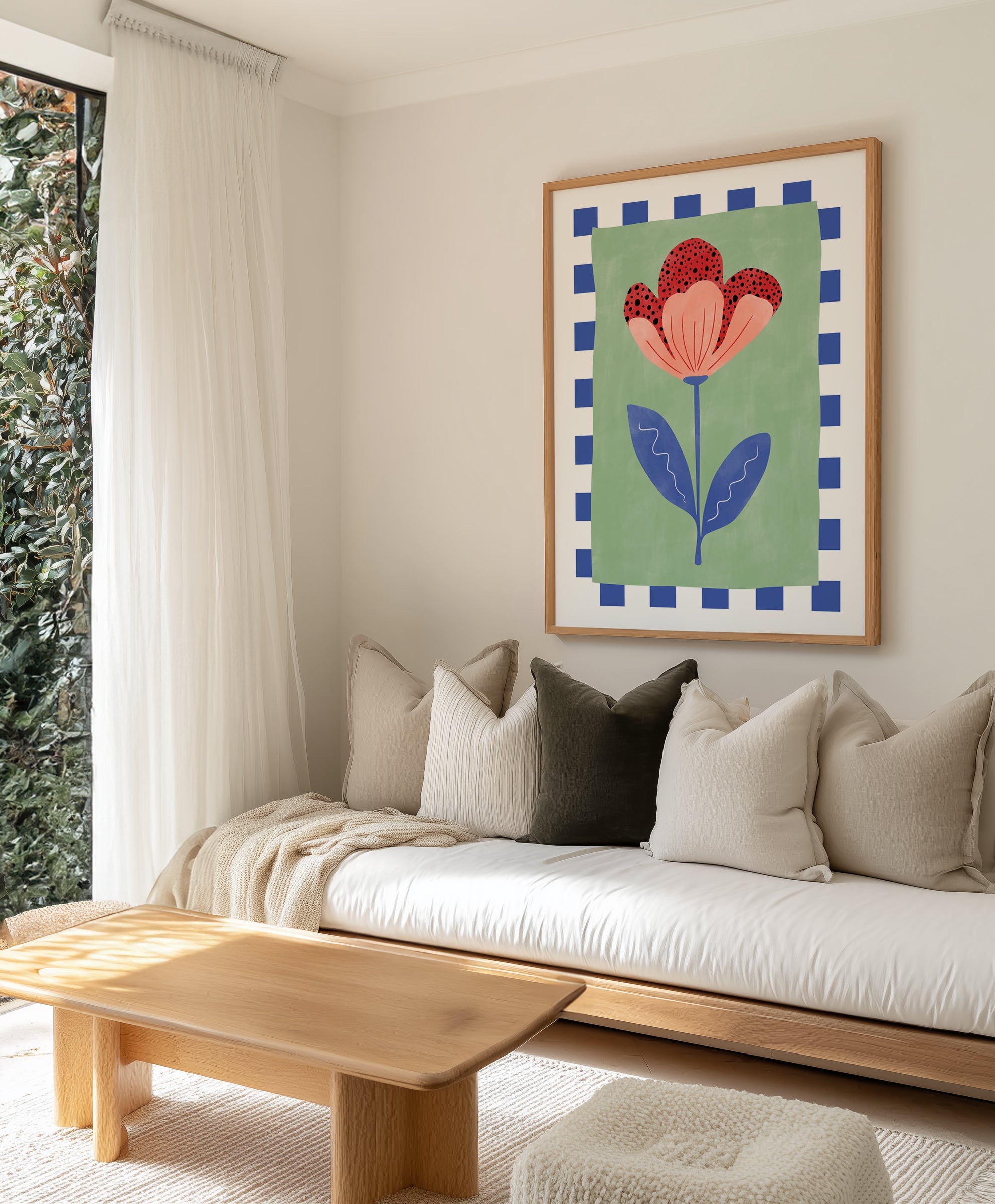
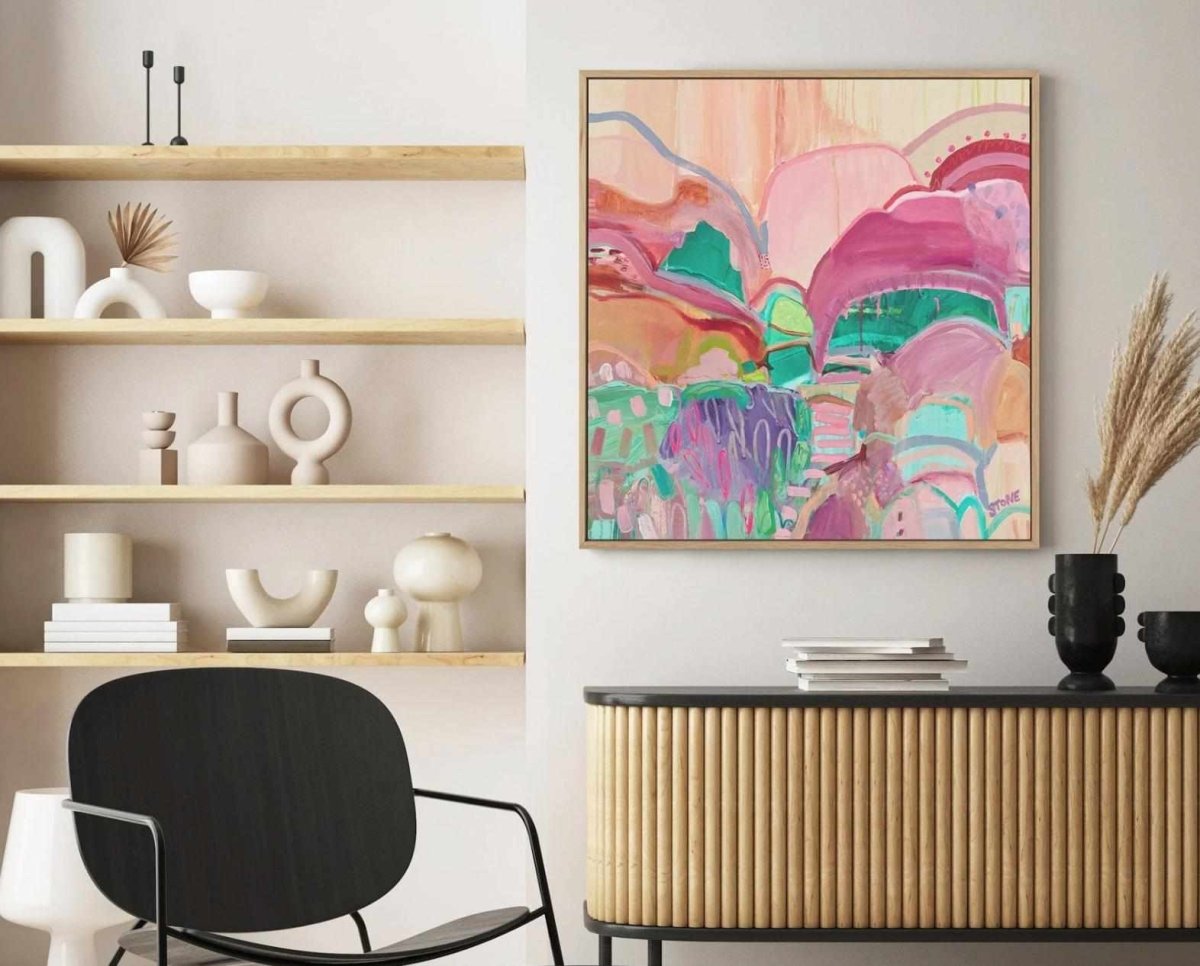
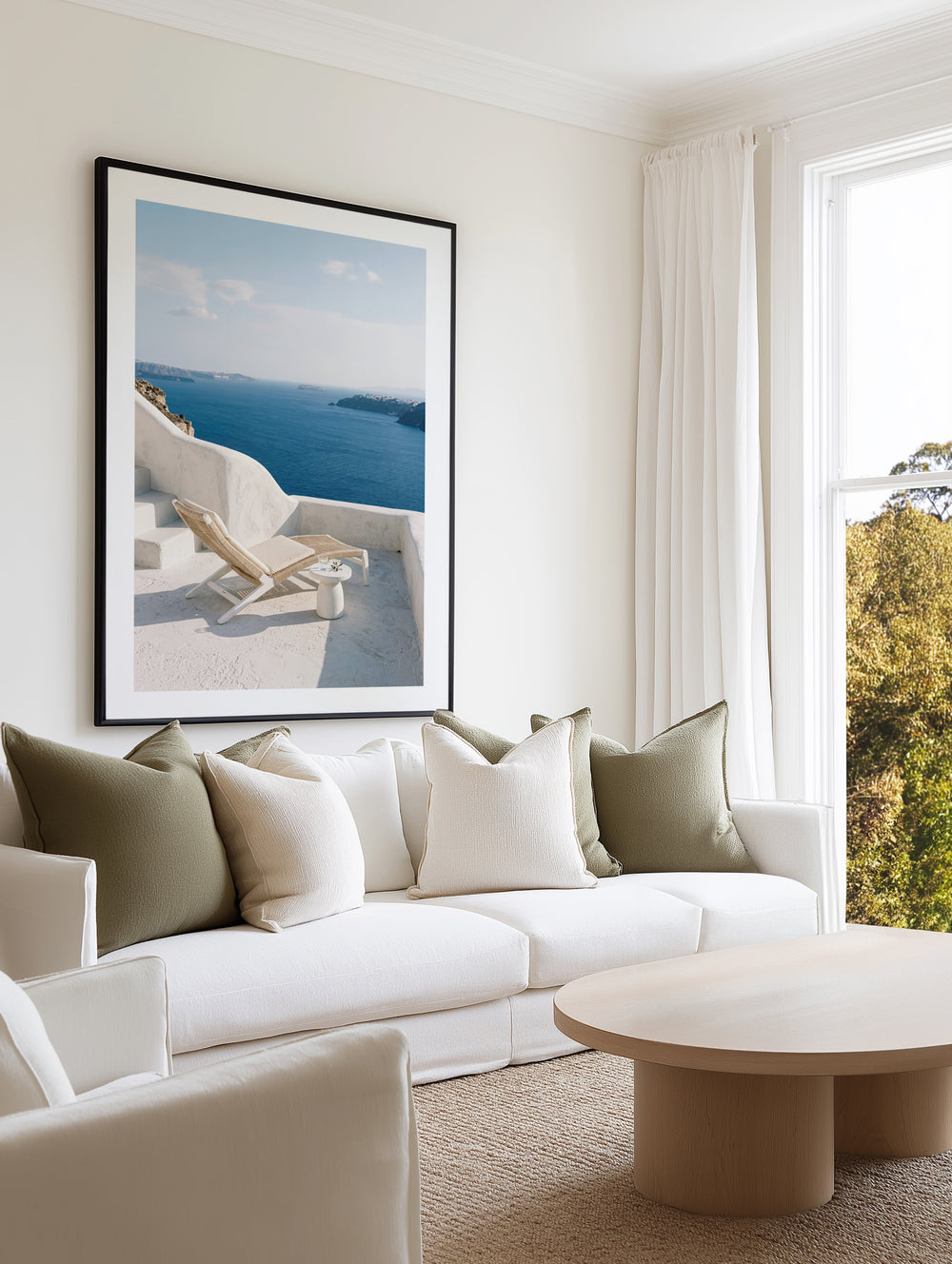
The living room is where art spending either pays off daily or quietly disappoints for years, and the difference is almost never taste. It is method: scale, height, format and palette, applied in the right order. This is the complete buying guide for the room guests judge and households actually live in, from the people who print and frame living room walls every working day. Our living room collection is printed on archival stock and framed in solid timber at our West Gosford facilities; everything below is the advice we give across the counter with it. Beyond The Vase Bloom 5 by Shatha Al Dafai · Sketched Form I Square Art Print · Flowering Pastels by Dani Heyward Scale First: The Decision That Decides the Rest Get the size right and an average artwork looks intentional; get it wrong and a masterpiece looks like an apology. The living room arithmetic is settled: above a sofa, art should span two-thirds to three-quarters of the sofa's width, a 2.4m sofa wants roughly 160 to 180cm of artwork, which is a 70x100 at minimum, a pair hung tight, or a genuine statement piece. On open walls, the artwork claims half to two-thirds of the visible width between interruptions. Anything less reads as a placeholder, and the room never quite settles, visitors cannot name what is wrong, but the wall tells them something was left unfinished. Blue-tape the outline on the wall before buying and live with it for an evening; it is the five-minute discipline that prevents the one regret this room produces. When the tape looks slightly too big, it is right, ten years of "I wish I'd gone bigger" emails and effectively none in the other direction is the clearest data we own. The full method, including ceiling-height adjustments, lives in the large wall art guide. Nobody has ever regretted the bigger artwork. The regret mail is uniformly about the smaller one. Height: The Free Fix Most Rooms Need Half the living rooms in customer photos would improve tonight with no purchase at all, just a rehang. The standard: centre of the artwork at 145cm from the floor. Hung above a sofa, the frame's bottom edge sits 15 to 25cm above the backrest, close enough that sofa and art read as one composed unit rather than strangers sharing a wall. Most Australian living rooms hang art a full 20 to 30cm too high, a hangover from standing-height instincts in a room experienced seated; galleries hang low for the same reason museums put benches in front of paintings, the art meets the resting eye. The height guide has the numbers for every scenario, but the sofa-wall rule alone fixes most rooms. If your art currently floats in the top third of the wall with a band of empty plaster between it and the furniture, that band is the problem, and it costs one new hook to solve, tonight, before you spend a dollar on anything new. Beyond The Vase Bloom 7 by Shatha Al Dafai · Duo No 2 Square Art Print Format: Reading the Room's Light Living rooms have the most complex light in the house, windows, downlights, lamps, screens, and format should answer it. The wall opposite the main window is reflection territory: glazed frames there hand you the garden's glare all afternoon, which makes it the natural canvas wall. Softly lit walls, and any wall the lamps rake obliquely, flatter framed prints from the framed range, where glazing adds a jewel-box finish to detailed work. Mixing formats in one room works under the palette-thread rule: keep one colour note and one frame finish consistent and canvas can live beside framed paper without a seam. The format guide runs the full decision tree wall by wall. Palette: Key to the Bones, Not the Cushions The most expensive living room mistake is matching art to the current sofa, because sofas turn over every seven years and good art does not. Key the artwork to the room's permanent materials instead: the floor timber, the rug's base note, the stone or brick, the window joinery. Art chosen against those bones survives every furniture cycle and recolours the room each time the textiles change around it, the same abstract reads fresh against three successive sofas if it was never the sofa's echo in the first place. Australian living rooms lean warm, timber floors, warm whites, sisal and linen, which is why warm-neutral abstraction from the neutrals collection and earth-toned landscape work anchor so many of them. Rooms with cooler bones, concrete, grey stone, black steel, take the monochrome range and blue-led work with more grace. One colour from the bones, repeated once in the art: that is the entire trick, and it is why the same artwork can look mediocre in the showroom and inevitable in your room, or the reverse. Wild Orchids II · Beyond The Vase Bloom 9 by Shatha Al Dafai The Three Living Room Wall Plans The single anchor: one large work over the sofa or facing wall, everything else stays quiet. Right for calm schemes, open plans and anyone decorating with restraint. Choose from the extra large range and let it govern. The pair or trio: matched works hung tight as one composition, scale plus rhythm, the most forgiving plan for first-time buyers, and the best answer for long walls. Same series, same frames, 5 to 8cm apart, per the pairs method. The gallery wall: six to nine works for collected, storied rooms, built by the composition method, one finish across all frames, floor-planned before hanging. The highest-effort plan and the most personal result. Living With It: The Long Game The living room is where art collections begin, usually with one properly scaled anchor bought after months of a bare wall, and the buying order matters more than the budget. Anchor first, at full scale, keyed to the bones. Companions second, a season later, once the anchor has taught you what the room wants. Personal layer last: the small found pieces, the photography, the things with stories, which fill the side walls and shelves over years. Rooms assembled in this order feel collected; rooms bought in one afternoon feel furnished, and the difference is visible from the doorway. It is also kinder to the budget: three considered purchases across a year, each one informed by the last, consistently outperform one big splurge both financially and on the wall. Care is minimal, dust the frame tops, keep direct hard sun off glazed work where possible, straighten after the vacuum bumps things, but the one habit worth keeping is the annual edit: each year, one piece earns promotion to a better wall, one newcomer arrives, and anything that has stopped earning its place moves to a bedroom or the hallway. Living rooms whose walls evolve at that gentle pace never need the dramatic redecoration, and the art budget spreads into an ongoing pleasure instead of a renovation line item. The Video-Call Corner and the Modern Living Room The living room has quietly acquired a new wall with its own rules: the one behind the desk, the video-call backdrop, or simply the corner that appears in every family photo. That wall is now seen by more people than any other surface in the house, colleagues, clients, relatives overseas, and it rewards deliberate treatment: one composed piece at camera height rather than clutter, tonal work that flatters skin tones on camera, nothing so bold it becomes the meeting's topic. The video call wall guide treats it fully; the short version is that monochrome and warm-neutral abstraction are the reliable performers. Screens changed the room's art in a second way: the television. The wall that holds the TV rarely takes art well beside it, competing rectangles, but the walls flanking and facing it matter more than ever, because that is where the eye escapes during the evening. A strong piece on the facing wall gives the room a second centre, which is the difference between a lounge room and a home cinema with sofas, and it is the placement we recommend planning before the TV wall gets its cabinetry. Households that hang that facing wall well report actually using the room differently, more reading, more conversation seated toward the art side, which is a larger return than any cushion has ever produced. Common Living Room Misfires, From the Support Inbox The same handful of problems produce most of the "something is off" emails, and all are cheap to fix. The floating postcard: a small print alone on a large wall, solved by scale or by grouping. The too-high hang: the band of bare plaster between sofa and art, solved with one hook moved down. The matching trap: art, cushions and throw all pulled from the same swatch card, which reads as a showroom and dates as one object; solved by keying art to the bones and letting textiles disagree politely. The frame argument: three finishes on one wall, solved by picking the room's single finish and letting odd frames migrate to other rooms. And the subtlest one: the room with six good small artworks and no anchor, which feels busy yet unfinished simultaneously. The fix is almost always promotion rather than purchase, take the strongest piece, move it to the main wall at proper height, cluster three of the others into a tight group elsewhere, and retire the rest to bedrooms. Most living rooms own better walls than they display; the method above is usually rearrangement before it is shopping. Frequently Asked Questions What size art does a living room need? Bigger than instinct says: above a sofa, two-thirds to three-quarters of the sofa's width, which means 70x100 minimum over a standard 2.4m sofa, or a pair hung as one composition. On open walls, half to two-thirds of the visible wall width. Undersized art is the single most common living room miss. How high should living room art hang? Centre of the artwork at 145cm from the floor, the gallery standard, which is lower than most people hang. Above a sofa, the frame's bottom edge sits 15 to 25cm above the backrest so furniture and art read as one composition. Canvas or framed prints for the living room? Both work; the light decides. Walls facing windows or downlights favour canvas, no glazing means no reflections. Softly lit walls suit framed prints perfectly, and the flat glazed surface flatters detailed work. Many living rooms use both, unified by palette. Should living room art match the sofa? Coordinate, never match. Pull one colour from the room's permanent materials, timber, rug, stone, into the artwork and let the rest of the palette breathe. Art matched to a sofa dates with the sofa; art keyed to the room's bones outlasts every furniture cycle. One large piece or a gallery wall? Big open wall and a calm scheme: one large piece. Storied, collected interiors: a gallery wall. The middle path, a matched pair or trio, gives scale with rhythm and is the most forgiving option for first-time buyers. What art styles suit Australian living rooms? The enduring styles: abstract work in warm neutrals, coastal and landscape pieces, botanical studies, and monochrome for rooms that need order. Australian light is strong and warm, and art with some tonal depth holds up in it better than very pale minimalism. How do I choose art for a rental living room? Removable hooks rated for the frame weight handle everything up to statement scale, and art is the highest-impact change a rental living room allows. Choose pieces keyed to your furniture rather than the rental's finishes, so the scheme moves intact to the next address. Start with the living room collection, scale up through extra large art and living room canvas, or begin the collection with a matched pair. Printed and framed in West Gosford, shipped ready to hang to more than 40 countries, and sized honestly by a team you can send the wall photo to before you commit.
Learn more
Kitchen Wall Art: The Complete Guide to the Room Everyone Forgot
Kitchen wall art is the decorating decision most Australian homes never make, the kitchen gets the renovation budget, the appliance upgrades, the stone bench, and then the walls stay bare because nobody thinks of it as an art room. It is, and the homes that treat it as one feel different the moment you walk in. This is the complete guide: where art belongs in a kitchen, what survives there, and why the least formal room in the house is the most fun to buy for. Everything here is printed at our West Gosford facilities on archival stock, the kitchen wall art collection exists precisely because the kitchen deserved better than novelty posters. Il Capri Art Print · The Classic Margarita By Jenny Liz Rome Art Print · Summer Sessions Art Print Why Kitchens Went Bare (and Why They Should Not) The modern Australian kitchen is the most-occupied room in the house, the actual living room by hours logged, and the last to receive art. Partly it is surface anxiety, tiles and splashbacks feel undrillable; partly it is a hangover from when kitchens were service rooms rather than social ones. Both reasons are expired. Kitchens today have open wall above benches, servery nooks, shelving runs and breakfast corners, and every one of those surfaces changes character with one framed print on it. If the kitchen flows into a dining zone, the two rooms' art should be planned as one conversation, our dining room collection is the natural continuation of everything below. The payoff is disproportionate because expectations are low. Art in a living room is expected; art in a kitchen is noticed. A single cocktail illustration above the coffee machine or a market-scene print by the pantry reads as a household with a sense of itself, and guests comment on kitchen art more than any other placement in the house, we hear it from customers constantly, usually with some version of "why didn't I think of that", which is the whole point: nobody thinks of it, so the households that do stand out immediately. The kitchen is where the household actually lives. Its walls should know that. The Placement Map: Where Art Lives Safely Kitchens have a working zone and a living zone, and the map is simple: art belongs in the living zone. The cooking triangle, cooktop, sink, the bench between, generates heat, steam and airborne oil, and nothing you care about should hang inside it. Everything else is fair territory: the wall above the coffee station, the servery and breakfast bench backdrop, the pantry-side wall, the dining nook, and the tops of open shelving where a leaned frame sits among the crockery. The leaned frame deserves special promotion in this room. No drilling into tile, instant seasonal rotation, and easy lift-down cleaning; an A4 or A3 from the print range leaned on a shelf is the lowest-commitment art placement in the house and one of the most charming. For hung pieces, standard picture hooks in plasterboard handle everything kitchen-sized, and the hanging guide covers the tile-adjacent tricks. Whisky Sour By Jenny Liz Rome Art Print · Spaghetti by Britney Turner Art Print What Kitchen Art Does Best: Appetite, Wit and Colour Every room has a mood it does best, and the kitchen's is appetite. Food and drink illustration is the native language, pasta studies, citrus, the cocktail series school of charm, work that makes people feel like staying for another coffee. It is the one room where art is allowed to be funny, and the Jenny Liz Rome and Britney Turner illustration ranges we print live disproportionately in kitchens for exactly that reason. Beyond the literal food-and-drink subjects, colour-forward work thrives here: kitchens are full of hard neutral surfaces, stone, steel, white joinery, and a saturated print supplies the warmth the materials withhold. Mediterranean scenes, market flowers from the flower market range, aperitivo culture, the whole sunlit-table genre belongs, and the kitchen canvas range carries it for the walls safely beyond the cooking zone. What rarely works is solemnity: moody formal abstraction in a breakfast nook reads like a dinner guest who will not relax. Format Rules: The One Room That Prefers Glass Kitchens flip the usual format logic. Everywhere else, canvas versus framed print is a style call; in the kitchen it is practical, glazed framed prints wipe clean, canvas weave holds whatever the air delivers, so framed wins in any placement within cooking distance. Matte fine art paper behind glazing is the specification for every piece in our kitchen and bar collection, and it is the right one. Size runs smaller here than any other room because viewing distance is arm's length, not across-the-room. A3 and A2 framed carry open walls; A4 works leaned and in clusters; the 50x70 scale is reserved for the dining nook or a genuinely large servery wall. A trio of small framed prints stepping along a shelf run outperforms one large piece in most kitchens, rhythm suits a room you move through constantly, and the pairs and trios range arrives pre-matched for exactly this job. Our Home · La Dolce Vita by Britney Turner Art Print Kitchens That Host: The Bar Wall The drinks corner has become a fixture of Australian kitchens and butler's pantries, and it is the single best small art moment in the modern home. One framed cocktail illustration above the bottles and glassware turns a shelf of spirits into a considered bar; a pair, negroni and margarita, say, turns it into a destination. This is also prime gift territory: bar-wall art from the cocktail range is the rare present that is personal, useful and impossible to get wrong for anyone who entertains. For the full entertainer's kitchen, carry the same mood through to the adjacent dining zone, the dining room guide picks up where the servery ends, and a shared palette across kitchen and dining art makes an open-plan space read as one designed room rather than two rooms arguing. Open-Plan Kitchens: Art as the Zoning Tool Most new Australian homes run kitchen, dining and living as one volume, and art is the cheapest zoning tool the layout has. The principle: each zone gets its own art moment, but the moments share a thread, a palette note, a consistent frame finish, a mood that flexes rather than flips. The kitchen corner carries the wit, the dining wall carries the anchor, the living wall carries the scale, and a colour that appears in all three, a terracotta, an olive, a denim blue, stitches the run together so the eye reads intention from one end to the other. The mistake in open plans is either extreme: identical art everywhere, which reads as a hotel corridor, or three unrelated schemes, which makes one room feel like three rentals. The thread method threads between. It also future-proofs: when the living room art eventually upgrades, the kitchen and dining pieces still agree with the newcomer as long as the thread survives, which is why we advise choosing the shared colour from the room's permanent materials, the timber, the stone, rather than from any single artwork passing through. Renters, First Kitchens and the Weekend Upgrade The rental kitchen is usually the most dated room in the lease and the least permitted to change, which makes it precisely where art earns hardest. Nothing in the placement map requires a drill: leaned frames on shelves and benches, removable hooks on the one open wall, and the whole scheme moves out in a box. A dated rental kitchen with two good prints in it stops apologising; the beige tiles stop being the story because something in the room finally has a point of view. The same weekend-upgrade logic applies to first homes waiting on the real renovation. Art now, renovation later, is the right order more often than people think: the prints cost a fraction of a single appliance, they survive the eventual renovation and rehang into it, and they buy years of liking a kitchen you were merely tolerating. We have watched this sequence play out in customer photos for a decade, and the kitchens with art in them get renovated more calmly, the household already likes being in the room, so the renovation becomes an upgrade rather than a rescue. Seasonal Rotation: The Kitchen's Secret Advantage Because kitchen art runs small and much of it leans rather than hangs, this is the easiest room in the house to re-dress, and the one where rotation feels most natural. Citrus and spritz prints for summer, market flowers for spring, moodier still-life work for winter: two or three pieces per position, swapped when the season turns, keeps the busiest room in the house feeling current for the cost of one extra print per spot. Store the off-season pieces flat in a kitchen drawer with a sheet of baking paper between the frames; they are the only artworks in the house whose storage is two steps from their wall, and the swap takes less time than unloading the dishwasher. Rotation also solves the commitment problem that stalls most kitchen art purchases. You are not choosing the print for this wall forever; you are choosing this season's shift. That lower stake is exactly why we suggest the kitchen as the starting room for households new to buying art, the prices are the lowest, the formats are the smallest, the room is the most forgiving, and the pleasure-per-dollar is the highest in the house. Start with one A3 above the coffee machine, from $9.95 at the smallest size, and let the habit grow from there, most of our repeat customers' first-ever order was something small for a kitchen. Frequently Asked Questions Where should art hang in a kitchen? Away from the splashback and cooktop zone, where heat and oil live. The natural spots: the wall above a coffee station or servery bench, the pantry-adjacent wall, above open shelving as a leaned piece, and the dining nook if the kitchen has one. Every kitchen has at least one wall the cooking never touches. Will steam and cooking damage framed prints? Not in the placements above. A framed print two metres from a cooktop with a working rangehood lives as long as one in the hallway. The genuine no-go is directly beside or above the cooking zone, where airborne oil settles on everything, glazing included. What style of art suits kitchens? Wit and appetite: food and drink illustration, market and cafe scenes, colour-forward abstracts, vintage-leaning prints. The kitchen is the least formal room in the house, and art that takes itself slightly less seriously belongs there. What size art works in a kitchen? Smaller than the living room, larger than you think: A3 to A2 framed on open wall, A4 pieces leaned on shelves, and a 50x70 above a dining nook table. Kitchens are viewed close-up, so smaller detailed work earns its place. Can I lean art on kitchen shelves instead of hanging? It is one of the best kitchen moves: a framed A4 or A3 leaned among the crockery restyles in seconds, avoids drilling tiles, and keeps the art easy to lift down when the shelf needs cleaning. Rotate seasonally without a single hole. Is kitchen art a good gift? The best kind, because it is low-stakes and high-charm. A cocktail print for the entertainer or a pasta study for the cook lands better than most gifted art, precisely because kitchen walls invite personality over solemnity. How do I clean art near a kitchen? Glazed frames wipe clean with a dry or barely damp microfibre cloth. Choose framed prints over bare canvas for kitchens: glazing is wipeable, canvas weave is not, which is the one format rule this room has. Start in the kitchen wall art collection, browse the bar and cocktail range, or pick a leaning-size piece from the art print range. Printed and framed in West Gosford, shipped ready to hang or lean, and guaranteed to be the least expensive thing in your kitchen renovation by several orders of magnitude.
Learn more
Bathroom Prints and Wall Art: The Complete Humidity-Proof Guide
Bathroom art that survives steam: format rules for humidity, coastal and botanical registers, placement walls and powder-room boldness.
Learn more
Bedroom Prints and Wall Art: The Complete Calm-First Buying Guide
Bedroom art chosen for 10pm, not noon: calm registers, over-bed sizing rules, lamplight palettes and the walls beyond the bedhead.
Learn more
Dining Room Wall Art: Framed Pictures and Paintings That Host Well
Dining room art that earns the table: evening-light palettes, sideboard sizing rules, formal vs relaxed formats and dinner-party depth.
Learn more
Large Wall Art: How to Buy Big With Total Confidence
Large wall art without the hesitation: what counts as large, where it belongs, canvas vs framed at scale and the tape-test sizing method.
Learn more
Canvas Wall Art: The Complete Australian Buying Guide
Canvas wall art done properly: construction quality tells, float framing, sizing rules and room-by-room selection from Australian makers.
Learn more
Framed Wall Art: The Complete Australian Buying Guide
Framed wall art decoded: solid timber vs composite, frame colours, the 60-75 percent sizing rule and where the money really goes.
Learn moreWhy Family Photo Wall Art Beats Flowers Every Mother's Day (A Gift That Lasts Forever)
Every year on the second Sunday in May, Australians spend tens of millions of dollars on Mother's Day flowers. Bouquets get hand-delivered to homes across the country, presented at brunches, set down on kitchen counters with a card. Mum smiles. She says they're lovely. She puts them in water. And then, somewhere between Wednesday and Sunday of the following week, she throws them in the bin. I'm not anti-flower. Flowers are gorgeous. A bunch of peonies on the kitchen island makes the whole house feel different. But every Mother's Day I watch my friends and family panic-buy $80 bouquets because it's the default, and I think: there's a better way to spend that money. A way that lasts longer than a weekend. A way that doesn't end with mum quietly sweeping wilted petals into a dustpan, feeling slightly sad about it. This is a piece for anyone who wants to give mum something meaningful this year — something she'll still be looking at in 2036. Custom family photo wall art is, hands down, the gift mums keep, talk about, and quietly cry over when they unwrap it. Below, I'll walk you through the maths, the emotional case, and how to spend your usual Mother's Day flower budget on something that won't be in the compost by next weekend. If you're already convinced and just want to get on with it, jump straight to our family photo collection. Otherwise, read on — this'll help you make the case to anyone in your group chat still defaulting to roses. The flower problem (let's just say it) A standard Mother's Day bouquet runs $60 to $120 in Australia in 2026. The good ones — proper florists, locally arranged, with eucalyptus and the kind of foliage that costs as much as the blooms — push past $150. You hand it over. Mum is genuinely touched. The bouquet sits on the dining table for three days looking incredible. And then it starts. Petals on the floor. The tulips bend dramatically. The lilies bruise. By day five, half the stems have gone slimy at the bottom of the vase. By day seven, mum is having the awkward conversation with herself: do I throw these out today, or do I give it one more night? She gives it one more night. By day nine, she's binning them, often a bit teary about it because that bouquet was from you. Now do the cost-per-day maths. An $80 bouquet that lasts seven days is $11.40 a day for a memory that's literally rotting on her sideboard. If she's a softie, she keeps a single dried rose in a book somewhere — that's the only fragment that survives. The rest goes in the green bin. It gets worse when you look at the supply chain. Most bouquets sold in Australia for Mother's Day include flowers grown overseas — Kenya, Colombia, Ecuador — that have already spent three to five days in cold storage by the time they reach the florist. They're often picked at half-bloom and shipped in a refrigerated box, which means by the time mum gets them, you're already burning through their best days. A bouquet that arrives "fresh" on Mother's Day morning may have been picked the previous Tuesday. And — this is the part nobody says out loud — mum's reaction is often a little performative. She loves you. She knows you tried. She says "oh, they're lovely!" because what else can she say? But the real story is what happens on day eight, when she's the one cleaning up the dropped petals and quietly mourning that this expensive, thoughtful gesture turned into a chore. That's not a guilt trip. It's just the honest cost-benefit of cut flowers. Once you see it, you can't un-see it. The wall art alternative — let's do the maths An A4 framed art print from our catalogue starts at around $79. A custom framed family photo in A3 sits between $130 and $180 depending on the frame. Compare that to the flower budget you'd spend each year, and the maths gets uncomfortable for the bouquet team very quickly. A $79 framed print, hung properly on her wall, will give her at least 10,000 days of joy — that's roughly 27 years, and most prints last considerably longer than that with proper care. Even on the conservative end, you're looking at less than a cent per day. A flower bouquet runs roughly $11 a day. The print is over a thousand times better value, before we even talk about how it makes her feel. And the value isn't just financial. Wall art is there in the background of her life, doing quiet work. It's there every morning when she has her coffee — the first thing her eyes land on when she's still half-asleep. It's there when her oldest friend pops in for a wine and asks "oh, when did you get that?", and mum tells the story of who gave it to her and why. It's there at Christmas when the kids are over and the house is full. It's there on the days she's flat or sad and needs a visual reminder of what matters most. That's the difference. Flowers give her three good days. Wall art gives her ten thousand. Once you reframe Mother's Day as "what's the highest-leverage thing I can do with this $80?", the answer stops being a bouquet and starts being a frame. Why family photo prints win specifically Generic wall art is good. Custom family photo prints are something else entirely. Here's why. When mum looks at a beach print, she thinks "that's pretty." When she looks at a framed photo of her grandchildren, or her wedding day, or a candid of her own mum from forty years ago — her brain does something different. It releases the same warm dopamine hit she gets when she scrolls to that same photo on her phone, except the print is bigger, more present, and she can't accidentally swipe past it. It's permanent. It's sitting on her wall, claiming space in her daily life. It's also a built-in conversation starter. Every guest who comes over notices a framed family photo. "Oh, when was this?" "That's our Byron trip, the kids were tiny." "How old is he there?" "That's mum's 70th." A framed family print becomes the centrepiece of those conversations — and mum gets to tell the story over and over for years to come. Try doing that with a bouquet. Then there's longevity. Most mums currently look at their favourite family photos on their phone. Phones get replaced every two to three years. Photos get buried under thousands of newer ones. Cloud storage glitches. iCloud asks her to upgrade. The photo she loved most slowly disappears into a digital archive she doesn't really know how to navigate. A framed print, hanging on her wall, is immune to all of that. It's there until she takes it down — which she won't. The other quietly powerful thing about family photo prints: you're saying something specific to her. You're saying "I noticed you love this picture. I had it printed for you. I had it framed in solid timber frame with oak finish because that suits your house. I picked the size, the paper, the matting. I thought about you." That's the gift. The print is just the wrapping for the attention. If you've never ordered one, the process is simpler than you'd expect. You upload the photo to the family photo product page, choose your size, choose your frame, and we handle the rest from our Central Coast studio. We'll do light retouching, colour correction, and dust removal on older scans at no extra charge — so even slightly grainy photos from 1995 can come out looking gallery-quality. What to do with the flower money this year Let's get practical. Here's how the typical Mother's Day flower budget converts directly into wall art she'll actually keep. $50 budget: An A4 unframed family photo print. Mum can pop it in an off-the-shelf frame, or you can take it to her with a $20 frame from somewhere like Officeworks. It's the perfect "I tried but I'm on a budget" gift, and the print itself is exactly the same fine art paper we use on our framed pieces. $80 budget (the standard bouquet swap): An A4 framed family photo print. This is the move. Same money you would've spent on flowers, except mum hangs it on the wall and looks at it every day for the next decade. The frame is real solid timber (oak, white, or black finish), and the print is hand-framed in our Central Coast studio. $150 budget: An A3 framed family photo print, plus a small bunch of fresh flowers from the local florist on the day. This is the absolute sweet spot if she's a flower person — she still gets the bouquet on Sunday morning, but the framed print becomes the permanent part of the gift. Best of both worlds, and you're still spending less than a single fancy bouquet. $250 budget: A2 framed family photo print, OR a matching pair of art prints from our pair and set collection. This is statement-piece territory — the kind of thing that hangs above the couch or the bed and visibly anchors a room. $400+ budget: An A1 framed family photo print, a trio of three matching prints, or a custom-sized canvas piece. This is for the milestone Mother's Day — her 60th, her first as a grandmother, the year you really want to land it. The kind of gift she'll mention in the eulogy fifty years from now (sorry, but it's true). If you want help picking sizes, our art hanging guide covers proportions, hanging heights, and how big a piece needs to be to land properly above a couch, console, or bed. What about mums who genuinely love flowers? Some mums genuinely, deeply love flowers. They have a garden. They identify everything by its Latin name. A bouquet, for them, is genuinely a love language. I'm not here to drag your floral-obsessed mum into a wall art future she didn't ask for. But here's the move: lean into the flower love by giving her flowers that don't wilt. Botanical and floral wall art prints capture exactly the same energy as a bouquet — peonies, roses, foliage, pressed-flower studies — except they last forever. We've got pieces shot from real flower studies and pieces illustrated in soft watercolour, framed pieces and unframed prints, single panels and trios. For a flower-loving mum, a framed botanical above her bed is a love letter that doesn't expire. If she's also a wallpaper-curious mum, our wallpaper collection has full floral feature wall options — Bal Harbour and Palisades in particular turn a powder room or bedroom feature wall into something a magazine would shoot. Order a $4.99 wallpaper sample first (samples are wallpaper-only, so she can check the colour against her walls before committing). The hybrid approach is the best Mother's Day move I know: a small, cheap, fresh bunch of flowers on the morning of, plus a framed botanical print as the permanent gift. She gets the floral hit she loves, and a piece of art that quietly references it on her wall every day for the rest of her life. Total cost: roughly the same as a single big bouquet. Total joy: not even comparable. The emotional case (the bit that really matters) Strip away the maths and the practicality and here's what this is really about. When you give mum flowers, you're giving her something pretty for now. It's a lovely gesture. It says "I thought of you on Mother's Day, here's a bouquet." That's nice. That's enough, in a way. When you give mum framed wall art — and especially a custom family photo print — you're giving her something different. You're giving her: I want you to think of me, or us, or this memory, every single day. I want this to be on your wall. I want you to glance at it when you're making your morning coffee, or watching telly at night, or feeling lonely on a Tuesday. I want you to see it for the next thirty years. Mums know the difference. They feel it. The reaction when she opens a framed print versus a bouquet is genuinely different — there's usually a longer pause, sometimes tears, sometimes that particular kind of speechless hug. We've had hundreds of customers tell us about that exact moment in their reviews on our testimonials page. It's the same story over and over: she opened it, she went quiet, she cried. The other thing: mums remember thoughtful gifts forever. She might forget the flowers you gave her in 2024 (she will). She will not forget the framed photo of her grandchildren you gave her in 2026. She'll point at it for the next twenty years and tell every visitor who gave it to her. That's the gift. The print is the medium. The point is the message — that you actually saw her, paid attention, and made an effort beyond the default. If that sounds like a lot to put on a piece of paper in a frame — well, yeah. That's the whole job of art on a wall. It's not décor. It's a daily reminder of the people, places, and moments that matter. Our whole studio is built around that idea. How to actually pull this off this year If you're reading this with two weeks or more until Mother's Day, you've got plenty of time. Pick the photo (or browse our family photo collection), order it framed, and we'll print it in our Central Coast studio and ship it nationwide in 3-5 business days. Express delivery is available across Australia for closer-to-the-day orders. If you're reading this with less than a week to go, you've still got options. Unframed prints ship faster, and a printed photograph plus a $20 off-the-shelf frame she can pop it into is a perfectly respectable Mother's Day gift. Or grab a piece from our most-popular range — they're our fastest-moving stock, and they ship quickly. We've also written a full Mother's Day gift guide with last-minute picks if you're really cutting it close. And if you want recipient-specific picks — for a grandmother, a new mum, your own mum versus your mother-in-law — we've covered that in detail in our by-recipient gift guide. The deep-dive on family photo prints specifically lives in this companion piece — worth a read if you want help choosing the right photo and crop. One more thing. If you do still want flowers in the mix, do the hybrid: a small fresh bunch from a local florist on the morning of, plus a framed print as the main event. Total spend: about the same as one big bouquet. Total impact: she'll be talking about that print twenty years from now. The flowers just buy you the moment of opening. The print buys you the rest of her life. Frequently asked questions What's the best Mother's Day gift that isn't flowers? A framed custom family photo print, hands down. It costs roughly the same as a mid-range bouquet, lasts forever, and triggers a much stronger emotional reaction. You upload the photo, choose the size and frame finish, and we handle the printing and framing in our Central Coast studio. How much should I spend on a Mother's Day gift that lasts? You can do a meaningful framed gift from around $79 (A4 framed print). $130-$180 gets you a properly-sized A3 framed family photo. $250+ moves you into statement-piece territory with A2 framed prints or matching pairs. The cost-per-day on any of these completely demolishes a flower bouquet — under one cent per day versus around $11 for a bouquet that lasts a week. Why do framed photo prints make a more meaningful gift than flowers? Flowers give mum three to seven good days. A framed photo gives her a daily emotional touchpoint for decades. There's also a specific dopamine hit when she looks at a framed photo of her family — same as scrolling to it on her phone, but bigger, more permanent, and impossible to lose to a phone upgrade or a cloud storage glitch. What if my mum genuinely loves flowers though? Two options. First, lean into a botanical or floral framed print from our flower and botanical wall art collection — same flower love, doesn't wilt. Second, do the hybrid: a small fresh bunch on Sunday morning plus a framed botanical print as the permanent gift. Total cost is similar to one fancy bouquet, but she gets both the moment and the keepsake. How long does it take to get a framed family photo print delivered in Australia? Standard turnaround from order to dispatch is 3-5 business days from our Central Coast studio. Express shipping is available across Australia. So even with two weeks until Mother's Day, you're well inside the window. Closer than that? Unframed prints ship faster, or browse our most-popular framed pieces for fastest turnaround. What size framed print should I buy for above a couch or bed? A general rule: the artwork should fill roughly two-thirds the width of the furniture below it. Above a standard couch (around 220cm wide), an A1 framed print or a matching pair of A2s lands well. Above a queen bed, A2 framed or a pair of A3s work nicely. Our art hanging guide walks through the proportions in more detail. Are your prints actually made in Australia? Yes — every print and frame is made in our Central Coast studio. We print on archival fine art paper, hand-frame in solid timber frame with oak finish, solid timber frame with white finish, or solid timber frame with black finish, and ship Australia-wide. Read more about our studio here. What's the most thoughtful Mother's Day gift for a mum who has everything? A custom framed photograph of something she can't buy: her grandchildren, her wedding day, a candid from a holiday years ago, her own mum at the age she is now. The "she has everything" mum doesn't need another object — she needs something that reflects her life back at her. A framed family photo does exactly that. Start in the family photo collection for ideas. Make this the year Mother's Day on Sunday 10 May 2026 is two and a bit weeks away. You can either spend $80 on a bouquet that's already in cold storage in Kenya, or you can spend the same money on a framed family photo print that mum will look at every morning until you're both old. The second option is genuinely better, and once you've done it once, the bouquet default never feels quite the same again. Start with our custom family photo print page, browse the wider family photo collection, or — if you're still flower-curious — wander through our botanical and floral wall art. And if you want a sense of the full Mother's Day range across every kind of mum and budget, our 2026 Mother's Day gift guide covers 25 picks across every category. One last thing. If she's a flower person, get her flowers anyway — just smaller, cheaper, fresher, on the morning of. Then give her the print as the real gift. The flowers fade by Friday. The print stays on her wall for the rest of her life. That's the whole pitch.
Learn more