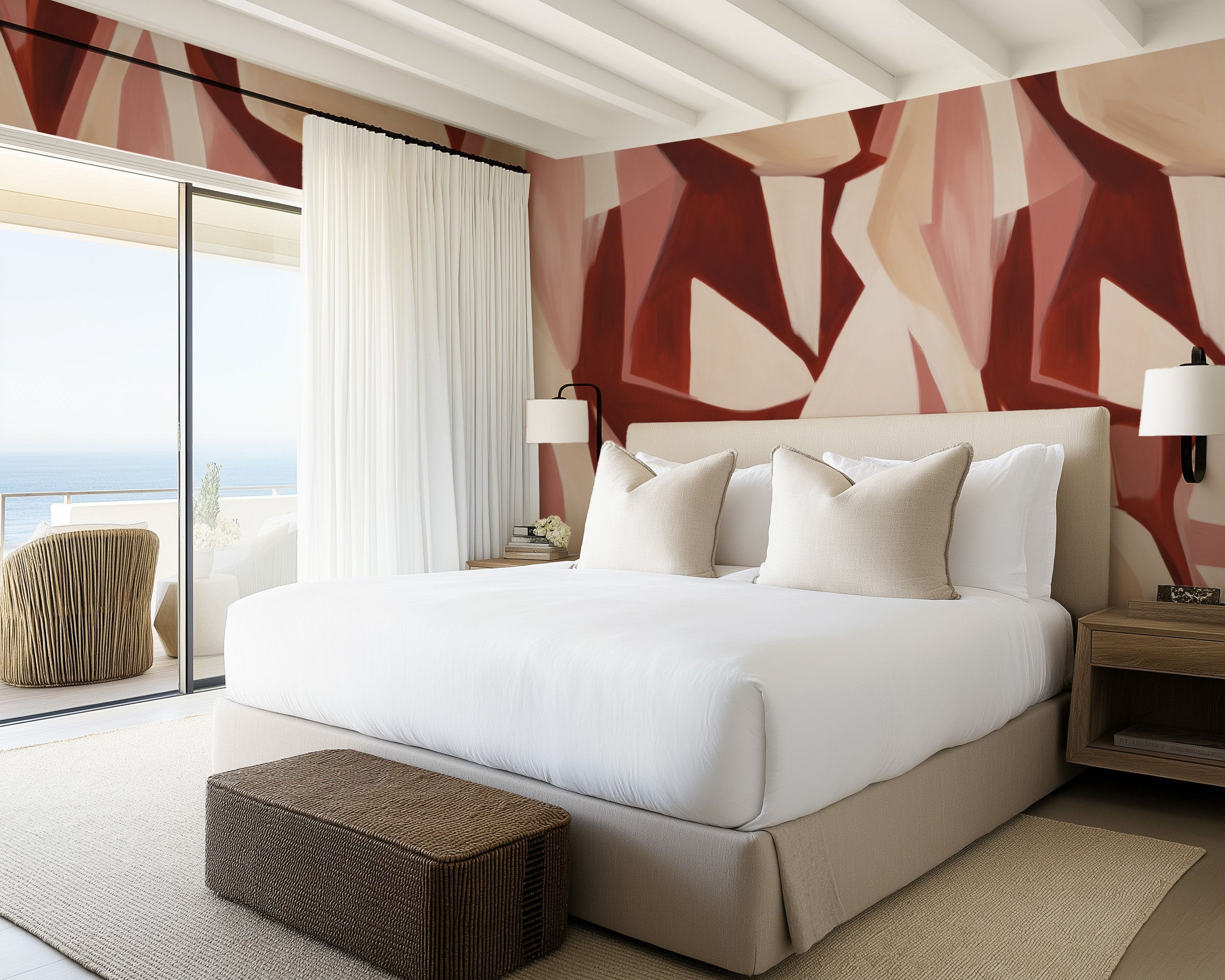
Maximalism is the most misunderstood interior design aesthetic in contemporary home decor. In popular usage, it has come to mean "a lot of stuff" — rooms crowded with objects, surfaces covered in pattern, colour stacked on colour without restraint. This is not maximalism; it is accumulation. True maximalist design is as disciplined as minimalism — it is simply disciplined toward abundance rather than reduction. The distinction matters because it determines whether a maximalist room feels exhilarating or exhausting. Wallpaper is the most powerful tool available for maximalist interiors, and understanding how to use it correctly is what separates rooms that feel deliberately rich from rooms that simply feel busy.


Savoir Abstract in Ruby Red Commercial Vinyl Wallpaper · Bellagio Wallpaper Mural · Side Kicks Wallpaper
The maximalist aesthetic has driven some of the most significant interior design trends in the US over the past three years. On Pinterest, maximalist living rooms and "more is more" bedrooms consistently outperform minimalist interiors in saves and engagement. On TikTok, "grandmillennial" style — a maximalist approach drawing on traditional pattern mixing, layered textiles, and bold wallpaper — has generated hundreds of millions of views. The cultural shift away from the bare-white-walls minimalism that dominated the 2010s is real, sustained, and accelerating. Wallpaper is at the centre of that shift.
At Olive et Oriel, our maximalist range spans abstract expressionist prints by Jackie Green, bold commercial vinyl patterns, paint-drip compositions, and character-driven designs that defy the quieter aesthetics that dominate most wallpaper collections. We manufacture custom-sized wallpaper shipped to the US, UK, Europe, and 40+ countries. The guidance below reflects the design principles that make maximalist interiors work — not as a collection of rules to follow, but as a framework for making confident decisions in a design direction that rewards confidence.


U Do U Wallpaper by Jackie Green · Love Your Mind Wallpaper by Jackie Green
The Rules of Maximalism (Yes, There Are Rules)
Pattern mixing requires a connective logic. The defining characteristic of maximalist design is the mixing of multiple patterns — stripes with florals, geometrics with botanicals, abstract with representational. This mixing looks effortless in the best maximalist rooms because it follows a connective logic: a shared colour, a shared scale, or a shared tonal range that ties the disparate patterns together. Without this logic, pattern mixing reads as visual noise. With it, it reads as layered richness. Before adding a second pattern to a room, identify what it shares with the first pattern — not what makes it different, but what connects them.
Colour is the primary organising tool. In a maximalist room with multiple patterns, multiple textures, and multiple scales of visual interest, colour is the element that creates cohesion. The most successful maximalist interiors have a clear colour story — typically three to five colours that appear and reappear across every element in the room. The wallpaper's palette should be the colour story's source document: everything else in the room draws its colour from the wallpaper's range. This is not a limitation; it is what makes the room feel designed rather than assembled.
Scale variation prevents monotony. A maximalist room with all patterns at the same scale — all large, or all small — reads as relentless. The room needs scale variation: a large-scale wallpaper pattern anchored by small-scale pattern in textiles, or a fine-repeat wallpaper texture paired with oversized furniture forms and large-scale artwork. The variation in scale creates a visual rhythm that gives the eye places to rest and places to engage, preventing the fatigue that a uniformly complex visual environment produces.
One surface dominates. Even in the most fully realised maximalist room, one surface dominates the pattern hierarchy — and it is almost always the walls. The wallpaper is the room's primary pattern statement, and every other pattern in the room is subordinate to it. This hierarchy is what prevents maximalism from becoming chaos: the room has a clear visual centre of gravity, and everything else orbits around it. Without this hierarchy, the patterns compete rather than compound.
Wallpaper Choices for Maximalist Interiors
Abstract expressionist wallpaper — bold, gestural, painterly compositions — is the maximalist choice that works most broadly across room types and furniture styles. The abstract composition does not compete with figurative elements in the room; it creates a charged visual environment that amplifies everything in front of it. Jackie Green's wallpaper designs in our collection — including U Do U and Love Your Mind — bring the energy of original art to a wall surface that covers the full room rather than a single canvas area.
Commercial vinyl with bold pattern — like the Savoir Abstract in Ruby Red — gives maximalist interiors both visual power and material durability. Commercial vinyl wallcovering was designed for high-traffic environments; in a residential maximalist context, its durability means the boldest pattern choice in the room is also the most practically resilient surface in the home.
Paint-drip and expressive abstract wallpaper — including the Luxe Paint Drip Wallpaper — references the visual language of action painting and abstract expressionism. This reference is particularly effective in maximalist interiors that include original artwork, because the wallpaper pattern and the artwork speak a related visual language. The wall becomes an extension of the art collection rather than its background.
Character-driven and illustrative wallpaper — including designs like Side Kicks — brings narrative and personality to a maximalist room. These patterns work particularly well in maximalist children's rooms and playrooms, where the design direction is explicitly about abundance, imagination, and visual pleasure rather than restraint.
Colour in Maximalist Wallpaper
The maximalist colour palette is not the same as a bright palette. Some of the most effective maximalist interiors are built on deep, saturated colours — ruby red, burnt orange, forest green, deep navy — rather than the bright primaries that the word "maximalism" sometimes suggests. The defining characteristic of a maximalist colour palette is saturation and intentionality, not brightness. A room of deep ruby, warm terracotta, and forest green is as maximalist as a room of primary yellow, cobalt blue, and scarlet — and often more liveable, because the depth of the colours creates richness without visual aggression.
Orange wallpaper — one of the most searched maximalist colour choices in the US right now — works in maximalist interiors because orange is a colour with no neutral gear: it commands attention, reads as warm and energetic, and references the maximalist tradition of colour as statement rather than background. Paired with deep navy, forest green, or warm terracotta, orange wallpaper creates the high-energy colour relationships that define the maximalist aesthetic at its most confident.
Materials
- Commercial Vinyl: For maximalist interiors where the wallpaper will be a permanent, long-term installation. Commercial vinyl provides the material durability appropriate to a bold investment wallpaper — the pattern that the room is built around deserves a substrate that will perform for decades. The Savoir Abstract Ruby Red is available in commercial vinyl and is the correct choice for dining rooms, home offices, and any high-traffic maximalist application.
- Paste the Wall Smooth: For abstract and painterly maximalist designs where the sharpness of the printed image is central to the design's impact. Abstract expressionist wallpaper with gestural brushwork and complex colour relationships renders with maximum fidelity on smooth substrate.
- Peel and Stick: For maximalist renters and for anyone who wants to test a bold pattern choice before committing permanently. The peel-and-stick substrate does not diminish the visual impact of a bold maximalist pattern — the Luxe Paint Drip and Jackie Green designs are equally powerful on peel-and-stick as on paste-the-wall substrates.
Room by Room
- Living room: All four walls in a bold abstract or expressive wallpaper, with furniture and textiles pulled from the wallpaper's colour palette. The maximalist living room commits fully — one wall is not maximalism, it is decoration. The full-room treatment creates the immersive, charged environment that defines the aesthetic. Layer pattern on pattern in the textiles: cushions, throws, and rugs in patterns that share the wallpaper's colour story but not its exact motif.
- Dining room: Bold commercial vinyl on all four walls, a statement pendant light, and a table that can hold its visual weight against the pattern. The dining room maximalist treatment is the most socially impactful application — every guest who sits at the table is immersed in the room's design for the duration of the meal.
- Home office: Abstract expressionist wallpaper on all four walls, or on three walls with the fourth as a gallery wall of original artwork. The maximalist home office creates the kind of visually stimulating environment that creative professionals consistently report as more productive than minimal, neutral spaces. The wallpaper does the environmental design work that would otherwise require a collection of artwork across every surface.
- Children's rooms: Character-driven and illustrative maximalist wallpaper — like Side Kicks — creates genuinely imaginative environments that children love and that parents do not find exhausting. The key is a colour-connected selection: the wallpaper's palette drives all the room's other colour choices, creating visual coherence within the maximalist abundance.
- Bedroom: All four walls in a bold wallpaper with coordinated textile layering — multiple cushions, a patterned bedhead, layered throws, and a patterned rug. The maximalist bedroom is the most intimate application and the one that most requires the colour-story discipline: every pattern in the room must share the wallpaper's colour range, even if it shares nothing else.
Designer Tips
- Start with the wallpaper and build everything else from it — not the other way around. The maximalist room's colour story comes from the wallpaper, and every subsequent decision (paint colour, textile pattern, furniture finish, artwork selection) should reference the wallpaper's palette. Starting with furniture and then finding a wallpaper that "goes with" it produces a room that looks coordinated; starting with the wallpaper and building from it produces a room that looks designed.
- Order the $4.99 sample and live with it for a week before ordering. Bold maximalist patterns look different on the wall than on screen, different at different times of day, and different after the eye has had time to adjust to them. A pattern that seems overwhelming on first viewing often settles into a room after 48 hours. A pattern that seemed manageable on screen can feel relentless on the wall. The sample check is more important for maximalist wallpaper than for any other category — it is the difference between a considered commitment and an expensive mistake.
- Custom manufactured to your exact wall dimensions. Ships to all US states, UK, Europe, and 40+ countries with all import duties included. Production 4 business days. Browse the full maximalist wallpaper range or read our guide to designing with dark wallpaper — the dark palette is the maximalist choice that works most broadly across US interior styles right now.