
Australian Aboriginal art is among the oldest continuous art traditions on earth. For more than sixty thousand years, the peoples of this continent have recorded their knowledge, their country, and their relationship with the living world through visual language — on rock walls, on bark, on bodies, on sand, and more recently on canvas and paper in forms that have reached collectors and institutions across the world. When we speak of Aboriginal art in the context of the home, we are speaking of something that carries a weight and a history that demands genuine engagement rather than decorative convenience.
At Olive et Oriel, we are committed to reproducing Aboriginal art only through properly licensed arrangements with artists and their communities. Every Aboriginal artwork available through our platform is reproduced with the full knowledge and approval of the original artist, with royalties paid. We understand that this is not simply a commercial arrangement — it is an act of cultural stewardship, and we take that responsibility seriously. The guidance in this article is written in the same spirit: to help you engage with Aboriginal art in your home with the genuine respect and understanding that this art tradition deserves.
Understanding the Art Traditions
Aboriginal art is not a single tradition but many. Australia's first peoples comprise hundreds of distinct nations, each with their own language, country, and cultural practices — and their own visual traditions. Understanding something of this diversity is the foundation of genuine engagement with the art.
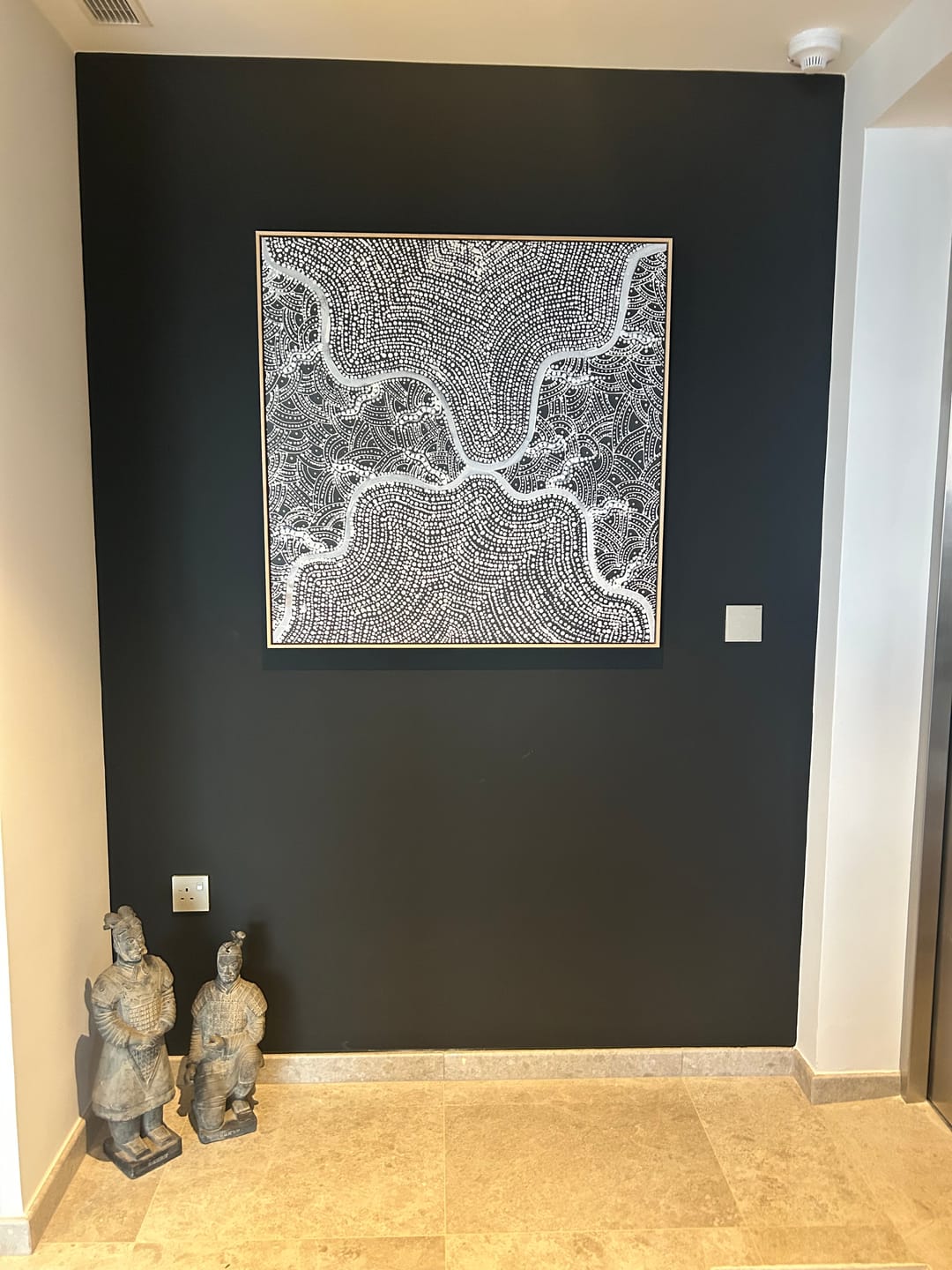
Dot painting. The most widely recognised contemporary Aboriginal art form internationally, dot painting emerged from Western and Central Desert communities in the early 1970s. The dots are not simply decorative — they encode topographic and spiritual information about country, concealing sacred knowledge in plain sight while simultaneously revealing it to those who can read the visual language. The apparently abstract compositions of artists like the Papunya Tula collective are in fact highly specific maps of country, ceremony, and Dreamtime narrative.
X-ray art. Developed in Arnhem Land in the Northern Territory, x-ray art depicts animals and human figures with their internal organs and skeletal structures visible alongside their external form. It is both a hunting knowledge system and a spiritual practice — an acknowledgment of the layers of existence beneath the visible surface.
Bark painting. One of the oldest documented Aboriginal art forms, bark paintings on stringybark from Arnhem Land use ochre pigments (red, yellow, black, and white — the four colours of the earth) in forms that encode clan identity, spiritual knowledge, and connection to country. Contemporary bark paintings continue a tradition of extraordinary depth and sophistication.
Contemporary Aboriginal art. Alongside these traditional forms, a vibrant contemporary Aboriginal art movement produces work that engages with both cultural heritage and the conditions of contemporary life — urban Aboriginal experience, political resistance, cultural survival, and the ongoing relationship with country.
Ethical Purchasing: What to Know
The Aboriginal art market has historically been subject to exploitation — of artists, of cultural materials, and of buyers who unwittingly purchased inauthentic works. Ethical purchasing requires active awareness.
Purchase from Indigenous-owned galleries or platforms that demonstrate transparent licensing arrangements with artists. Ask about the artist directly: their name, their community, their country, and the story behind the specific work. Authentic Aboriginal art comes with this information because it is inseparable from the work itself — the where and who are part of what the work means.
Be wary of unverifiable claims of authenticity. A certification alone is not sufficient; the relationship between the seller and the artist community must be demonstrable.
Placement in Contemporary Homes
Aboriginal art is not a token. The single most common mistake in placing Aboriginal art in a contemporary home is treating it as an accent — one small dot painting on a white wall among an otherwise generic interior. This approach reduces the work to decoration and misses the opportunity to engage genuinely with what the art offers.
A more considered approach treats Aboriginal art as the primary visual statement of a room. One significant work — large enough to hold the wall it occupies, placed at the correct height (eye level, centre at 145cm from floor), given the space it needs to breathe — commands attention in the way that significant art should. The room is then designed in response to the art rather than treating the art as an afterthought.
Colour relationships between Aboriginal art and contemporary interior palettes are often more harmonious than people expect. Ochre, red earth, warm black, and burnt yellow — the traditional pigment palette — sit naturally with the terracotta, warm cream, and natural timber palettes that define contemporary Australian residential design. Deep blue and white abstracts from coastal communities work with the coastal interior palette. The art's colours are not separate from Australian interiors — they are its oldest expression.
Materials
- Timber: Light australian hardwoods — particularly those with warm grain — complement the earth tones of Aboriginal art more naturally than imported light oak or white-washed Scandinavian timbers.
- Stone: Sandstone, ochre-toned granite, and warm terracotta tiles all resonate with the earth-pigment palette of traditional Aboriginal art.
- Metals: Aged brass and copper. The warm oxidised tone of these metals echoes the gold and rust of the art without competing with it.
- Fabrics: Natural fibres in earth tones — jute, rough linen, and woven cotton in cream and oat — provide the tactile and visual warmth that supports rather than competes with the art.
Room by Room
- Living room: A significant primary work above the main seating, or as the centrepiece of the room's primary wall. Give the work space — resist the urge to add supplementary art around it.
- Entrance hall: A strong, confident work in the entry sets the tone for the entire home and signals genuine cultural engagement from the first moment of arrival.
- Study or library: Aboriginal maps of country and Dreamtime narratives belong in rooms associated with knowledge, story, and contemplation.
- Bedroom: More intimate works — smaller scale, softer palette — in the bedroom. The art here should contribute to the room's sense of sanctuary.
Designer Tips
- To sample before the full-size purchase, order the artwork in its smallest size first — an A5 or A4 print (from $9.95) is made on the same 230gsm archival paper as the full-size piece, a true sample of colour and detail for your wall. Colour relationships between the art and your specific wall and floor surfaces need to be seen in person, in your actual light conditions, before committing.
- Our art prints are custom manufactured to your specified dimensions at our Central Coast NSW facility, with 4 business days production time. If you need a size not listed, contact us — we can produce almost any dimension within our printing parameters.
- All art print orders ship internationally. We ship to over 40 countries with all applicable duties. See our guide to hanging wall art for installation advice that respects the work.
Explore our full wall art collection or search specifically for Australian art for works that celebrate this country's extraordinary visual heritage.


