

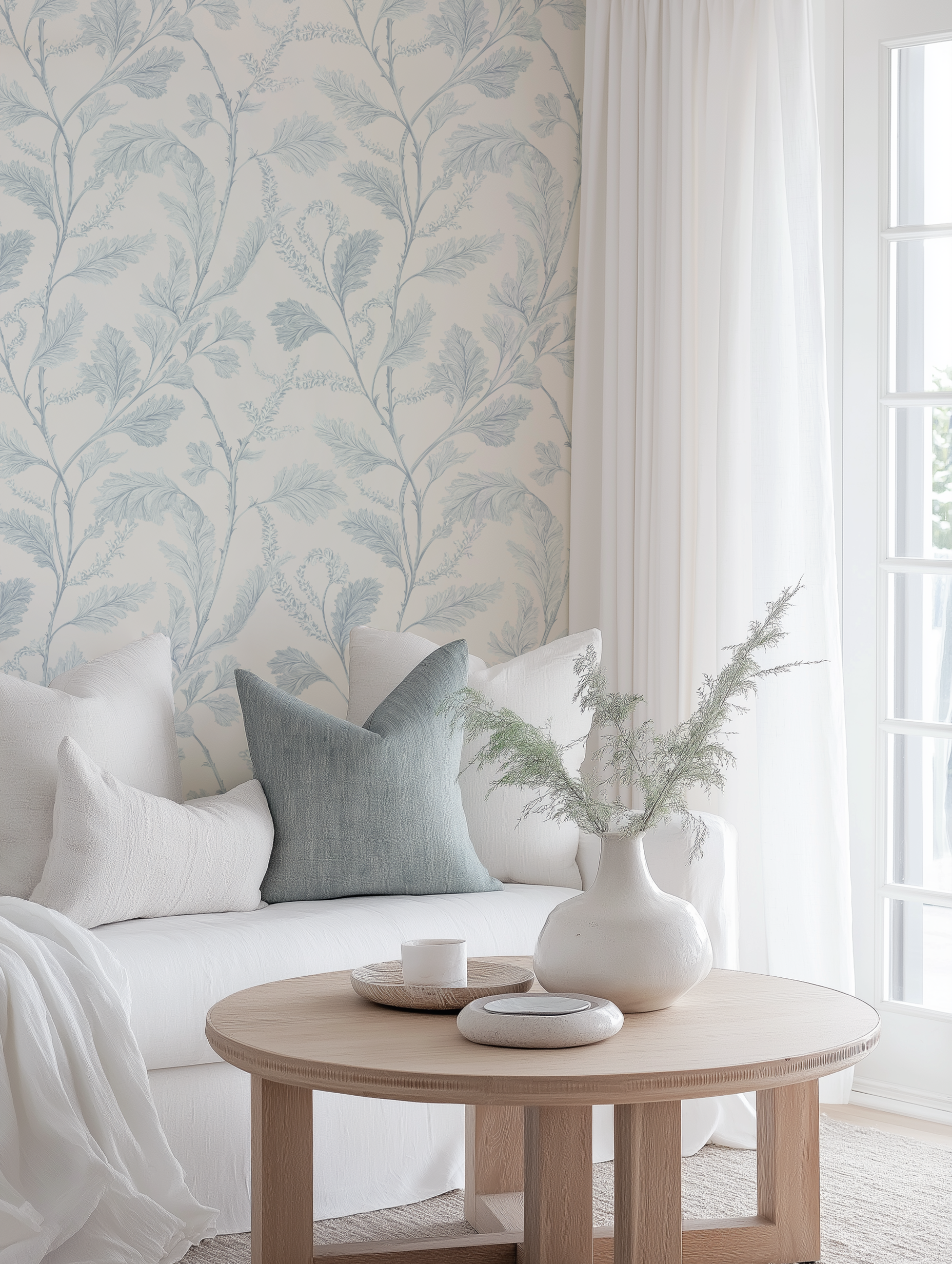
Ask an interior designer whether to paint or wallpaper a room, and you will not get the answer you expect. You will get a pause, a question about the room, another question about the light, another about how long you plan to live with the result — and then a specific, honest verdict. The real answer is almost never "just paint it." Paint solves one problem: colour on a flat surface. Wallpaper solves seven, and in most rooms that are used every day, wallpaper earns its keep in the first two years.
This is the honest comparison, written the way we write it for clients. We will cover the real cost in AUD (including the parts most quotes leave out), the durability truth in an Australian climate, the maintenance trade-offs, the rooms where each wins, the hybrid approach we recommend for anyone nervous about commitment, and the resale-value impact nobody talks about.


Hamptons Vines in Light Blue Wallpaper · Coastal Canopy in Hamptons Blue Wallpaper · Miami Palms Wallpaper
The Real Cost: Paint vs. Wallpaper in AUD
Most cost comparisons between paint and wallpaper are rigged from the start. They compare a single coat of budget paint to premium wallpaper, ignore the prep that every painter actually charges for, and pretend labour is free. Here is what an honest line-item looks like for a standard 3m x 4m feature wall (about 12 square metres of coverage area) in an Australian home in 2026.
Paint, done properly: A quality premium interior paint sits at roughly $90–$130 per 4L can in Australia. One 4L tin covers around 14 square metres per coat. You need a minimum of two coats on new plaster, three if you are going from dark to light or covering a patchy wall. Add primer ($60–$80), rollers, trays, painter's tape, drop sheets and sandpaper, and you are at $220–$320 in materials alone. Professional labour for prep, two coats and clean-up runs $400–$700 for a feature wall. Total: $620–$1,020. That wall will need to be repainted in roughly five to eight years in a high-traffic zone, sooner if it meets small children.
Wallpaper, done properly: A custom-sized wall at Olive et Oriel runs from around $38 per square metre for non-woven paste-the-wall, which puts a 12m² wall at roughly $456 for the paper itself, custom-sized to your actual wall so there is minimal offcut waste. Add paste ($25–$40) and a professional installer at around $50–$80 per roll (roughly $250–$400 for a feature wall). Total: $730–$900. Ten- to fifteen-year lifespan on traditional wallpaper, often longer in low-wear rooms.
On a five-year horizon, paint and wallpaper land in the same neighbourhood. On a ten-year horizon — which is how long most people actually live with a wall before changing it — wallpaper is usually cheaper, because you are not repainting every six years to cover scuffs, marks, pram rubs, chair rails, and the ghost of picture hooks. Browse the full wallpaper collection to see pricing by design.
The honest cost question is not "which is cheaper this weekend" — it is "which one will I still like, and still be paying for, in ten years."
Durability in an Australian Climate
Australia is brutal on interior finishes. Summer humidity in Brisbane and the tropical north hits 80%+. Cold-night condensation in Melbourne and Hobart leaves walls damp at 6am. UV coming through unlined windows bleaches anything it touches, and coastal homes deal with salt air that eats adhesives. This is the environment every wall finish has to survive.
Paint durability: A quality washable paint in a satin or semi-gloss finish will hold up for five to eight years in a living room before it starts to look tired. High-traffic zones — hallways, staircases, kids' bedrooms, around light switches — will show wear within two years. Paint shows every knock. Pram scuffs, chair-back marks, the scrape of a suitcase along the hallway, the ring left by a hand on the staircase wall: each one is visible because paint is fundamentally a uniform colour field. Any inconsistency reads as damage.
Traditional wallpaper durability: Non-woven wallpapers like the ones we produce on the Central Coast of NSW are engineered for 10–15 years of daily life. The fibrous backing breathes, which matters enormously in Australian humidity — vinyl wallpapers from the 1980s trapped moisture and grew mould, but modern non-woven substrates move air through the wall and prevent that. The printed surface is scrub-resistant with a damp cloth, and the textured patterns we print on hide the tiny knocks that would be obvious on paint.
Peel-and-stick wallpaper durability: Three to five years, honestly. Peel-and-stick is an extraordinary rental solution and a tricky long-term one. The adhesive weakens in high humidity (Queensland bathrooms, Sydney summer kitchens) and can release at edges. It is perfect for renters, accent walls in temporary spaces, and nurseries that will be repurposed in four years — but not the right product for a forever home's main living wall. Explore the peel-and-stick wallpaper collection when removability is the priority.


Vintage Meadow Bloom Wallpaper · Vintage Autumn Floral Wallpaper
The Maintenance Truth
This is the category where paint wins on paper and wallpaper wins on reality, and it is worth explaining the difference. Paint is genuinely easier to clean in the sense that you can wipe a pen mark off a satin-finish wall with a damp cloth in thirty seconds. Wallpaper is more forgiving in the sense that most marks never appear in the first place, because patterned surfaces camouflage them.
Cleaning scuffs and marks: Quality non-woven wallpaper takes a damp microfibre cloth with a drop of mild soap. Magic erasers are a firm no — they strip the printed surface. Paint in matte or flat finishes is surprisingly hard to clean; scrubbing leaves a polished patch that shows against the rest of the wall. Paint in satin or semi-gloss is easy to clean, but the sheen reveals every surface imperfection underneath, which is why high-gloss walls only work on perfectly flat plaster.
Hiding damage: A small dent in a wallpapered wall can be invisible. The pattern breaks up the eye's ability to register a tiny shadow. The same dent in a painted wall is immediately obvious because the flat colour field has no information to hide the shadow behind. This is why designers use wallpaper in hallways — the single most scuffed zone in any house.
Ageing gracefully: Wallpaper ages like a quality garment. It softens, catches patina, and often looks better at year eight than year one. Paint ages uniformly badly — it yellows in sun, dulls in shadow, and never develops character, only tiredness.
Application: DIY vs. Professional
The skill ceiling for paint is lower than for wallpaper, which is why most DIY-ers choose paint for their first project. But the skill ceiling is not the same as the skill floor. A truly well-painted wall is surprisingly hard — crisp cut-in lines, no roller texture, no drip ghosts, even sheen — and most DIY paint jobs look like DIY paint jobs forever.
Paint DIY reality: Plan for a full weekend for a single feature wall if you are doing prep properly. Sanding, filling nail holes, priming, taping, first coat, dry time, second coat, third coat if going light over dark. It is meditative, affordable, and forgiving of mistakes (you can repaint) — but the finish is only as good as your hand.
Wallpaper DIY reality: Modern paste-the-wall wallpaper has made DIY installation far more approachable than most people realise. You paste the wall (not the paper), hang the dry paper into it, smooth with a plastic spatula, and trim the edges. One person can install a feature wall in four to six hours. Our paste-the-wall installation guide walks through every step. Peel-and-stick is genuinely the easiest — no paste, no mess, just measure, peel, align, and smooth — but it is the least forgiving of wrinkles.
When to hire a professional: Anything above ceiling height, rooms with more than two internal corners, panoramic murals, or pattern-matched designs like panoramic landscape wallpaper murals. Our wallpaper installer directory lists vetted installers across Australia — use it. A good installer charges $50–$80 per roll and saves you the gut-punch of a $400 pattern-matching error. Measuring first? Use our how-to-measure guide before you order.
Design Flexibility: What Each Cannot Do
Paint is infinitely colour-flexible and completely texture-inflexible. Wallpaper is infinitely pattern-flexible and less colour-flexible. The question is which flexibility matters more in the room you are actually decorating.
What paint cannot do: Pattern, scale, texture illusion, layered colour, or narrative. Paint cannot make a small room feel like a forest glade. Paint cannot draw the eye up to raise a low ceiling. Paint cannot add the visual weight needed to ground a tall, empty hallway. Paint cannot deliver the quietness of a grasscloth texture or the drama of a wall mural. These are the design moves only wallpaper enables.
What wallpaper cannot do well: Rapid colour changes. If you like to repaint every two years to match the season or a new sofa, paint is your friend. Wallpaper is a considered choice — you live with it for a decade. Wallpaper also cannot give you a true high-gloss lacquered finish; for that, specialty lacquer paint is the only option.
The practical takeaway: use paint where you want flexibility (a growing child's bedroom, a rental, a staging room). Use wallpaper where you want presence (dining rooms, entries, powder rooms, primary bedrooms, hallways).
The Rental Question
Australian rental rules vary wildly by state and landlord, but a general rule holds: you cannot paint without written permission, and you cannot leave changes behind. This is where peel-and-stick wallpaper quietly dominates paint for renters — it is fully removable with no wall damage, no paint tin in the storage cupboard, no "return to original colour" obligation on move-out.
We have had renters transform entire apartments with peel-and-stick and remove every trace on their final day. The key is reading the label: quality peel-and-stick on smooth, previously-painted, fully-cured plaster (the standard Australian rental wall) will come off cleanly. Textured walls, freshly-painted walls (under 30 days), and unpainted gyprock are the three surfaces where peel-and-stick can pull paint with it. Our peel-and-stick wall preparation guide covers every surface type.

Room-by-Room Verdict
No room wins universally. The right answer changes by use, light, humidity, and how long you want the finish to last. Here is how we brief each space:
- Bedroom: wallpaper wins. Low-traffic, high-visual-impact, sleep-sensitive. A textured or patterned wall behind the bedhead adds acoustic softness and depth that no paint can deliver. Our Hamptons wallpaper and floral and botanical wallpaper collections cover both the calm and the character ends of the bedroom spectrum.
- Kitchen: paint wins. Heat, steam, oil splatter, frequent cleaning. Paint in a semi-gloss finish is the right answer for the main kitchen walls. Reserve wallpaper for the adjacent dining nook or breakfast area where cooking splatter does not reach.
- Bathroom: depends on ventilation. With a good exhaust fan and a window, non-woven wallpaper works well in modern bathrooms — the fibrous backing breathes. Without ventilation (internal bathrooms in older apartments), paint is safer. Never use peel-and-stick in a bathroom; humidity defeats the adhesive.
- Hallway: wallpaper wins, hard. This is the single strongest case for wallpaper in any home. Hallways are scuff magnets, they have no furniture or windows to break up the wall, and painted hallways look tired within two years. A patterned wallpaper hides wear, gives the corridor a narrative, and stays looking intentional for a decade.
- Living room: the hybrid play. Wallpaper one wall (typically the fireplace wall or the TV wall), paint the other three. More on this below.
- Dining room: wallpaper wins. Dining rooms are designed to feel enclosed. Wallpaper delivers that enclosure. A botanical or textural wallpaper in a dining room makes long dinners feel intimate instead of cavernous.
- Nursery: peel-and-stick wins. The child's taste changes every two years. Peel-and-stick lets you swap designs without a repaint. Pair with a removable wall decal for low-commitment accents.
- Home office: wallpaper wins for Zoom. A textured, patterned wall reads as considered on video calls. A single flat paint colour reads as a rental. Your backdrop is your brand now.
The Hybrid Play: Wallpaper One Wall, Paint the Rest
This is the answer we give clients who know they want wallpaper but cannot commit to an entire room. Wallpapering a single feature wall — typically the focal wall behind the bedhead, sofa, or fireplace — and painting the remaining three walls in a complementary tone is the highest-return design move in residential interiors. Here is why it works.
First, it manages risk. You are committing one wall's worth of budget and one wall's worth of visual dominance. If you change your mind in five years, you are redoing a single wall, not four. Second, it anchors the room. A feature wall creates a centre of gravity that pulls furniture arrangement into focus. Third, it gives you the paint flexibility on the other walls — you can repaint the three painted walls in two years if your taste shifts, without touching the feature. Fourth, and most underappreciated, it amplifies the wallpaper itself. Pattern reads strongest against calm, so three painted walls make the feature wall look more deliberate, not less.
The colour-matching trick most people miss: pick the paint from the wallpaper, not alongside it. Take your wallpaper sample to the paint store and pull the quietest colour in the pattern. Match the paint to that. The result is a room that feels composed rather than colour-clashed.


Luxe Plaster Wallpaper · Stucco Facade Wallpaper · Marbled Shell Wallpaper
Environmental Comparison: VOCs, Off-Gassing, Footprint
Paint has an environmental problem that modern wallpaper has largely solved. Conventional interior paints off-gas volatile organic compounds (VOCs) for weeks after application — which is why a newly painted room smells, and why pregnant women and newborns are told to stay elsewhere for a fortnight after renovation. Even low-VOC paints release trace compounds as they cure.
Modern non-woven wallpaper, installed with a wheat-starch-based paste, is effectively VOC-free once dry. There is a faint paper smell for 24–48 hours, and then nothing. This matters enormously in nurseries, bedrooms, and for anyone with asthma or chemical sensitivities. Our Central Coast NSW facility prints on FSC-certified paper substrates with water-based inks, which is a meaningful step below the carbon footprint of the tin, thinners, and multiple cans paint requires per room.
The end-of-life picture also favours wallpaper. Dried paint cans are landfill. Non-woven wallpaper, peeled dry, goes into paper recycling.
Colour Matching: When Paint Mixers Cannot Find the Colour
This is the quietest advantage of wallpaper over paint, and it only matters in a specific moment: when you have an exact colour in your head that no paint chart contains. The soft terracotta of a sunset in Broome. The exact dusty rose of your grandmother's velvet sofa. The blue-green of Tasmanian glacier water.
Paint mixers have thousands of codes, but the human eye can distinguish millions. Wallpaper printing uses four-to-six-colour process printing, which means any colour in any image can be matched and produced on wallpaper. For the clients who arrive with a photograph instead of a paint chip, our custom wallpaper made just for you service is often the only route to the exact colour they are picturing. We have printed wallpaper from clients' own paintings, fabric swatches, holiday photographs, and mood board collages. Paint cannot do this.


Watercolour Gingham in Rose Pink Wallpaper · Watercolour Gingham in Sage Green Wallpaper
Resale Value: What Buyers Actually Notice
Agents will tell you to paint everything in safe neutrals before selling. They are half-right. Sellable neutrals matter in spec-home flips and rushed sales. In considered sales — homes where buyers are looking for character and investing time in the decision — a well-chosen feature wallpaper in the dining room or primary bedroom can lift the perceived value of the home. It signals that the previous owners cared. Stripped-back, repainted white walls can read as "recently vacated" and "any character has been erased to pass an inspection."
The safe rule: paint is neutral at resale. Wallpaper is either a meaningful plus or a meaningful minus, depending on choice. If you are selling in under three years, stick to tasteful, broadly-appealing wallpaper (tonal, botanical, textural) and avoid the high-personality picks (bright florals, bold murals, statement novelty prints). If you are selling in more than five years, put in the wallpaper you love — buyers in that window will have their own plans anyway.
Frequently Asked Questions
Can I wallpaper over painted walls?
Yes, with preparation. The wall must be clean, dry, and lightly sanded if it has a gloss or semi-gloss finish. A coat of wallpaper primer (not paint primer) gives the paste an ideal surface to bond to. Our paste-the-wall installation guide covers surface prep for every paint finish type, so work through it before you paste.
Can I paint over wallpaper?
Technically yes, but it rarely produces a finish you will be happy with. Seams show through the paint, especially in side light. Textured wallpapers print their pattern through any paint layer. The honest answer: remove the wallpaper properly, skim-coat the wall, then paint. It is more work, but the result is the flat painted wall you were hoping for.
What is the real lifespan of each?
Quality interior paint: five to eight years in a lived-in room before it looks tired. Traditional non-woven wallpaper: ten to fifteen years. Peel-and-stick wallpaper: three to five years. Murals and panoramic installations: the same as traditional wallpaper — a decade or more — because they are typically installed in low-traffic feature zones.
Does wallpaper damage walls when removed?
Modern non-woven wallpaper, removed correctly, leaves the wall in the same condition you left the paint in. Lift a corner, pull the paper slowly at a steady angle parallel to the wall, and it comes off in large sheets. Any residual paste washes off with warm water. The myth of wallpaper destroying plaster belongs to the 1980s vinyl era.
What are the realities of peel-and-stick wallpaper?
Peel-and-stick is brilliant when used inside its envelope and disappointing when pushed outside it. The envelope: smooth, fully-cured painted plaster; low-to-moderate humidity; rooms under 25°C most of the time; vertical surfaces (not ceilings). Outside the envelope — textured walls, bathrooms, new plaster, ceilings, hot laundries — it will peel. Always order the $4.99 wallpaper sample (48cm x 40cm / 19in x 16in) and tape it to the intended wall for a week before committing to the full order.
Is wallpaper harder to install than paint?
Paste-the-wall wallpaper is roughly the same difficulty as painting when you include all the prep and multiple coats paint requires. The skills are different — paint rewards a steady brush and patience between coats; wallpaper rewards accurate measurement and a firm smoothing stroke. Neither is truly beginner-proof, but both are learnable in a weekend.
When is each a mistake?
Paint is a mistake when you have a wall that needs visual weight — the focal wall of a living room, the end of a long hallway, the wall behind a sofa in an open-plan area. Flat paint there will always read as underwhelming. Wallpaper is a mistake when you expect to change your mind in under two years, when the room has severe humidity and no ventilation, or when you choose a pattern you are trying to love rather than one you already do.
How do I get the exact colour I am picturing if no paint chip matches?
This is the moment to consider custom wallpaper. Send us a photograph, a fabric swatch, a screenshot, or a Pinterest board, and our design team will colour-match and produce a custom print to your exact wall dimensions. Our custom wallpaper service handles everything from colour adjustments to scale changes, so the colour in your head becomes the colour on your wall.
Designer Tips
- Order the $4.99 wallpaper sample (48cm x 40cm / 19in x 16in) and tape it to your wall for a full week before committing. Light changes dramatically from morning to evening, and you need to see the sample in both before you know if it is right.
- Paste-the-wall non-woven wallpaper is faster to install than painting two coats — four to six hours for a feature wall, no dry time between coats, no return trips.
- Our 10+ years of Central Coast NSW manufacturing experience means every order is custom-sized to your exact wall dimensions — no offcut waste, no pattern-match guesswork.
- Four business days production on full-price orders. Whether you are in Sydney, London or New York, we ship to 40+ countries with all import duties paid globally — no surprise fees at customs, ever.
- Use our wallpaper installer directory to find a vetted professional in your city if the wall is above 2.4m, has multiple corners, or features a panoramic mural.
Explore the full wallpaper collection, browse removable options in the peel-and-stick wallpaper range, or read related guides on On the Wall.


