

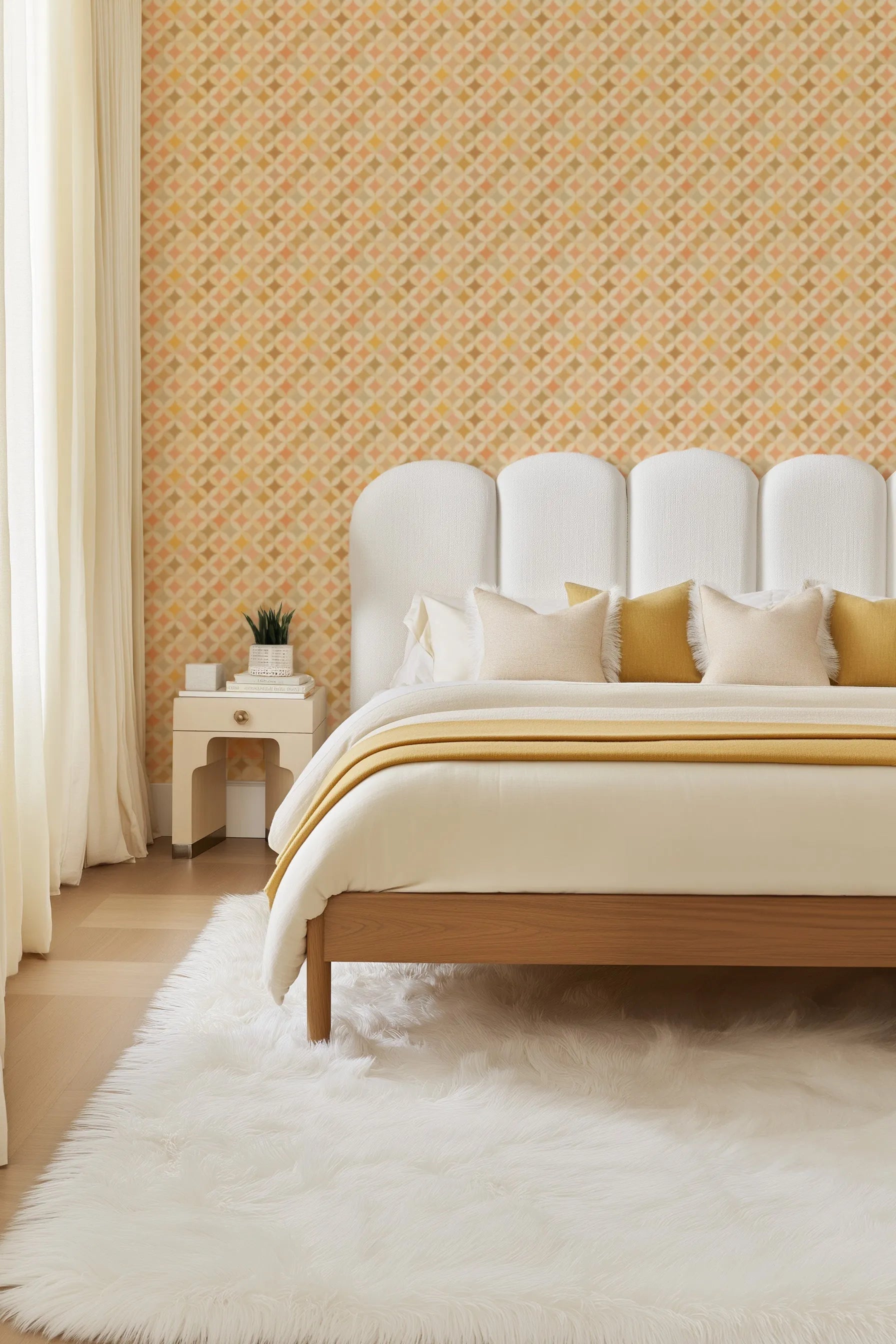
Mid-century modern is the most searched interior design style in the United States — consistently outperforming Scandinavian, industrial, bohemian, and contemporary in Google search volume and Pinterest saves year over year. Its dominance is not difficult to explain: MCM is the American interior style. It emerged from US design culture in the postwar decades, reached its peak in the 1950s and 1960s, and has been in continuous revival ever since. The wallpaper of that era — bold geometric patterns, organic curves, atomic-age abstracts, Palm Springs colours — is back at the centre of contemporary interiors, not as nostalgia but as a design language that genuinely works in modern homes. This guide explains how to use mid-century modern wallpaper effectively in every room.


Retro Diamonds Wallpaper · Purple Curves Wallpaper · Retro Poppies Wallpaper
The mid-century modern aesthetic is built on a specific set of visual principles that distinguish it from both the minimalism that followed it and the maximalism that preceded it. MCM interiors are neither sparse nor cluttered — they are curated: every element chosen for its visual clarity and functional honesty. Pattern in a MCM interior is never decorative in the traditional sense; it is structural. The bold geometric wallpaper patterns of the 1950s were not applied to surfaces as ornament — they were part of the room's visual architecture, defining zones, creating rhythm, and expressing the postwar confidence in modern design as a genuinely better way to live.
At Olive et Oriel, our mid-century modern range spans retro diamond geometrics, organic curve patterns, atomic-age florals, Palm Springs breeze block designs, and arc deco compositions — all available custom-sized to your exact wall dimensions and shipped to all US states, the UK, Europe, and 40+ countries globally.


Arc Deco Wallpaper · Breeze Blocks in Palm Springs Pink Wallpaper
The MCM Colour Palette
The mid-century modern colour palette is one of the most distinctive and most frequently misrepresented in contemporary interior design. The popular shorthand — avocado green, harvest gold, burnt orange — references the 1970s residential versions of MCM colour, not the original 1950s palette. The authentic MCM palette is considerably more sophisticated.
The primary MCM colours are warm neutrals anchored by strong accent tones: warm white and cream as the base, accented by terracotta, dusty rose (particularly the Palm Springs palette), teal, mustard, and forest green. These are not the saturated primary colours of pop art; they are mid-toned, slightly dusty hues that read as warm and considered rather than bright and energetic. The dustiness is the key quality — it is what makes MCM colour feel mid-century rather than contemporary.
Palm Springs pink — the warm, slightly coral pink associated with Palm Springs architecture and pool culture — is one of the most searched MCM colour references in US interior design right now. The Breeze Blocks in Palm Spring Pink captures this palette precisely: the breeze block pattern references the architectural vernacular of MCM Palm Springs design, and the pink references its iconic colour.
Forest green is the MCM accent colour experiencing the strongest contemporary revival. In combination with warm wood tones and brass hardware — the material combination most associated with MCM furniture — forest green wallpaper creates the richest and most recognisable MCM interior environment. The Criss Cross Lattice in Forest Green is the geometric pattern choice that most directly references MCM architectural screening and lattice motifs.
MCM Pattern Types and Their Applications
Geometric diamond and tile patterns are the defining pattern type of mid-century modern wallpaper. The diamond grid, the hexagon repeat, and the tile-on-tile composition all reference the era's fascination with mathematical order applied to domestic surfaces. The Retro Diamonds wallpaper is the most direct expression of this pattern language in our range — the angular geometry and warm palette position it squarely in the MCM tradition without tipping into pastiche.
Organic curve patterns represent the other half of MCM's visual vocabulary — the biomorphic, kidney-shaped, amoeba-curve forms that balanced the era's geometric rigour with organic softness. The Purple Curves Wallpaper brings this language into a contemporary colourway — the purple tones are more current than the original MCM palette while the curve geometry is unmistakably mid-century in reference.
Retro floral and botanical patterns — stylised rather than naturalistic, drawn with the graphic clarity of 1950s illustration — represent MCM's relationship with the natural world mediated through design. The Retro Poppies Wallpaper captures the stylised botanical language of MCM design: the poppy forms are clearly natural in reference but rendered with the graphic flatness and bold outline that distinguish mid-century botanical illustration from both Victorian naturalism and contemporary loose-wash florals.
Arc deco and architectural geometric patterns reference the Art Deco precedent that directly shaped MCM's geometric vocabulary. The Arc Deco Wallpaper bridges the Art Deco and MCM traditions — the arc geometry and warm neutral palette work in both historic and contemporary interpretations of the mid-century interior.
MCM Wallpaper in the American Home
Mid-century modern architecture — the ranch house, the split-level, the Eichler, the brick colonial modernised in the 1960s — is the dominant residential building type across vast stretches of the United States. The suburbs of Los Angeles, Phoenix, Chicago, and the Northeast are filled with homes built between 1945 and 1975 whose architecture is inherently mid-century modern. In these homes, MCM wallpaper is not an aesthetic choice applied to a neutral container — it is the wallpaper that the architecture was originally designed to receive. A diamond geometric or a stylised botanical wallpaper in a 1962 ranch house reads as restoration; in a 2010 townhouse, it reads as considered design in dialogue with the MCM revival. Both applications are correct.
The rooms in American homes that most consistently benefit from MCM wallpaper are the spaces where the era's design language was most originally expressed: the living room (the social and design centrepiece of the postwar home), the dining room (where the era's confidence in modern living was performed for guests), and the home office (which in the MCM era was the study — a room of serious purpose and serious design). In each of these rooms, a bold MCM wallpaper pattern does not decorate the room; it defines it.
"Mid-century modern wallpaper is not nostalgia. It is a design language that works — that has been proven to work across seven decades of American interior history. The patterns are not retro; they are resolved. They do not need to be made current because they were never fashionable in the way that fashion becomes dated."
Materials
- Peel and Stick: The correct choice for mid-century modern wallpaper in rental properties, apartments, and any home where the design decision may evolve. The MCM revival is partly driven by younger renters who want to reference the aesthetic without permanent commitment — peel-and-stick makes the full range of MCM patterns available to them. The Arc Deco Wallpaper and Breeze Blocks in Palm Spring Pink are available in peel-and-stick and are the two most versatile MCM patterns for this substrate.
- Paste the Wall Smooth: For MCM geometric and diamond patterns where the sharpness of the geometric line is central to the design's effect. The clean, precise edges of a diamond repeat or lattice pattern render most accurately on smooth substrate. MCM pattern is inherently graphic — it rewards the substrate that keeps its lines sharpest.
- Paste the Wall Linen: For MCM organic curve and stylised botanical patterns where a slight surface texture adds warmth appropriate to the era's tactile aesthetic. MCM interiors combined visual precision with material warmth — timber, wool, linen — and a linen substrate wallpaper connects to that material sensibility.
Room by Room
- Living room: A bold MCM geometric — diamond, hexagon, or atomic abstract — on the feature wall facing the primary seating. The pattern anchors the room's design direction and provides the visual structure that MCM furniture and accessories need to read as a coherent aesthetic rather than a collection of vintage pieces. Remaining walls in a warm MCM neutral — cream, warm white, or a dusty mid-tone pulled from the wallpaper's palette.
- Dining room: A stylised MCM floral or curve pattern on all four walls. The dining room is where MCM's confidence in bold pattern was most fully expressed, and where the all-four-walls wallpaper application — standard in the 1950s and 1960s — is most historically appropriate. The Retro Poppies creates a dining room that reads as both historically informed and genuinely contemporary.
- Home office: Forest green geometric or lattice wallpaper on all four walls or as a three-wall treatment. The MCM study was a room of serious visual intent — dark, rich, pattern-driven. The Criss Cross Lattice in Forest Green creates a home office environment that references this tradition directly, and that photographs extraordinarily well on video calls.
- Bedroom: Organic curve or muted geometric on the headboard wall. The MCM bedroom balanced the era's graphic confidence with a quieter, more enveloping palette — the curves and dusty tones appropriate to a rest space. The Purple Curves on the headboard wall creates a bedroom that reads as both MCM-informed and genuinely restful.
- Entryway: A Palm Springs breeze block or bold diamond geometric on all walls. The entry is where the home's design language is first declared — an MCM entryway in a breeze block or geometric pattern sets the design tone with confidence and visual clarity that the MCM aesthetic demands.
Designer Tips
- Pair MCM wallpaper with the material signatures of the era: warm timber (walnut, teak, oak in warm finishes), brass hardware, wool and linen textiles, and ceramic or rattan accessories. The wallpaper establishes the pattern and colour direction; the materials confirm the aesthetic reference. MCM wallpaper in a room full of chrome and glass reads as incongruous; in a room of warm timber and wool, it reads as resolved.
- Order the $4.99 sample (48cm x 18in) and assess the geometric scale against your room dimensions. MCM geometric patterns look different at full wall scale than at sample scale — a diamond that reads as delicate in the hand may read as bold at 3 metres on the wall. The scale assessment at room distance is particularly important for geometric patterns because the repeat rhythm changes significantly with viewing distance.
- Custom manufactured to your exact wall dimensions. No standard roll calculations, no pattern repeat waste at the edges. Ships to all US states, UK, Europe, and 40+ countries with all import duties included. Production 4 business days. Also read our guide to planning a feature wall and our guide to wallpaper vs paint for the decision framework that applies directly to MCM interior design choices.


