

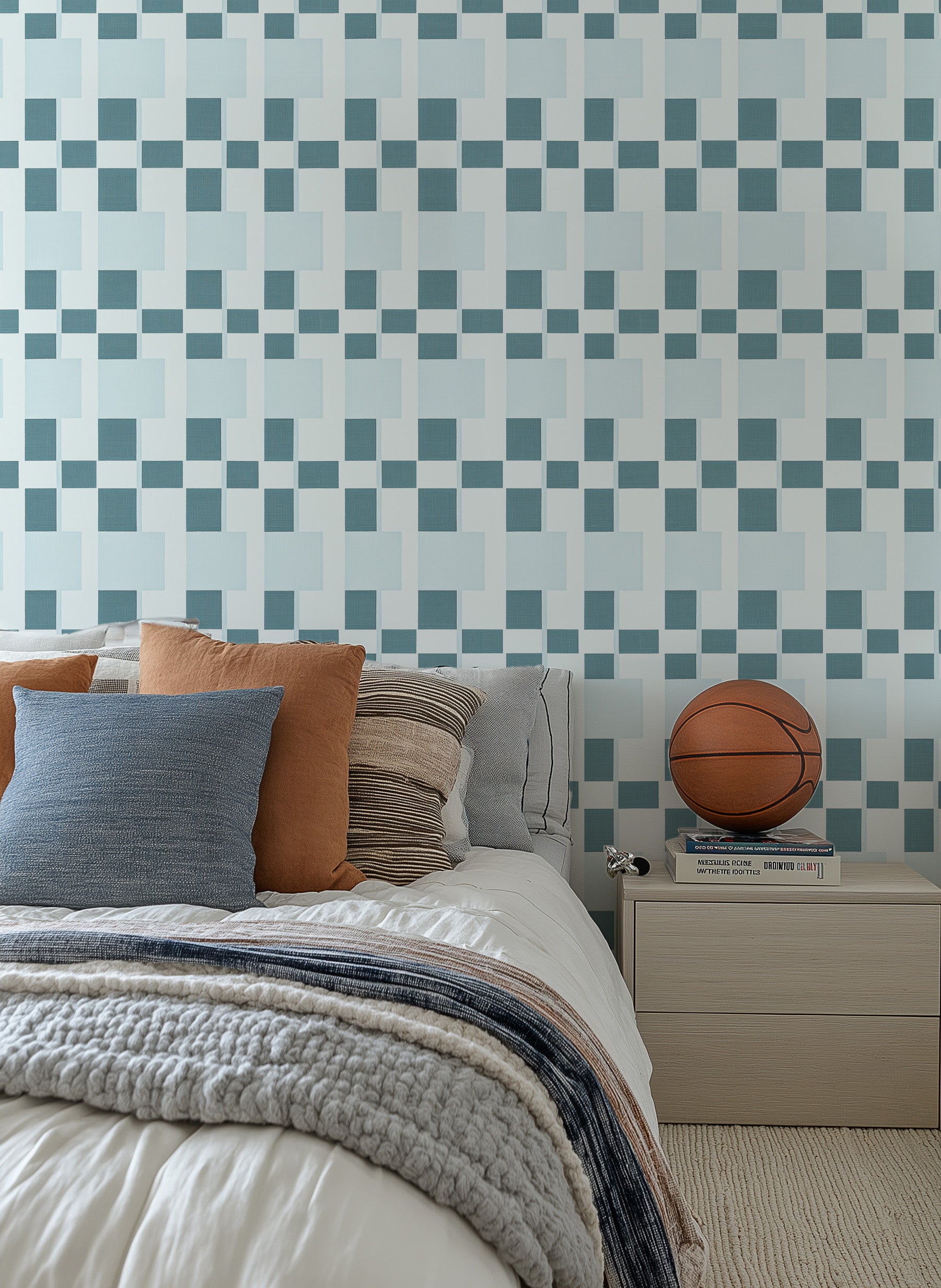
Children's room wallpaper requires a different set of considerations from any other room in the home. The obvious consideration — the child's current preferences — is actually the least important one. A four-year-old who is certain about dinosaurs will be seven in three years and may have strong views about dinosaurs being embarrassing. The wallpaper that was chosen to reflect a moment in a child's development will outlast that moment and become a problem to be solved rather than a backdrop to be enjoyed. The design decisions that produce the best children's room wallpaper balance the child's current world with the room's capacity to evolve alongside them.


Tech Grid Check Wallpaper · Wavy Tides in Green By the Roll Wallpaper · Palm Break Wallpaper Mural
At Olive et Oriel, wallpaper for children's rooms is one of our most emotionally charged purchase categories. Parents bring their children's specific interests, their own design instincts, and a genuine desire to create a space that feels made for the child. We manufacture at our Central Coast NSW facility, and we have supplied children's rooms across Australia and in more than forty countries. The guidance that follows is drawn from that experience, with particular attention to the practical realities of Australian homes — the mix of renting and owning, the climate variability from tropical north to temperate south, and the specific light quality that affects how children's room colours read in Australian conditions.
Before any pattern or colour decision, the substrate decision matters most. Children's rooms are high-traffic surfaces — they experience more contact, more moisture, and more impact than any other room in the home. The correct substrate for any child under ten is Peel and Stick. It removes cleanly without damaging walls when the design needs updating, withstands normal cleaning with a damp cloth, and does not require professional installation. The ability to update the room as the child changes is not a minor convenience — it is the feature that makes children's room wallpaper a sustainable long-term investment rather than a one-time commitment to a specific design moment.


Botanical Blush Wallpaper · Malibu Sunsets Wallpaper Mural
The Longevity Problem
The most common children's room wallpaper mistake is choosing a design that is precisely correct for the child's age at the time of installation. Character-licensed patterns, designs featuring specific toys or media properties, and patterns representing very specific developmental interests all carry a built-in expiry date. When the interest passes — which it reliably does, and faster than parents expect — the wallpaper remains, and now it reads as a record of a former preference rather than a designed environment. The child who loved the pattern at installation may actively dislike it within two or three years.
The patterns that wear well in children's rooms are those that speak to enduring visual interests rather than specific cultural moments: nature (always relevant, never exhausted), abstract geometric pattern (grows in complexity as the child does), colour (always present, always appropriate), and typography or abstract form. These categories allow a room to evolve in its interpretation without requiring the wallpaper to be replaced. A botanical or jungle print that reads as exciting to a five-year-old reads as lush and atmospheric to a twelve-year-old. A geometric pattern that feels playful at four feels considered at fourteen. Design for the room the child will grow into, not only the room they need today.
Colour in Children's Rooms
Australian children's rooms receive a wider range of natural light conditions than almost any comparable market — from the tropical north where light is intense and warm year-round, to the temperate south where winter light is cool and grey. Colour choices that work in a Sydney north-facing bedroom will not necessarily work in a Melbourne south-facing room, and vice versa. This variability is more pronounced in children's rooms than in adult spaces because children's room colour palettes tend to be more saturated and more sensitive to light shift.
Soft warm neutrals — warm white, linen, dusty blush — read well in most Australian light conditions and provide a background against which pattern and colour in the room can be experienced without the wall competing. Stronger colours — deep sage, warm terracotta, soft navy — work well as feature wall treatments in children's rooms when the remaining walls are neutral. The $4.99 sample check is as important in a children's room as in any adult space — assess the sample on the actual wall in the room's specific light before ordering the full run. A colour that looks soft and calm on a screen may read as intense in the room's actual light.
The kids wallpaper collection spans the full range of appropriate children's room palettes — from the soft and calming designs suited to nurseries and young children's rooms, to the bolder and more graphic patterns that work for older children and teenagers. Browse the full range to find the combination of pattern and colour that is right for your child's room and your home's light conditions.
"The best children's room wallpaper is one the child still wants in the room five years after it was installed. Design for growth, not only for the moment."
Materials
- Peel and Stick (strongly recommended): The only logical choice for children's rooms in rental properties, and the preferred choice in owner-occupied homes with children under ten. Removes cleanly without wall damage, can be wiped clean with a damp cloth, and can be replaced when the design needs updating without any remediation of the wall surface. The bond is strong enough for a permanent-feel installation — it will not lift at the edges under normal conditions — and clean enough for end-of-lease removal without bond deductions. Read our complete guide to installing peel and stick wallpaper for the full preparation and installation process.
- Paste the Wall: Appropriate for owner-occupied properties where the design has been chosen for long-term use — nature-based, geometric, or abstract patterns selected specifically for their capacity to evolve with the child. Paste the Wall substrates offer a broader range of textural finishes and are appropriate for rooms expected to remain unchanged for five years or more. In rooms where the child is old enough to have expressed a considered, enduring design preference, Paste the Wall is the appropriate substrate choice.
Room by Room Design
- Nursery: Soft botanical, cloud, or abstract pattern in warm neutral tones. The nursery is experienced primarily by the parent in its early months — choose a pattern that the adult wants to be in as well as the infant. Avoid high-contrast patterns, which can be visually stimulating in a space designed for sleep. The pattern should be readable from the cot — something the infant can focus on at close range during the awake periods that precede sleep.
- Toddler and early childhood room: Nature-based patterns — gentle jungle scenes, botanical prints, animal illustrations — at a scale the child can engage with at close range. The wall beside the bed is experienced at eye level from the mattress; choose a pattern the child will want to look at from that position. Peel and Stick for flexibility as interests evolve rapidly in this age group.
- Primary school age: Graphic pattern with more visual complexity — geometric, abstract, or large-scale botanical. The room is now used for play, homework, and social engagement. Feature wall only — the other three walls in a coordinating solid — allows the pattern to be bold without dominating the functional space. The child's input into the decision is important at this age; involve them in the sample assessment process.
- Older children and teenagers: Treat the room as an adult space with the child's input. Geometric, abstract, textural, or large-scale nature-based patterns all work. A feature wall in a strong colour or bold pattern with the remaining walls in a calm neutral is the most flexible approach — it creates visual interest while leaving the room adaptable as tastes evolve. The teenager who participates in choosing the wallpaper is the teenager who cares about the room.
Designer Tips
- Order the $4.99 sample and involve the child in the assessment — hold it against the wall and discuss it together. A child who participated in the decision is more invested in the result and more likely to remain happy with it over time. The sample assessment is also a practical exercise in helping children understand that walls need to look good in the actual room, not just on the screen.
- Measure the feature wall carefully. Children's rooms in Australian homes are frequently compact, and standard roll widths often do not divide evenly into the available width, resulting in partial pattern repeats at edges that undermine the design. Our panels are manufactured to your exact wall dimensions — every pattern is complete from edge to edge. Production at our Central Coast NSW facility takes 4 business days. All import duties covered globally on wallpaper orders.
- For families who rent, Peel and Stick is the definitive solution. The bond is strong enough for a permanent-feel installation and clean enough for end-of-lease removal without bond deductions. A children's room that the landlord never needs to remediate at lease end is the practical measure of a successful peel and stick installation. Document the wall condition before installation and after removal — this protects the bond and demonstrates the substrate's clean removal performance.
Preparation: The Step Most Guides Skip
Wall preparation is the foundation of any wallpaper installation, and it is the step most guides address in a single sentence. In Australian conditions — where homes span from subtropical humidity in Queensland to the dry heat of inland regions and the variable temperate conditions of southern states — wall preparation requirements vary significantly. A wall in a Brisbane terrace house has different moisture characteristics from a wall in a Melbourne Victorian terrace or a Darwin apartment. Understanding the specific preparation your wall requires is not a minor formality; it is the difference between an installation that lasts a decade and one that begins to lift or bubble within months.
New plasterboard walls must be sealed with a wallpaper primer before any installation. Unprimed plasterboard is highly absorbent — it will draw adhesive out of the wallpaper paste too quickly, preventing full bond formation and making panel repositioning impossible once the panel contacts the surface. Even on previously painted walls, a primer coat creates a consistent adhesion surface that is more reliable than raw paint of variable age and formulation. Allow the primer to dry completely — in humid Australian conditions, a minimum of 24 hours, ideally 48 hours in subtropical environments or during summer months.
For peel and stick wallpaper specifically, Viponds Self Adhesive Prep Coat is the product recommended for Australian conditions. It is specifically engineered for self-adhesive films and reduces the bubbling, peeling, and premature wear that occur when peel and stick wallpaper is applied to surfaces with inconsistent porosity. The wall must cure for a minimum of 24 hours after prep coat application before any peel and stick installation begins. Three coats of Viponds prep coat are recommended on freshly painted walls — the paint must also have cured for a minimum of 30 days before prep coat application. Our full preparation guide is available on the product page for each substrate type.


